The financial landscape for Indian food-tech giant Swiggy has reached a precarious inflection point. As the company navigates the competitive pressures of the quick-commerce era, its Q2 FY27 results have laid bare a fundamental tension: the company’s core food-delivery business is maturing into a profitable engine, yet the aggressive, capital-intensive expansion of its quick-commerce arm, Instamart, is acting as a significant drag on the bottom line.
On October 23, 2026, the market responded to this divergence with severe skepticism. Swiggy’s shares plummeted by approximately 15% on the BSE, settling at ₹179.90. This single-session rout wiped out nearly ₹9,000 Cr in market capitalization, underscoring a deepening investor fatigue. Having shed more than half of its value since its public debut in November 2024, Swiggy now faces the unenviable task of proving that its heavy investments in Instamart are not just burning cash, but building an unassailable moat.
The Financial Tug-of-War: A Quantitative Overview
Swiggy’s earnings report for the September quarter provides a study in contrasts. On the positive side, revenue from operations grew a robust 36.1% year-on-year (YoY) to reach ₹7,571 Cr. The consolidated net loss narrowed to ₹922 Cr, an improvement from the ₹1,092 Cr loss recorded in the same period last year. However, this progress was undermined by a sequential decline: losses widened from the ₹791 Cr reported in the preceding quarter, suggesting that the path to profitability is not a straight line.
The food-delivery vertical remains the company’s bedrock. It achieved record adjusted EBITDA, driven by a strategic combination of increased advertising revenue and enhanced delivery efficiencies. With a gross order value (GOV) of ₹10,054 Cr—a 17.7% YoY increase—and adjusted EBITDA margins expanding from 2.8% to 3.4%, the food business is a testament to the viability of the marketplace model.
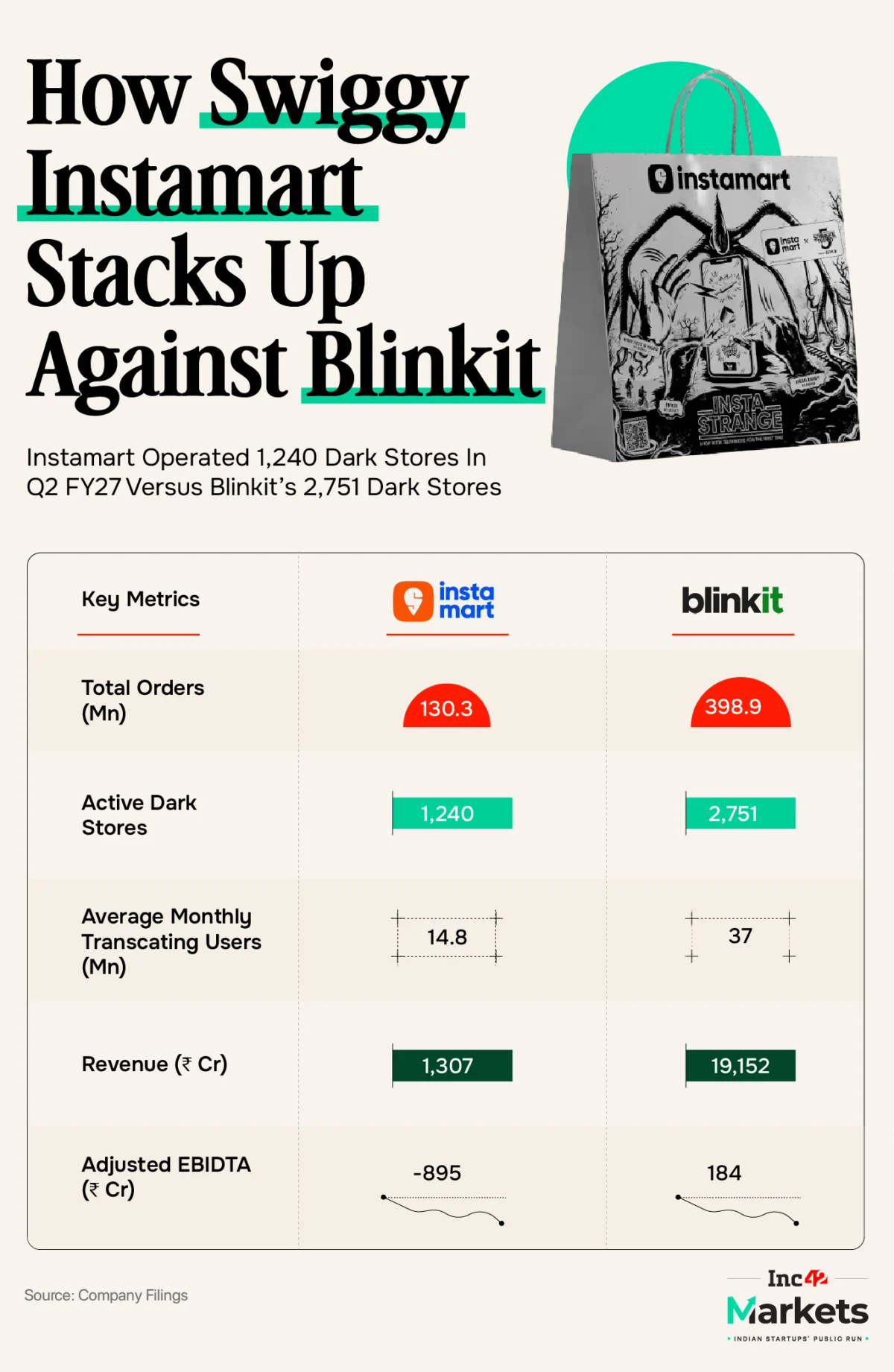
Conversely, Instamart tells a different story. Its adjusted EBITDA loss widened to ₹895 Cr from ₹849 Cr a year earlier. While the net order value (NOV) grew 13.4% sequentially, the contribution margin dipped to -1.0% of GOV. For shareholders, this raises a burning question: at what point does the scale of growth justify the erosion of capital?
Chronology of the Q2 Fiscal Squeeze
The events leading up to the October 23 sell-off were marked by high expectations of a "quick-commerce breakout."

- Early Q2: Swiggy ramped up its dark store network, adding 69 net locations to reach a total of 1,240 stores across 133 cities. The strategy focused on deepening engagement in high-frequency categories like fresh produce and staples.
- Mid-Quarter: Management highlighted improved user retention metrics and a 29.3% YoY increase in orders (130 million). These figures were intended to reassure analysts that the platform was building genuine consumer habits.
- The Earnings Release: Despite the growth in active transacting users (up 23% YoY to 14.8 million), the widening EBITDA loss at Instamart dominated the narrative.
- Market Reaction: Financial institutions, including Citi and CLSA, expressed immediate concern regarding the pace of growth and the depth of losses, leading to downward revisions in price targets and a significant drop in share price.
Instamart vs. The Blinkit Benchmark
Swiggy’s strategic dilemma is exacerbated by the shadow of its fiercest rival, Blinkit. In the race for dominance in the 10-minute delivery segment, the gap between the two players has become impossible to ignore.
Blinkit’s expansion strategy has been far more aggressive. While Swiggy added 69 stores in Q2, Blinkit added 308, bringing its total footprint to 2,751 locations—more than double that of Instamart. The financial outcomes are equally disparate: Blinkit reported a positive adjusted EBITDA of ₹184 Cr, a stark contrast to Instamart’s ₹895 Cr loss.
The core issue is "network density." Blinkit’s superior footprint allows for higher order throughput and lower delivery costs per unit. For Swiggy, the risk is twofold: if it matches Blinkit’s expansion, its losses could widen further; if it stays the course with a smaller network, it risks losing market share in the critical battle for speed and availability. Swiggy’s management has signaled a move toward an inventory-led model, which they anticipate will improve contribution margins by roughly 80 basis points, but this pivot will take several quarters to materialize.
The Strategy: Beyond Headcount and Footprint
Swiggy’s leadership is betting on a long-term shift in unit economics. They argue that the current investments are necessary to transition from a "convenience" platform to a "daily habit" platform. The roadmap to break-even is contingent on scaling the annualised NOV to approximately ₹60,000 Cr—a massive jump from the current ₹26,400 Cr.
Management estimates that two-thirds of this required improvement will come from higher revenue per order (via product mix, private labels, and advertising), while the remaining one-third will be achieved through lower costs per order (via automation and network optimization).
However, the "break-even" timeline remains nebulous. There is no hard deadline, and in a market as volatile as Indian retail, patience is a scarce commodity. Investors are now looking for a "turning point" in the upcoming Q3 results—specifically a 100-basis-point improvement in adjusted EBITDA margins.

Implications for the Sector
The broader implications of Swiggy’s struggles are significant for the entire Indian startup ecosystem.
- The End of "Growth at Any Cost": The market’s reaction to Swiggy serves as a warning that public investors are no longer satisfied with top-line growth. They demand a clear, documented path to EBITDA positivity.
- Inventory Transition: Swiggy’s planned move to an inventory-led model is a major strategic pivot. By owning inventory, the company hopes to control margins better and improve the consistency of supply, though this adds significant complexity and working-capital requirements to the business model.
- Sector-wide Pressure: The struggles of peers, such as the recent profit-margin concerns at Zetwerk and the volatility at Bluestone, suggest that companies that successfully scaled during the pandemic are now struggling to navigate the transition to operational efficiency in a high-interest, low-tolerance investment environment.
Final Analysis: A Crucial Juncture
As the company moves into the second half of the fiscal year, it finds itself in a state of high-stakes transition. The food-delivery business has proven it can be a "cash cow," but it is currently being tasked with subsidizing the massive infrastructure requirements of the quick-commerce division.
The "tug-of-war" between growth and profitability is reaching a climax. If Swiggy can successfully execute its inventory-led transition and improve its store-level productivity, it may yet prove that its current losses are merely the "price of admission" to a dominant market position. However, if the next two quarters do not show a meaningful narrowing of losses at the unit level, the market will likely continue to discount the company’s valuation.
For the management team, the mission is clear: prove that the business model is not just a mechanism for burning venture capital, but a sustainable operation that can thrive in a crowded, hyper-competitive landscape. The coming months will be a testament to whether Swiggy can pivot from the "blitzscaling" phase to the "profitability" phase without losing the very users that define its current success.