When the editorial team at HubSpot transitioned to an "AI-first" writing model in June 2025, the internal reaction was a study in professional duality. On one hand, there was the undeniable allure of efficiency; the promise of clearing technical bottlenecks and accelerating production cycles was palpable. On the other, there was a deep-seated anxiety.
For many writers, the craft is not merely about the output—it is about the ownership of the process. The rhythmic satisfaction of finding the perfect sentence, the pursuit of a reader’s attention, and the nuance of tone are what define a career in content. As a manager who has spent years both writing for and leading the HubSpot blog, I understood that this transition was not just a technical shift; it was a fundamental disruption of the creative spirit.
One year into this experiment, we have learned that the public narrative surrounding AI content is fundamentally flawed. The prevailing assumption—that AI makes the hard part of writing "go away"—is a recipe for mediocrity. In a digital landscape where content competes for finite human attention, generic, low-effort writing is a losing strategy. Here is how we navigated the transition, the pitfalls we encountered, and why, in the era of artificial intelligence, human craftsmanship has become our most valuable competitive advantage.
The Chronology of the Shift: From Experimentation to Integration
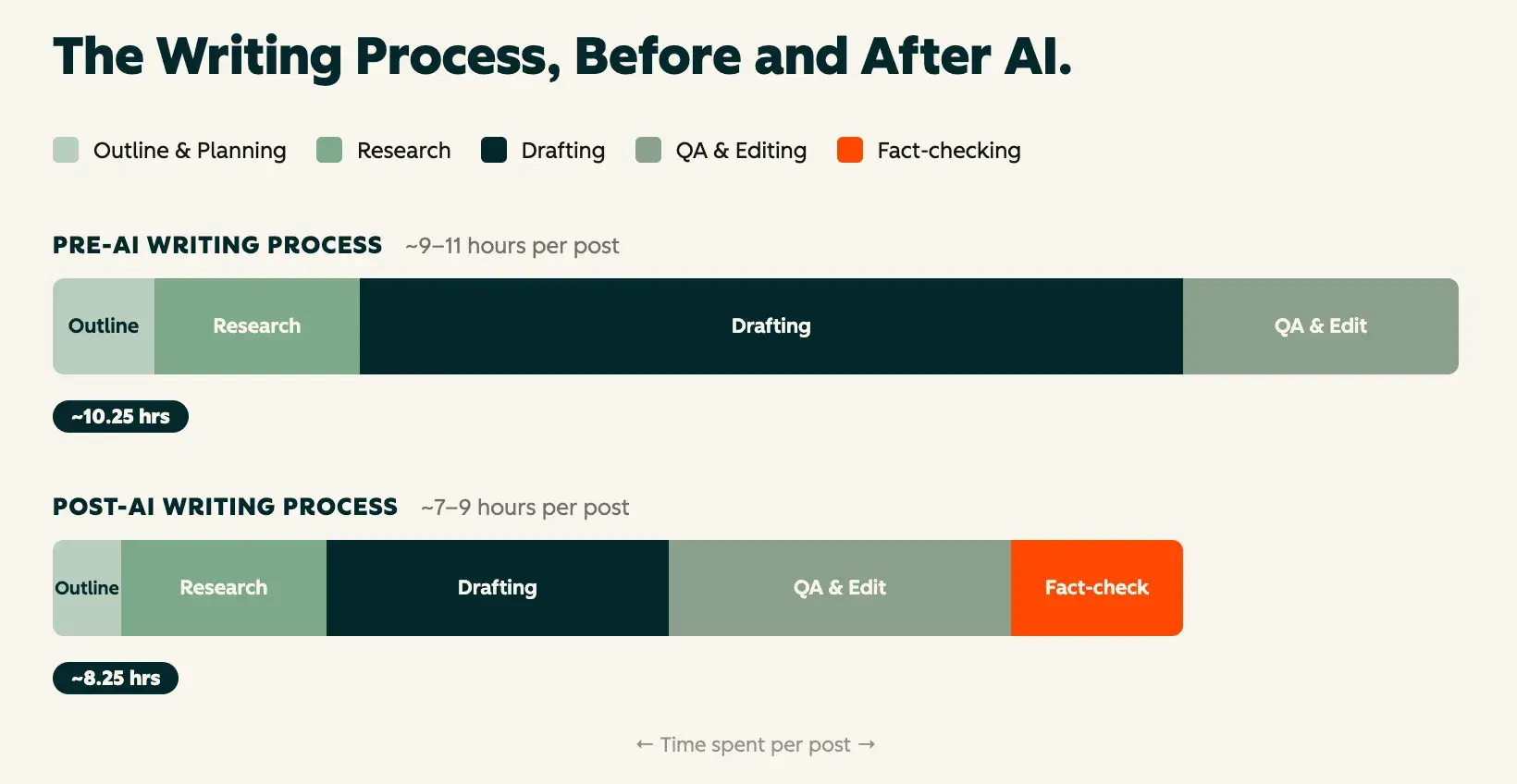
Before the integration of AI, the HubSpot blog operated on a model of individual autonomy. We hired writers for their editorial judgment, trusting them to navigate the complexities of their craft within established quality guardrails. The workflow was traditional: ideation, structural planning, drafting, and iterative editing. A standard post could easily consume a full workday, with the bulk of that time dedicated to the mechanics of writing.

In June 2025, we formally introduced AI tools—specifically Claude, ChatGPT, and NotebookLM—into our workflow. Our directive was intentionally non-prescriptive. We wanted our writers to treat AI as a laboratory for experimentation rather than a mandatory mandate. We recognized that writing is a deeply personal endeavor, and imposing a rigid, "AI-only" methodology would have stifled the very creativity we sought to amplify.
What followed was not the linear productivity spike many stakeholders expected. Instead, we entered a period of recalibration. We discovered that while AI excels at rapid synthesis, it introduces significant friction in areas like accuracy, tone consistency, and original perspective. Over the subsequent 12 months, we iteratively built a hybrid process, codifying new steps for fact-checking and quality assurance that allowed us to leverage AI’s speed without sacrificing our brand integrity.
Supporting Data: The Reality of AI-Driven Content
The most critical realization of our first year was that "faster drafting" does not equate to "faster content." While our writers were indeed generating initial drafts more rapidly, the total time-to-publish did not drop proportionally.
The Complexity Paradox
Data tracking revealed a counterintuitive trend: as AI took over the heavy lifting of drafting, the expectations for content depth increased. Our writers were not "saving" time; they were reallocating it. They spent more time sourcing primary expert quotes, diving deeper into complex technical subjects, and performing rigorous product reviews. AI allowed us to produce better content, not just more of it.

The Accuracy Gap
Research proved to be our most significant hurdle. While AI is a powerful tool for summarizing general knowledge, it is notoriously unreliable for niche data. We encountered instances where LLMs provided outdated competitor pricing or fabricated statistics with an air of absolute authority. This led to a mandatory shift: fact-checking is no longer a final pass; it is a dedicated, time-intensive phase of our workflow. For a standard piece, this adds 30 to 60 minutes of manual verification.
The Traffic Trap
The industry-wide trend of "flooding the zone" with AI-generated content has proven to be a dangerous gamble. Data from SEO experts, including studies tracking over 220 websites, shows a recurring pattern: rapid initial gains in organic traffic followed by catastrophic, long-term declines. Nearly a quarter of these sites lost over 75% of their peak traffic as search algorithms became increasingly adept at penalizing "AI slop"—content that is technically coherent but devoid of original insight, firsthand perspective, or verifiable data.
The "Quality-First" Official Stance
The core philosophy that emerged from our transition is simple: Start with standards, then add AI.
We maintain a strict adherence to E-E-A-T (Experience, Expertise, Authoritativeness, and Trustworthiness) principles. AI is treated as a lever, not a replacement. If a piece requires human empathy, a unique point of view, or complex strategic reasoning, it remains firmly in the hands of the human writer.

Addressing the Hallucination Problem
We have integrated a custom Quality Assurance (QA) layer directly into our document workflow. This includes automated checks for common AI artifacts—such as repetitive sentence structures, robotic transitions, and overused buzzwords—that often escape a cursory read. By institutionalizing these quality guardrails, we ensure that every piece of content meets our editorial standards before it ever reaches the publishing queue.
Implications for People Management
For the content manager, the AI transition is as much an emotional journey as a technical one. The shift requires a delicate balance between fostering operational efficiency and maintaining team morale.
The Two Types of Writers
We found that writers generally fall into two camps regarding AI:
- Outcome-Oriented: These writers view AI as a force multiplier that helps them achieve business goals with less friction. They embrace the efficiency gains as a way to focus on high-level strategy.
- Craft-Oriented: These writers find meaning in the labor of writing itself. For them, AI can feel like an intrusion.
My role as a manager evolved to meet these distinct needs. I created safe channels for honest, even negative, feedback. The writers who pushed back the hardest against our early AI workflows were the ones who ultimately helped us refine our processes. By listening to their concerns, we learned that the goal wasn’t just to produce content—it was to ensure that our writers still felt like "real writers."

Lessons for the Modern Editorial Lead
If you are currently managing a team through an AI transition, consider these pillars of success:
- Validate the Craft: Acknowledge that the transition is difficult. Don’t frame AI as a way to replace writers; frame it as a way to remove the "grunt work" so they can focus on the high-value insights that only humans can provide.
- Build for Transparency: If a writer flags a problem with a tool, treat it as a critical data point. Your team is your best defense against bad data and AI hallucinations.
- Measure What Matters: If you are measuring success purely by "number of posts published," you are incentivizing "slop." Pivot your KPIs to reflect quality, engagement, and long-term search performance.
- Standardize, Don’t Stagnate: Use AI to handle the "how" (drafting, structuring), but keep the "what" (strategy, opinion, data) strictly human-led.
Conclusion: The Human Edge
One year later, the HubSpot blog remains a bastion of quality because we refused to compromise on the human element. The most profound takeaway is that AI has not rendered the writer obsolete; it has made the truly talented writer more essential than ever.
When you strip away the automation and the prompts, you are left with the fundamental truth of content marketing: People want to read work written by people. They want to engage with content that reflects a unique perspective, a rigorous commitment to truth, and a clear, human voice.
AI is a tool, and like any tool, its value is dictated by the hand that wields it. By keeping our writers at the center of our process and holding the line on quality, we have not only survived the AI transition—we have thrived in it. The path forward is not about out-producing the competition with algorithms; it is about out-thinking them with human insight. As we move into the future of content, the winners will be the teams that use AI to amplify their humanity, not replace it.