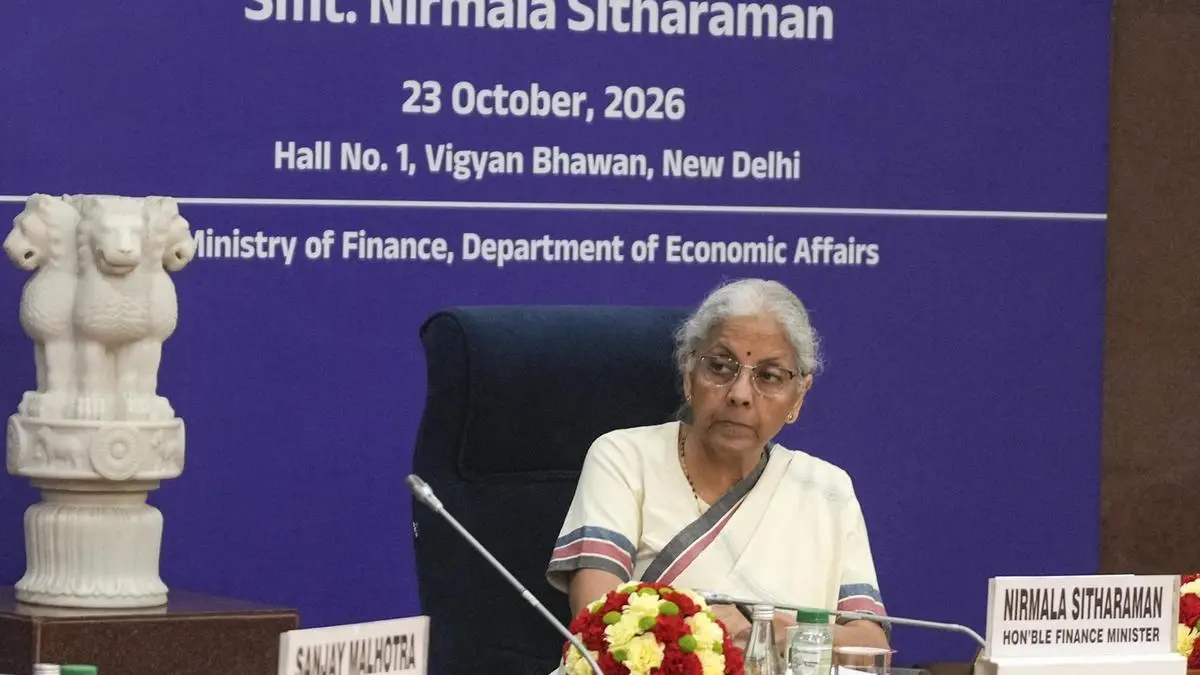
New Delhi | October 23, 2026
In a high-level strategic gathering aimed at fortifying the nation’s economic architecture, Union Finance Minister Nirmala Sitharaman chaired the 30th meeting of the Financial Stability and Development Council (FSDC) in New Delhi on Friday. The meeting, which brought together the architects of India’s fiscal and monetary policy, served as a critical platform to review the macro-financial landscape and ensure seamless coordination among regulatory bodies in an increasingly complex global economic environment.
The FSDC, established in 2010, continues to act as the primary firewall for the Indian economy, tasked with monitoring systemic risks and fostering an environment conducive to sustainable growth. As the global economy navigates the challenges of 2026, the 30th edition of this council meeting signals the government’s proactive stance on maintaining stability while fostering digital and financial inclusion.
The Core Mandate: Safeguarding Economic Stability
The FSDC operates as the apex-level forum for financial oversight in India. Its mandate is multi-dimensional, covering not just the monitoring of financial stability but also the promotion of financial literacy, inclusion, and the macroprudential supervision of large financial conglomerates. By bringing together the heads of various regulatory bodies, the FSDC ensures that the "silo effect"—where different arms of the government operate without full awareness of the other’s actions—is mitigated.
During Friday’s deliberations, the council focused on the interplay between domestic growth imperatives and the external vulnerabilities that currently characterize the international market. With the participation of the Reserve Bank of India (RBI) Governor and the heads of the Securities and Exchange Board of India (SEBI), the Insurance Regulatory and Development Authority of India (IRDAI), the Pension Fund Regulatory and Development Authority (PFRDA), and others, the meeting served as a comprehensive audit of the nation’s financial health.
A Chronology of Governance: From 2010 to 2026
To understand the weight of the 30th FSDC meeting, one must look at the evolution of the council over the last 16 years. Constituted via a government notification on December 30, 2010, the FSDC was envisioned as a response to the lessons learned from the global financial crisis of 2008. The goal was to institutionalize a mechanism that would prevent systemic failures by facilitating constant dialogue between regulators.
- 2010: The FSDC is formed to replace the High-Level Coordination Committee on Financial Markets (HLCCFM).
- 2013-2018: The council expands its scope to include the regulation of pension funds and insolvency proceedings, integrating the PFRDA and the IBBI into its formal consultative framework.
- 2021-2023: Focus shifts heavily toward fintech regulation, cybersecurity, and the digitization of the financial sector, necessitated by the rapid adoption of digital payments and crypto-asset discussions.
- 2026: The 30th meeting marks a transition into a more data-centric, technologically integrated era of financial oversight, underscored by the presence of cybersecurity experts from CERT-In.
This historical trajectory illustrates the council’s ability to pivot according to the needs of the time, moving from traditional banking oversight to a holistic governance model that includes technology, insurance, and insolvency management.
High-Level Participation: The Convergence of Regulators
The significance of the 30th meeting was reflected in the high-profile attendance. Beyond the Union Finance Minister, the room was occupied by the primary custodians of India’s economic stability:
- Monetary & Fiscal Leadership: The RBI Governor and secretaries from the Departments of Economic Affairs, Revenue, and Financial Services.
- Market Regulators: Key figures from SEBI (capital markets), IRDAI (insurance), and PFRDA (pension).
- Specialized Agencies: The International Financial Services Centres Authority (IFSCA) and the Insolvency and Bankruptcy Board of India (IBBI).
- Digital Guardians: A notable inclusion in this meeting was the presence of senior officials from the Ministry of Electronics and Information Technology (MeitY) and the Indian Computer Emergency Response Team (CERT-In).
The involvement of CERT-In highlights a paradigm shift: the government now views cyber-resilience as a fundamental component of financial stability. As India’s financial transactions migrate almost entirely to digital rails, the threat of cyber-attacks on critical financial infrastructure has become a paramount concern for the FSDC.

Supporting Data and Strategic Implications
While the specific details of the confidential discussions remain under the purview of the Ministry, the broader implications of the meeting align with current government priorities.
1. Cyber-Resilience and Operational Risk
The presence of MeitY and CERT-In indicates that the FSDC is formalizing its defense against digital threats. In 2026, financial fraud and infrastructure outages are no longer just technical issues; they are systemic risks. The Council is likely evaluating protocols for "stressed" digital environments, ensuring that banks and payment aggregators have robust business continuity plans.
2. Macroprudential Supervision of Conglomerates
As Indian corporate houses grow in complexity, the "too big to fail" doctrine becomes relevant. The FSDC’s focus on the functioning of large financial conglomerates is intended to ensure that risks do not cascade from one entity to another within a group, thereby protecting the retail depositor and the integrity of the market.
3. Financial Inclusion and Literacy
Despite the progress in digital banking, the FSDC continues to push for deeper penetration of financial services into rural and underserved sectors. This involves balancing innovation—such as Central Bank Digital Currencies (CBDC)—with consumer protection frameworks that ensure the vulnerable are not exploited by sophisticated financial products.
Official Responses and Ministerial Intent
The Ministry of Finance, via its official social media channels, emphasized the continuity and collaborative spirit of the meeting. The brief statement released by the Ministry underscored that the session was a standard, yet vital, exercise in maintaining the rhythm of Indian economic governance.
While official press releases from such council meetings are often measured, the underlying message is clear: the government is satisfied with the current state of financial stability but remains hyper-vigilant. The FSDC does not wait for a crisis; it anticipates it. By holding regular, high-level meetings, the Council ensures that when global headwinds—such as volatile commodity prices, shifting interest rate cycles, or geopolitical tensions—hit the Indian market, the regulatory response is coordinated, swift, and effective.
The Path Forward: Challenges and Opportunities
As the meeting concluded, several key themes emerged that will define the regulatory agenda for the coming months:
- Regulatory Harmonization: As the lines between banking, insurance, and investment products blur, the FSDC is tasked with creating a "unified" regulatory experience for the consumer. This requires SEBI, RBI, and IRDAI to synchronize their compliance requirements to prevent regulatory arbitrage.
- Sustainability and Green Finance: With the rise of ESG (Environmental, Social, and Governance) investing, the Council is likely exploring ways to standardize green finance disclosures to attract global capital without compromising on systemic transparency.
- Cross-Border Financial Flows: As India integrates further into the global financial system, the FSDC is actively monitoring capital flows and the potential impact of global currency fluctuations on domestic volatility.
Conclusion
The 30th FSDC meeting is a testament to the institutional maturity of India’s financial oversight framework. In an era defined by rapid technological change and geopolitical uncertainty, the ability of the government to bring all stakeholders to the table—from the RBI Governor to the experts at CERT-In—is what separates a resilient economy from a fragile one.
The decisions taken at this meeting will likely percolate into new circulars, policy amendments, and regulatory guidelines over the next fiscal quarter. For the Indian investor, the corporate sector, and the common citizen, the stability provided by the FSDC remains the bedrock upon which the nation’s long-term economic aspirations are built. As the fiscal year 2026-27 progresses, the coordinated approach demonstrated in this meeting will be essential in navigating the path toward a more stable and inclusive financial future.