The Indian startup ecosystem witnessed a period of recalibration during the third week of October 2026. After a high-energy previous week, funding activity moderated, reflecting the cautious optimism currently permeating the venture capital landscape. Between October 19 and October 23, domestic startups secured over $184 million across 17 distinct deals, marking a 22% decline in total capital inflow compared to the $236.2 million raised during the preceding week.
The contraction in deal volume was equally pronounced, with the number of funding announcements falling by 32%—from 25 deals in the prior period to 17 this week. While the aggregate numbers suggest a cooling phase, a closer look at the sector-specific data reveals that investors remain laser-focused on high-growth, high-utility domains, particularly Artificial Intelligence (AI) and HealthTech.
The Funding Landscape: Sectoral Dominance and Market Trends
Despite the overall dip in capital, the appetite for innovation remains robust. AI startups emerged as the undisputed leaders of the week, cumulatively raising $93.9 million across six deals. This dominance underscores the sustained shift in investor interest toward the application layer of AI, where startups are solving specific B2B inefficiencies.
Following closely behind, the HealthTech sector proved its resilience by attracting $60.6 million across two major deals. The continued investor interest in In-Clinic Healthcare solutions highlights the sector’s evolution from digital-first platforms to integrated, physical-digital (phygital) care models.
Venture debt and early-stage participation were key themes this week. Firms such as Trifecta Capital and Blume Ventures demonstrated sustained activity, each backing two startups. This indicates that while equity funding might be experiencing cyclical fluctuations, venture debt is increasingly becoming a strategic tool for founders to maintain operational liquidity without excessive dilution.
Chronology of Capital: A Day-by-Day Breakdown
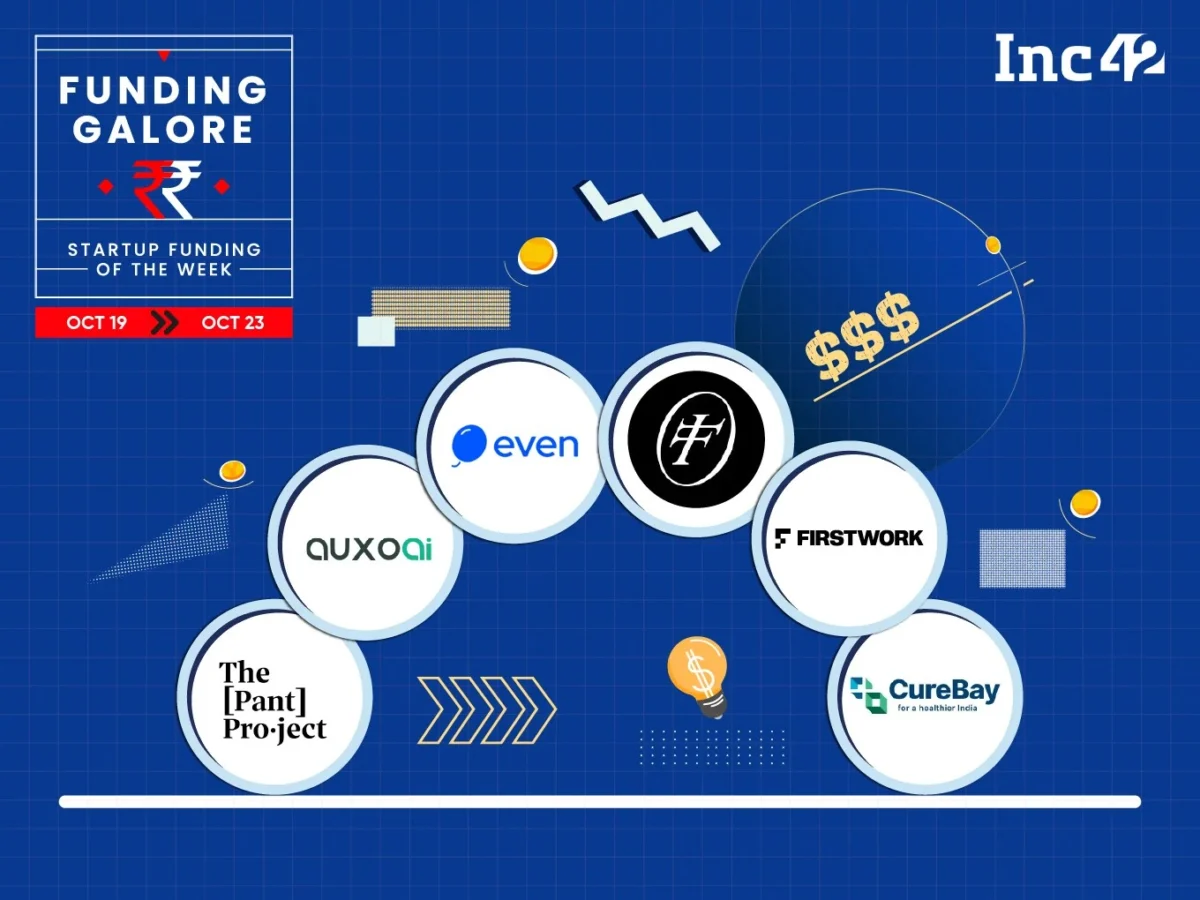
The week began with a significant splash on October 19, when Even Health secured $50 million in a Series B round led by Khosla Ventures and Alpha Wave. This transaction set the tone for the week, emphasizing the continued interest in robust health infrastructure.
Throughout the week, the momentum shifted toward the AI vertical:
- October 21: AuxoAI, a B2B application layer firm, successfully closed a $20.7 million Series A round, backed by NTTVC and prominent industry veterans from ServiceNow and Norwest Venture Partners.
- October 22: Different, an AI-focused startup, secured $48 million in a Seed round led by General Catalyst and Lightspeed Venture Partners. On the same day, CureBay raised $10.6 million in a Pre-Series C round, further bolstering the HealthTech sector.
- October 23: Firstwork, an AI application layer startup, finalized a $15 million Series A round with participation from heavyweights like Y Combinator, Earlybird Venture Capital, and Deel Ventures.
The distribution of deals suggests a "flight to quality," where investors are concentrating their capital in startups that offer clear value propositions and scalable B2B business models.
Supporting Data: Strategic Analysis of the Weekly Funding Table
A granular analysis of the deal flow indicates that B2B business models are currently the preferred choice for institutional investors. Of the 17 deals recorded, a significant majority fall within the B2B sphere, specifically within AI application layers and specialized tech services.
| Date | Startup Name | Sector | Funding Round | Lead Investor(s) |
|---|---|---|---|---|
| 19 Oct | Even Health | HealthTech | Series B | Khosla Ventures |
| 22 Oct | Different | AI | Seed | General Catalyst |
| 21 Oct | AuxoAI | AI | Series A | NTTVC |
| 23 Oct | Firstwork | AI | Series A | Earlybird VC |
| 19 Oct | The Pant Project | D2C | Series B | Mirae Asset |
| 22 Oct | CureBay | HealthTech | Pre-Series C | IvyCap Ventures |
Note: Several transactions, including those for CureBay, Chapter Homes, and TravClan, involved a strategic mix of equity and debt, reflecting the growing trend of hybrid financing to optimize capital structures.
The presence of diverse investors, ranging from marquee global VCs like General Catalyst and Lightspeed to homegrown powerhouses like Blume Ventures and IvyCap Ventures, illustrates that the Indian startup story remains a global magnet for capital, even during periods of macro-economic uncertainty.
The Rise of the "Application Layer" in AI
A notable trend this week is the clustering of AI funding around the "application layer." Unlike the infrastructure layer—which is dominated by massive foundational model providers—the application layer focuses on real-world utility. Startups like Different, AuxoAI, and Firstwork are effectively building the "picks and shovels" for the modern enterprise, integrating AI into logistics, administrative workflows, and operational efficiency.

For investors, this is a de-risked approach to the AI boom. By investing in companies that use AI to solve specific, pre-existing business problems, VCs are betting on tangible ROI rather than speculative technological breakthroughs.
Official Responses and Investor Sentiment
While specific quotes from founders remain under wraps during the quiet period following these rounds, the general sentiment from participating venture firms points to a "cautious expansion."
A representative from one of the lead investors noted, "The market is currently rewarding startups that demonstrate fiscal discipline alongside technological innovation. We are not seeing the ‘growth at any cost’ mentality of previous years. Instead, there is a laser focus on unit economics and the ability of the startup to integrate into existing B2B workflows."
This sentiment is echoed by the prevalence of Pre-Series C and Series B rounds, which suggest that investors are doubling down on companies that have already proven their product-market fit and are now looking to scale operations sustainably.
Implications for the Indian Ecosystem
The cooling of funding activity in the third week of October should not be interpreted as a sign of distress, but rather as a sign of maturity. The Indian startup ecosystem is transitioning into a phase of "quality-over-quantity."
1. The Debt-Equity Hybrid Model
The increased participation of venture debt firms like Trifecta Capital and Stride Ventures signals that startups are becoming smarter about their capitalization. By utilizing debt to cover operational expenses and equity to fuel expansion, founders are protecting their ownership stakes and avoiding "down-rounds" in a volatile market.
2. Sectoral Resilience
HealthTech and AI remain the twin pillars of the current investment cycle. The demand for scalable healthcare solutions in India is evergreen, and the push for AI-driven enterprise productivity is only just beginning. These sectors are likely to continue attracting the lion’s share of funding in the coming quarters.
3. The Shift in Investor Profiles
The entry of specialized funds and individual family offices—as seen in the funding for The Pant Project and Harajuku Tokyo Café—indicates that the pool of capital is diversifying. This is a positive development for the ecosystem, as it reduces reliance on a handful of large, monolithic funds and encourages a more varied funding landscape.
Looking Ahead: What to Expect in Q4
As we move toward the end of the year, the Indian startup ecosystem is expected to remain cautious yet active. Analysts predict that Q4 will likely see a focus on late-stage IPO preparations and a continued emphasis on B2B SaaS and deep-tech innovations.
The dip in deal count from 25 to 17 serves as a reminder that liquidity is tightening. However, for startups that can prove a path to profitability, capital remains available. The "funding winter" that once dominated headlines has largely been replaced by a "funding filter," where only the most robust and strategically sound companies are securing capital.
In conclusion, the third week of October 2026 was a microcosm of the current state of the Indian startup economy: measured, strategic, and deeply invested in the future of B2B digital transformation. While the total dollar amount may have dipped, the underlying quality of the ventures receiving backing remains high, setting the stage for a resilient finish to the year.
As the ecosystem moves forward, the focus will likely remain on integrating AI into traditional sectors, optimizing balance sheets through hybrid financing, and continuing the push toward sustainable, long-term growth. Investors are no longer just looking for the next "unicorn"; they are looking for the next "essential"—a company whose product is so embedded in the business fabric that it becomes indispensable, regardless of the broader economic cycle.