The intersection of human ingenuity and photonics has long been a cornerstone of the maker movement. From the early 20th-century origins of the hobbyist electronics scene to the high-density, addressable LED arrays of the current decade, light has remained the preeminent medium for creative expression. As the maker community prepares to converge on Mare Island for the 2026 Maker Faire Bay Area, all eyes are on the "Dark Room"—a dedicated space where the most sophisticated light-based installations will debut from September 25th to 27th.
This year’s showcase promises more than just aesthetic brilliance; it represents a fundamental shift in how interactive art is engineered, moving beyond simple illumination toward responsive, generative, and "agentic" systems.
Main Facts: The New Frontier of Light
The 2026 Dark Room is characterized by a departure from static displays. The modern maker is no longer just a builder of hardware; they are a conductor of real-time sensory experiences. The exhibition features projects that leverage Large Language Models (LLMs), complex PCB design, and advanced optics to transform audience interaction into immediate, synchronized, and often improvised audiovisual performances.
At the heart of this year’s curation is the integration of "latent space" as a medium. Whether through the voice-responsive sculptures of Grant Patterson or the agentic VJ systems developed by Vrch.io, the common thread is the reduction of the barrier between human intent and machine execution.

A Chronology of Illumination: From Bulbs to Bits
To understand the significance of this year’s exhibition, one must look at the trajectory of lighting technology within the community:
- The Incandescent Era (Early 2000s): Early Maker Faires were dominated by simple circuits, basic microcontrollers like the BASIC Stamp, and rudimentary filament-based lighting. The goal was often simply "getting it to blink."
- The Digital Revolution (2010–2018): The mass availability of the Arduino platform and the refinement of WS2812B "NeoPixel" LEDs changed the game. Suddenly, makers could control individual pixels, leading to the rise of wearable tech and complex, programmable LED geometric structures.
- The Generative Era (2020–Present): With the advent of affordable high-compute edge devices (like the Raspberry Pi 5 and specialized AI accelerators), the focus has shifted. Light is now a reactive output of generative code, audio analysis, and AI interpretation.
The 2026 Dark Room serves as a physical manifestation of this evolution, where the complexity of the "code slop"—a term used by some makers to describe the raw, unrefined output of generative AI—is turned into a feature of artistic expression.

Supporting Data: Engineering the Dark Room
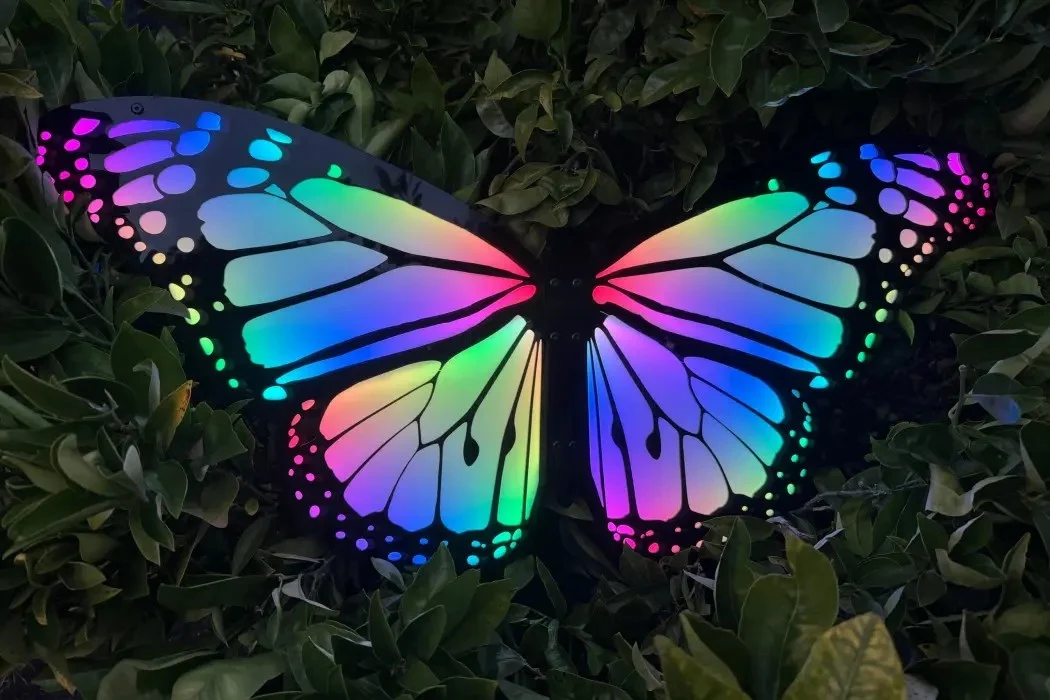
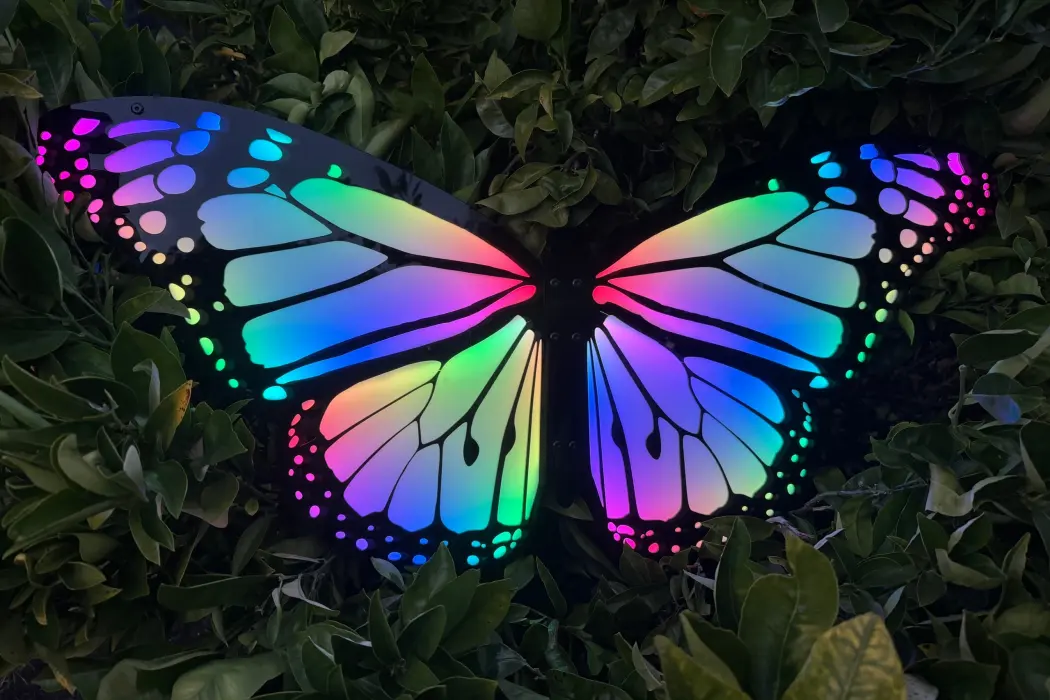
The technical requirements for this year’s exhibits are staggering. The "Lepidoptera Imaginaria" installation by Grant Patterson utilizes 570 full-color LEDs, requiring robust power distribution and heat management. The project is a testament to the convergence of hardware engineering and software architecture.
Similarly, the "Morphoresonator"—a nine-foot chandelier—demonstrates the potential of low-cost materials paired with high-end control logic. By using cellophane and packing tape to diffuse light, the creator proves that high-fidelity artistic outcomes do not necessarily require industrial-grade fabrication.

Key Technical Innovations:
- DMX Integration: Professional-grade theater lighting protocols (DMX) are being increasingly adopted by independent makers, as seen in Sydney Parcell’s "Chromolume," allowing for precise synchronization between lighting and stage sound.
- Optics and Refraction: Beyond digital light, projects like Johan Fredrik Källman’s "Luxtriplicata" highlight a return to fundamental physics. By using rotating plates and glass prisms, the project manipulates white light into complex spectrums, proving that analog refraction still holds its own against digital LEDs.
- Generative Audio-Visual Sync: Hardware-based synchronization devices, often built on custom PCBs, are now standard in the Dark Room. These devices analyze MIDI or live audio input to drive LEDs in real-time, effectively turning the entire room into a giant, touch-sensitive musical instrument.
Official Perspectives and Maker Philosophy
The curators of the 2026 Maker Faire Bay Area emphasize that the "Dark Side" of the event is, in fact, the brightest. "We are witnessing a generation of makers who treat the environment as a circuit board," says a representative from the organizing committee.
The philosophy behind the "agentic" exhibits is particularly noteworthy. In projects like the Vrch.io visual synthesizer, the creators argue that "latent space is the new medium." This suggests a shift in the definition of a "maker": the role is evolving from someone who assembles components to someone who designs the parameters of potentiality. By creating systems that react to emotion and gesture, these artists are effectively building "living" art that is never the same twice.

Furthermore, the influence of Burning Man culture is undeniable. The presence of large-scale mobile art like "Sepia Lux" (The Cuttlefish Art Car) and "Flash the Tortoise" brings a desert-tested resilience and sense of scale to the Mare Island indoor environment. These pieces are not just static sculptures; they are mobile, interactive, and highly sophisticated examples of mobile engineering.
Implications: The Future of Participatory Art
What does this surge in light art mean for the future of the maker movement? The implications are threefold:

1. The Democratization of Complex Software
Grant Patterson’s work, which allows users to generate lighting code via voice prompts, suggests a future where programming experience is no longer a prerequisite for creating complex digital art. By making AI-generated code visible—and by extension, the "slop" or flaws inherent in generative AI—Patterson challenges the audience to consider the trade-offs of automation. When a computer writes the code for you, can you still claim ownership of the "debugging" process? This is a critical philosophical question for the next decade of technology.
2. The Resurgence of Public Interaction
The Dark Room is designed to be a tactile experience. Whether it is brushing a strand of the "Night Canopy" to trigger a sound loop, or manually rotating the prisms in "Luxtriplicata," the installations are fundamentally incomplete without the audience. This move toward deep, sensory-based participation signals a shift away from the "screen-bound" nature of much modern tech. Makers are creating spaces that demand physical presence.

3. Sustainability and Material Innovation
While LEDs are energy-efficient, the sheer scale of some installations raises questions about long-term material use. However, the use of "found" or low-impact materials—such as packing tape in the Morphoresonator or folded paper in the "Samyra Drift" octopus—demonstrates that the community is increasingly conscious of its environmental footprint. The makers are proving that high-tech lighting can be achieved without high-impact manufacturing.
Conclusion: A Call to the Dark
The 2026 Maker Faire Bay Area is poised to be a milestone event. As visitors navigate the dark corridors of Building 101 on Mare Island, they will encounter more than just glowing objects; they will encounter the bleeding edge of human-machine interaction.

The exhibition is a powerful reminder that light, when channeled through the hands of a maker, is the ultimate language. From the four-foot, LED-infused octopus of "Samyra Drift" to the voice-responsive monarch butterflies of "Lepidoptera Imaginaria," the 2026 Dark Room is a testament to the fact that we are only just beginning to scratch the surface of what is possible when we combine curiosity, code, and a bit of "dark" magic.
For those planning to attend, the message is clear: do not merely observe the light. Bring your voice, your hands, and your curiosity. In the Dark Room, you are not just a spectator—you are the final component of the circuit.

For more information on tickets and the full schedule of the 2026 Maker Faire Bay Area, visit the official website. To join the ongoing conversation about these installations and the future of maker technology, visit the community Discord server.