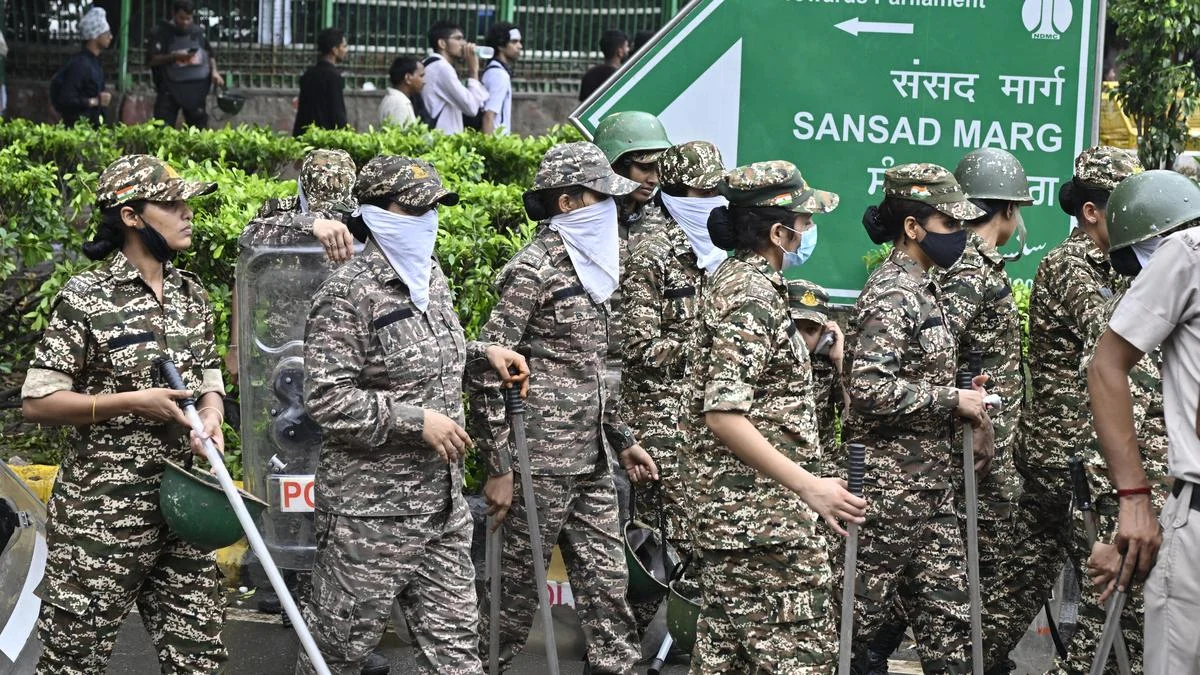
NEW DELHI — In an extraordinary display of state security power, Delhi Police and central paramilitary forces mounted a massive law enforcement operation on Saturday, October 10, 2026, systematically clearing the capital’s central avenues of thousands of civic and youth protesters. Imposing severe restrictions on public assembly and movement across key governmental zones, authorities detained an estimated 7,000 individuals, effectively shutting down public demonstrations aimed at the Election Commission of India (ECI).
However, despite the physical suppression of the protests and the transformation of central Delhi into a heavily fortified zone, the core administrative and constitutional questions surrounding the ECI remain unanswered. At the heart of the expanding controversy is the conduct of the Special Intensive Revision (SIR) of electoral rolls, overseen by Chief Election Commissioner (CEC) Gyanesh Kumar alongside Election Commissioners Sukhbir Singh Sandhu and Vivek Joshi. Recent investigative disclosures highlighting deep procedural anomalies in the revision process have sparked a crisis of credibility that barricades and mass detentions have failed to contain.
Main Facts: The Capital Lockdown and the Core Controversy
The police action on October 10 represented one of the largest preemptive security mobilizations in the national capital in recent years. Central police forces joined Delhi Police personnel to erect multi-layered steel barricades, deploy water cannons, and enforce strict perimeter security around Nirvachan Sadan—the ECI headquarters—as well as high-security corridors including Kartavya Path and surrounding administrative districts.
+-----------------------------------------------------------------------+
|                       OCTOBER 2026 DELHI CRACKDOWN                    |
+-----------------------------------------------------------------------+
|  Total Detentions:             ~7,000 activists, youth, & leaders     |
|  Primary Security Forces:      Delhi Police & Central Armed Forces    |
|  Key Target Zone:              Nirvachan Sadan (ECI Headquarters)     |
|  Core Institutional Issue:     Special Intensive Revision (SIR) Lapses|
|  Judicial Intervention:        Supreme Court Special Sunday Bench     |
+-----------------------------------------------------------------------+
Key Elements of the Unfolding Crisis
- Mass Detentions: An estimated 7,000 citizens—including prominent youth organizers from Citizens for Justice and Peace (CJP), university students, civil society representatives, and several former state chief ministers—were rounded up and transported to makeshift detention facilities across the capital’s suburbs.
- The Underlying Issue: The protest movement stems from widespread allegations of systemic flaws, arbitrary deletions, and procedural opacity within the ECI’s ongoing Special Intensive Revision (SIR) of electoral rolls.
- Investigative Disclosures: A series of investigative reports exposed 14 specific institutional and procedural objections within the ECI regarding the execution of the SIR, raising questions about data integrity and potential voter disenfranchisement.
- Institutional Silence: Despite mounting public pressure, the ECI and CEC Gyanesh Kumar have refrained from addressing the substantive technical and administrative criticisms, issuing only brief, generalized statements through public relations channels.
- Judicial Oversight: The Supreme Court of India convened an extraordinary special sitting on Sunday, October 11, to establish legal parameters regarding civic protests, public order, and the rights of citizens relative to state-imposed administrative lockdowns.
Chronology of Events: From Summer Unrest to October Lockdown
The current standoff is the culmination of months of escalating tension between civil society organizations, youth movements, political parties, and the election watchdog.
+-----------------------------------------------------------------------+
|                          TIMELINE OF EVENTS                           |
+-----------------------------------------------------------------------+
|  JULY 2026:      Initial youth protests met with heavy police action  |
|  AUG-SEP 2026:   Media exposes 14 internal objections to the SIR      |
|  OCT 10, 2026:   Mass security crackdown; ~7,000 detained in Delhi    |
|  OCT 11, 2026:   Supreme Court holds special Sunday emergency hearing |
|  OCT 12, 2026:   ECI issues minimal press statement amidst lockdown   |
+-----------------------------------------------------------------------+
July 2026: The Initial Flashpoint
The unrest began in mid-July 2026, when initial modifications to electoral rolls under the Special Intensive Revision program were rolled out in key states. Student groups and civil society organizations reported large-scale omissions of young voters and marginalized demographics. Early public demonstrations in Delhi were met with aggressive police action, resulting in clashes and public outcry over the use of force against peaceful assemblies.
August – September 2026: Investigative Revelations
Throughout late August and September, media investigations brought internal commission friction to light. Documents revealed at least 14 specific internal objections flagged regarding the implementation of the SIR. These objections highlighted skipped door-to-door verification protocols, reliance on unverified digital algorithms for voter deletion, and tight operational deadlines that compromised accuracy. Despite these revelations, the ECI maintained strict institutional silence, declining requests for public audits or open-door briefings.
Saturday, October 10, 2026: The Mass Crackdown
Civil society coalitions led by Citizens for Justice and Peace (CJP) called for a massive, peaceful march toward Nirvachan Sadan to demand transparency from CEC Gyanesh Kumar.
In response, the Ministry of Home Affairs and Delhi Police executed a total lockdown of central public spaces.
- Movement restrictions were placed under Section 144 of the Code of Criminal Procedure across central Delhi.
- Over 7,000 individuals were detained in early morning sweeps and at protest gathering points.
- Transit nodes and metro station gates leading to the administrative district were closed.
- While the operation avoided the violent clashes seen in July, it successfully prevented any public gathering near constitutional offices.
Sunday, October 11, 2026: Supreme Court Emergency Sitting
Recognizing the escalating constitutional and civil liberties implications, the Supreme Court of India held an unprecedented Sunday special hearing. The bench sought to balance the state’s duty to maintain public order and prevent severe public inconvenience against fundamental rights under Article 19 (Freedom of Speech and Assembly). While the court established temporary red lines regarding public blockades, critics noted the bench focused heavily on administrative imperatives rather than addressing the core issue of systemic voter roll manipulation.
Monday, October 12, 2026: The Aftermath
By Monday morning, central Delhi remained under heavy security control ("Fortress Delhi"). The ECI issued a terse press release reiterating its constitutional mandate but omitting direct answers to the 14 procedural objections raised against the SIR or the mass detentions executed outside its doors.
Supporting Data and Investigative Findings
The operational scale of both the security response and the electoral roll revision highlights the magnitude of the ongoing crisis.
+-----------------------------------------------------------------------+
|                    KEY METRICS OF THE CRISIS                          |
+-----------------------------------------------------------------------+
|  Total Detentions (Oct 10):       ~7,000 citizens                     |
|  Internal SIR Objections:         14 primary procedural red flags     |
|  Primary Demographics Involved:   Gen Z, university youth, CJP networks |
|  Key Figures Involved:           CEC Gyanesh Kumar, EC Sukhbir Sandhu,|
|                                   EC Vivek Joshi                      |
+-----------------------------------------------------------------------+
The 14 Objections to the Special Intensive Revision (SIR)
Investigative reports into the ECI’s internal operations revealed critical technical vulnerabilities in the SIR process:
- Bypassing Verification: Accelerated timelines led to the skipping of mandatory, physical door-to-door checks by Booth Level Officers (BLOs) in multiple jurisdictions.
- Algorithmic Deletions: High rates of automated, software-driven voter flags resulted in wrongful mass deletions without adequate notice given to affected voters.
- Inadequate Remedy Periods: The statutory period for citizens to appeal voter roll exclusions was drastically compressed, disproportionately affecting migrant workers and young voters.
- Lack of Digital Audit Trails: Absence of publicly accessible logs detailing who authorized specific batch deletions within the electoral database.
Scale of Enforcement Action
To suppress the October 10 demonstrations, security agencies deployed unprecedented logistical resources:
- Personnel: An estimated 15,000 police and paramilitary personnel were deployed across 45 strategic intersections.
- Infrastructure: 12 temporary detention facilities were established in sports complexes and secondary grounds on the periphery of National Capital Territory (NCT) boundaries.
- Transport: Over 200 state transport buses were requisitioned to move detainees out of the city center.
Official Responses and Political Rhetoric
The handling of the protests and the underlying institutional questions have drawn sharp lines between the government, independent bodies, and political movements.
+-----------------------------------------------------------------------+
|                        OFFICIAL POSITIONS                             |
+-----------------------------------------------------------------------+
|  RULING ESTABLISHMENT:  Frames protests as "anarchic," foreign-backed |
|                         attempts to destabilize state institutions.   |
|                                                                       |
|  ELECTION COMMISSION:   Maintains institutional silence; issues brief |
|                         bland press statements defending mandate.     |
|                                                                       |
|  OPPOSITION / CJP:      Demands CEC accountability, public SIR audit; |
|                         struggles to capture organic Gen Z momentum.  |
+-----------------------------------------------------------------------+
The Ruling Establishment’s Stance
Representatives of the government and the ruling Bharatiya Janata Party (BJP) adopted a stern security-first narrative. Government spokespersons framed the protests not as legitimate civic inquiry, but as calculated disruptions orchestrated by political adversaries.
"These mobilizations are driven by professional destabilisers and anarchists operating with the tacit backing of foreign powers seeking to undermine confidence in India’s democratic machinery," stated a senior government official during a briefing on Saturday evening. "No government can allow the security of the capital or the operations of constitutional bodies to be held hostage by street vetoes."
The Election Commission’s Silence
The Election Commission of India, historically known for public communication and voter outreach, has remained distant under Chief Election Commissioner Gyanesh Kumar.
Instead of hosting press conferences to address the 14 procedural points, the ECI’s response has been limited to formal communiqués. By relying on state police power to clear its perimeter rather than engaging in direct communication, critics argue the ECI has allowed the political executive to act as its defensive shield, compromising its constitutional role as an independent referee.
The Opposition and Civil Society Gap
While major opposition parties condemned Saturday’s mass detentions—which included several of their own senior leaders and former chief ministers—the response highlighted a broader disconnect within mainstream politics.
Organizations like Citizens for Justice and Peace (CJP) and independent student coalitions have driven much of the movement. Mainstream political parties have struggled to articulate a message that resonates with young citizens (Gen Z). Rather than leading the charge with a clear policy framework for digital voter rights and institutional transparency, traditional political networks have largely found themselves chasing the momentum of decentralized youth mobilizations.
Democratic Implications and Institutional Crisis
The events of October 2026 present long-term challenges for the health of India’s democratic infrastructure, institutional independence, and civic engagement.
+-----------------------------------------------------------------------+
|                     LONG-TERM CONSTITUTIONAL RISKS                    |
+-----------------------------------------------------------------------+
|  1. Erosion of ECI's historic institutional neutrality and trust      |
|  2. Normalization of police force to insulate administrative bodies   |
|  3. Growing rift between Gen Z voters and traditional governance      |
|  4. Precedent of using security apparatus to bypass civic audit       |
+-----------------------------------------------------------------------+
The Vulnerability of the Independent Referee
The Election Commission of India built its global reputation over decades—most notably during the transformative tenure of former CEC T.N. Seshan in the 1990s—on proactive communication, strict enforcement of rules, and complete accessibility to the electorate.
The current approach under CEC Gyanesh Kumar marks a significant departure from that legacy. By remaining silent amidst investigative disclosures and allowing physical access to its offices to be sealed off by paramilitary forces, the ECI risks eroding public trust in election outcomes. An election management body cannot rely on security barricades to protect its legitimacy; its credibility relies on radical transparency and public confidence.
The Over-Reliance on Security Measures
The routine use of Section 144, mass detentions, and physical barriers to manage political critiques creates a concerning precedent for governance. While police forces can clear streets and prevent physical gatherings, detaining 7,000 citizens does not resolve underlying administrative errors in voter registration databases. Using security forces to insulate administrative decisions creates a dangerous precedent where public accountability is treated as a law-and-order problem rather than a constitutional requirement.
The Generational Disconnect
The protests reflect a growing gap between India’s younger demographic and its political infrastructure:
- Digital Transparency Expectations: A generation raised on open-source information and real-time digital tracking expects granular transparency regarding how voter lists are managed.
- Inadequate Political Vocabulary: Neither the ruling establishment’s rhetoric of foreign conspiracies nor the opposition’s conventional political messaging addresses Gen Z’s focus on data rights, institutional integrity, and procedural fairness.
The Path Ahead
As Delhi returns to a state of guarded calm following the weekend’s detentions, the fundamental questions facing the Election Commission remain unaddressed. Resolving this crisis will require the ECI to step out from behind security perimeters, engage directly with public criticism, conduct a transparent audit of the Special Intensive Revision process, and restore public trust in the country’s voting infrastructure.
Until Nirvachan Sadan directly addresses these administrative concerns, physical barricades will only serve to highlight the growing divide between the institution and the public it serves.