In the world of personal finance, there is a pervasive myth that risk is a purely mathematical calculation—a percentage of a portfolio, a fluctuation in the stock market, or the interest rate on a fixed deposit. However, for those crossing the threshold of age 55, a new and far more dangerous variable enters the equation. It is a variable that cannot be earned back, negotiated, or hedged: Time.
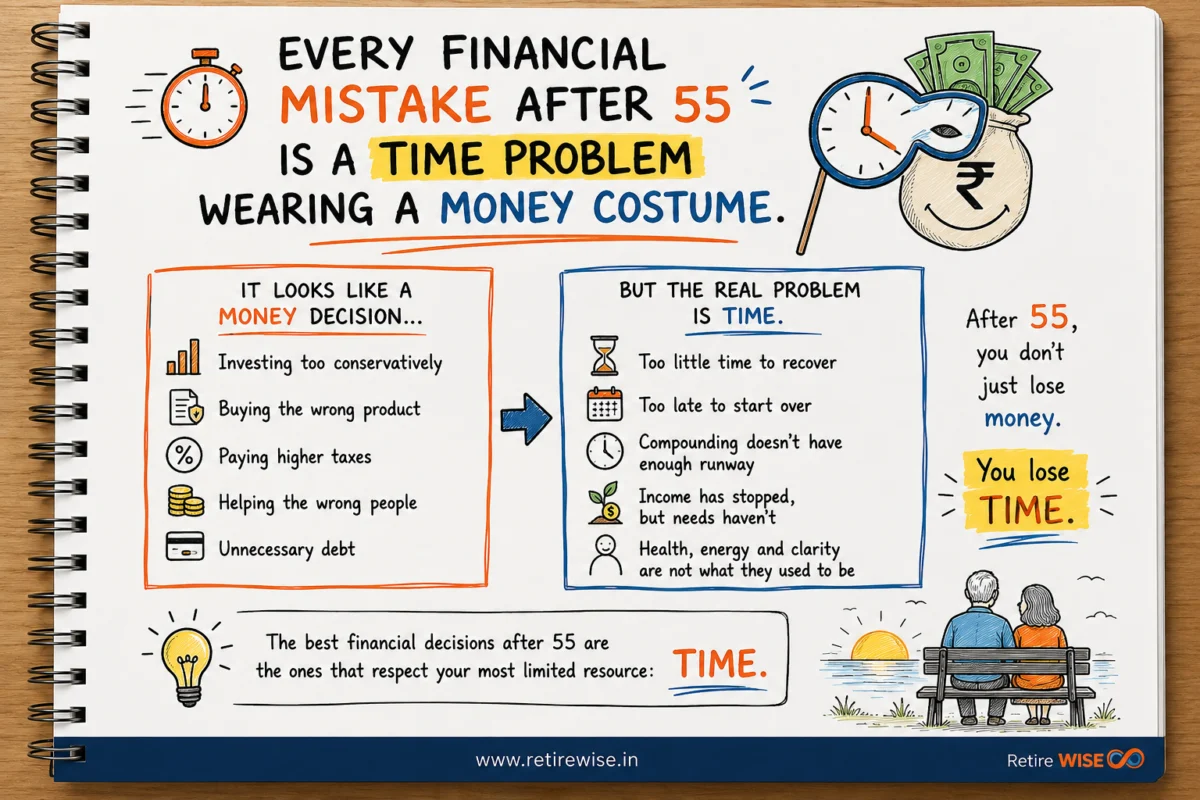
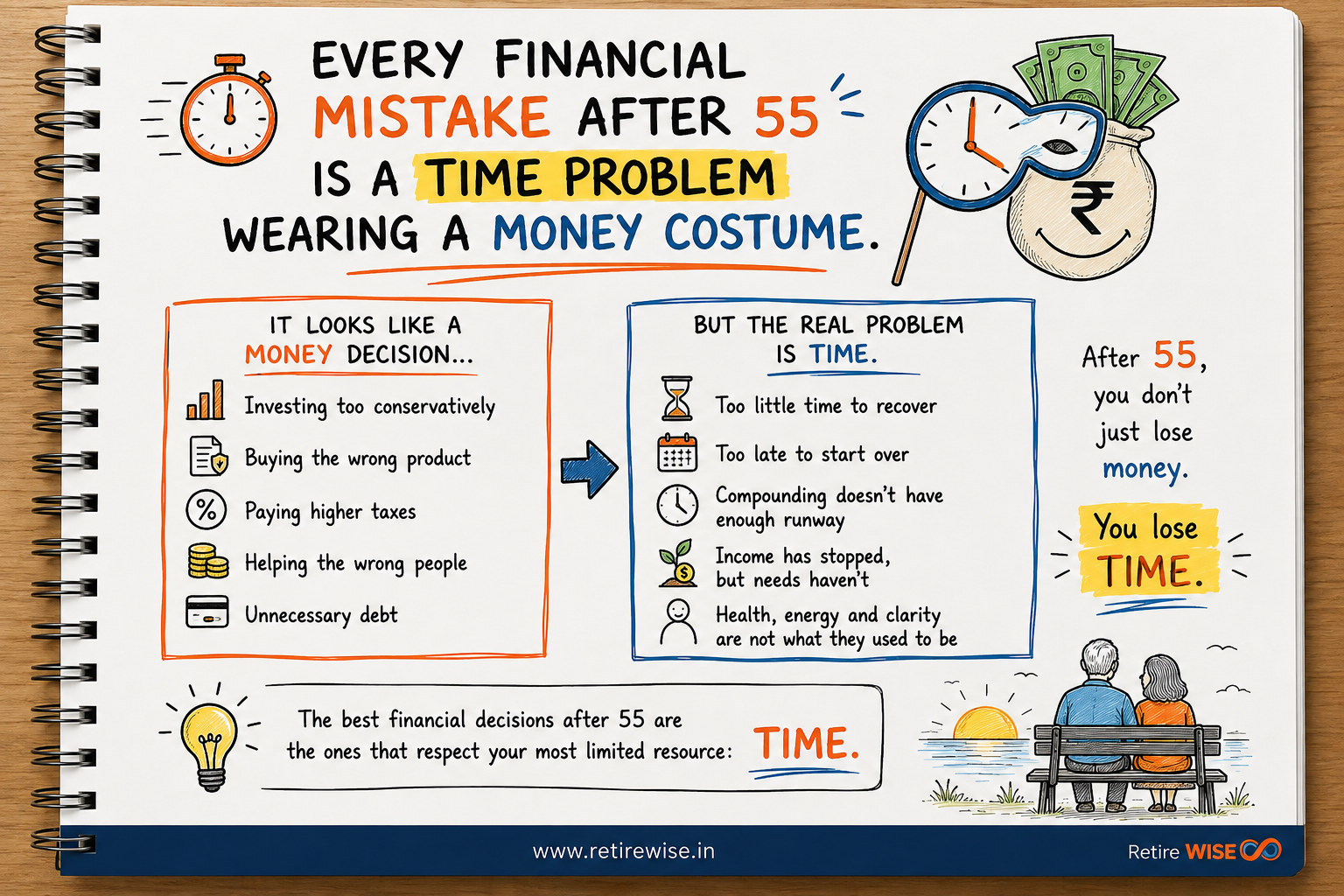
When a 30-year-old investor loses money, they have lost a resource that is, by definition, renewable. When a 65-year-old makes a strategic error, they haven’t just lost currency; they have lost the "runway" required to recover. This phenomenon, often described by financial planners as a "time problem wearing a money costume," represents the most significant psychological and structural hurdle in retirement planning today.
Main Facts: The Illusion of Safety in the "Red Zone"
The transition into the mid-50s and early 60s is often referred to by wealth managers as the "Red Zone" of financial planning. It is the period five to ten years before and after retirement where the impact of a single mistake is magnified exponentially.
A recent case study involves a successful professional in his late 60s returning to India after decades abroad. Despite building a substantial corpus, he maintained 85% of his wealth in bank deposits. His reasoning was grounded in an emotional need for "safety" and "peace of mind." However, as financial experts point out, this "safe" strategy often masks a devastating long-term risk.
The core facts of the post-55 financial landscape are:
- Purchasing Power Erosion: Portfolios heavily weighted in cash or low-interest deposits often fail to outpace inflation and taxes, leading to a slow-motion collapse of purchasing power.
- The Recovery Gap: The ability to "work more" to replace lost capital diminishes or disappears entirely after 60.
- The Resource Hierarchy: Investors must manage three assets—Money, Health, and Time. Of these, Money is the only renewable resource, yet it is the one retirees are most afraid to risk, often at the expense of the other two.
Chronology: The Evolution of Risk Across the Human Lifecycle
To understand why the age of 55 is a critical pivot point, one must look at how the nature of a financial mistake evolves over a career.
The Accumulation Phase (Ages 25–45)
During these decades, time is an investor’s greatest ally. A market crash or a failed business venture is a "highway detour." With 20 to 30 years of earning potential ahead, the investor can use their salary to "buy the dip" and benefit from compounding. In this stage, the greatest risk is not volatility, but a lack of participation in growth assets.
The Transition Phase (Ages 45–55)
As the professional peak approaches, the "runway" begins to shorten. This is the period where procrastination begins to transition from a minor nuisance to a major expense. Delaying retirement planning in the 40s creates a "catch-up" pressure that often leads to reckless aggression later on.
The Preservation and Distribution Phase (Ages 55–75+)
This is the "Short Runway" era. A mistake here—whether it is being too conservative (losing to inflation) or too aggressive (losing to market volatility)—is often permanent. There is no incoming salary to act as a buffer. The chronology of the mistake changes from "how much did I lose?" to "how many years of my life did I just spend?"
Supporting Data: The Hidden Mathematics of Retirement
The argument for a balanced approach after 55 is backed by the harsh reality of "Real Rates of Return."
The Inflation Thief
If a retiree keeps their money in a bank deposit earning 7% interest, but inflation is at 6%, the real return is only 1%. However, after accounting for income tax (which can be as high as 30% for high-net-worth individuals), the net return often drops to 4.9%. In this scenario, the investor is effectively losing 1.1% of their purchasing power every year. Over a 20-year retirement, this "safe" choice results in a massive reduction in lifestyle quality.
The "Zero Equity" Risk
Data suggests that a portfolio with 0% equity exposure has a significantly higher probability of failing over a 30-year retirement horizon than a portfolio with a 20–30% equity allocation. Equity provides the "growth engine" necessary to combat the rising costs of healthcare and lifestyle maintenance. Without it, the retiree is essentially betting that they will not live "too long"—a grim and risky wager.
The Cost of Procrastination
Financial modeling shows that a decision delayed by just three years at age 55 can result in a 15–20% reduction in the total corpus available at age 80, due to the loss of tax-efficient compounding and the missed opportunity to rebalance during market cycles.
Official Responses and Expert Perspectives
Hemant Beniwal, a prominent financial planner and the voice behind Retirewise, emphasizes that the psychological weight of money often obscures the reality of time.
"The safest-feeling choice and the safe choice are not always the same thing," Beniwal notes. He argues that many retirees are "allergic to unnecessary risk" but fail to recognize that avoiding the market entirely is, in itself, a high-risk strategy.
Professional advisors generally agree on three core tenets for post-55 planning:
- The Bucket Strategy: Segmenting money into "Immediate" (0-3 years), "Intermediate" (3-10 years), and "Long-term" (10+ years) buckets. This allows the retiree to keep safety for immediate needs while allowing long-term money to grow.
- Tax Efficiency: Moving away from fully taxable instruments (like FDs) toward more tax-efficient vehicles (like Debt Mutual Funds or Equity-Linked savings) where tax is only triggered upon withdrawal.
- Estate Logic: Recognizing that a portion of the corpus is often intended for children or grandchildren. That specific portion should be invested based on the heirs’ time horizon (30+ years), not the retiree’s.
Implications: The High Price of Doing Nothing
The implications of viewing financial mistakes through the lens of time are profound. It changes the definition of "prudence."
The Paradox of Choice
After 55, doing nothing is not a neutral act. It is a deliberate decision to spend the one resource—time—that cannot be replenished. Every year spent "waiting for the market to settle" or "waiting for interest rates to rise" is a year subtracted from the portfolio’s ability to sustain the individual in their 80s and 90s.
The Aggression Trap
Conversely, the "Time-Money" trap also explains why some retirees suddenly become gamblers. Feeling that they haven’t saved enough, they take large, concentrated bets at age 65. If these bets fail, the loss is total. This is often "fear wearing the mask of ambition." The implication is that a balanced, moderate path is the only one that respects the limited runway.
The Psychological Shift
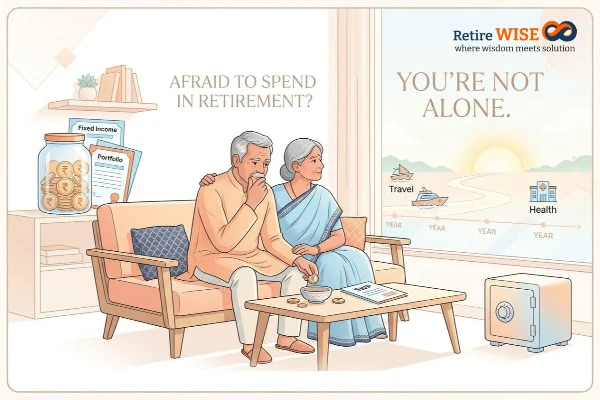
Perhaps the most significant implication is the need for a shift from "Accumulation" to "Decumulation." Many retirees who have spent 40 years saving find it psychologically impossible to spend. They remain frozen in a state of hyper-frugality, essentially "saving for a rainy day" that is already happening. This is a failure to recognize that the purpose of money is to facilitate a life well-lived within the time remaining.
Conclusion: Measuring Prudence in Years, Not Rupees
As the global population ages and life expectancies increase, the "post-55" phase of life may last three or even four decades. In this context, the traditional definitions of financial safety are becoming obsolete.
The gentleman in his 60s with 85% in bank deposits was not making a mistake of "greed" or "ignorance," but a mistake of "perspective." He was protecting his rupees while leaving his years vulnerable.
The ultimate takeaway for anyone over 55 is clear: When weighing a financial decision, do not only ask, "How much will this cost me?" Ask instead, "How many years would it take to recover if this went wrong?" If the answer is more years than you have left on the runway, the risk is too high. If the answer is that the "safe" path will leave you broke in 20 years, then the "safe" path is actually the most dangerous one of all.
In the final analysis, after 55, your most valuable asset is not the balance in your bank account—it is the time you have left to enjoy it. Financial planning, therefore, must serve the calendar, not just the ledger.