For 26-year-old Saloni, a day at a Delhi-based call center used to be defined by the rhythm of human interaction. As an employee for a firm servicing major ride-hailing giants, her role was multifaceted: onboarding new drivers, verifying complex documentation, and serving as a cultural ambassador for the company’s code of conduct. But more importantly, she was the human face of problem resolution, the person a rider turned to when a refund went missing or a bag was left in a car.
Today, Saloni’s desk is quieter. The wave of customer grievances—the "disgruntled" calls from Uber, Rapido, and Ola users—has been largely diverted. The first point of contact is no longer a person, but a voice-AI bot. For a brief period, Saloni served as the “human in the loop,” a fail-safe meant to intervene when an algorithm hit a wall. She recalls the experience with exhaustion: “By the time the voice bot transferred a call to me, the customer was already so frustrated that they would just start screaming.”
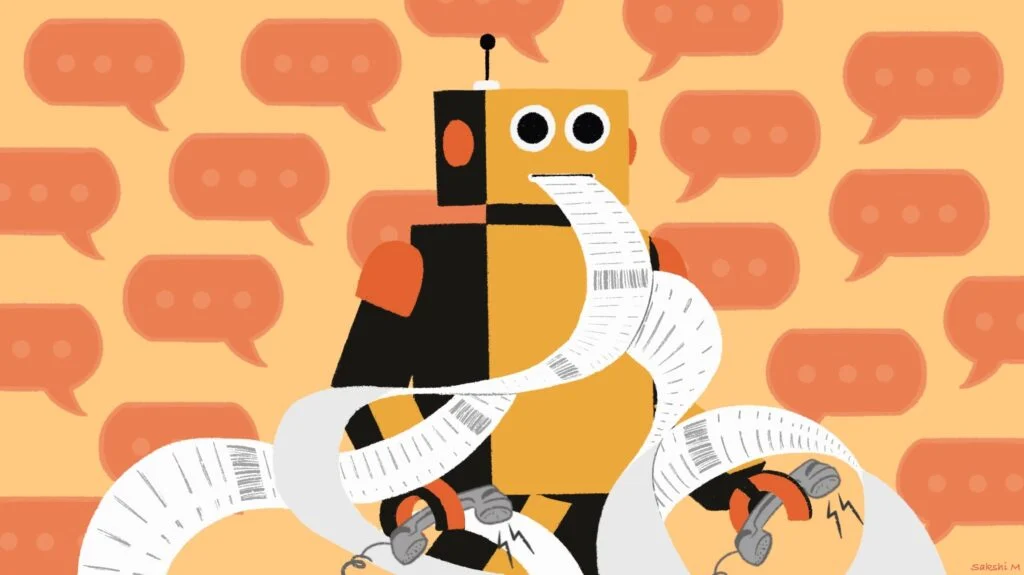
Saloni’s experience is not an anomaly; it is the frontline of a massive structural shift in the Indian service economy. As voice-AI technology matures, the human agent is being systematically replaced by bots capable of handling thousands of conversations simultaneously at a fraction of the cost.
The Rise of the Machine: A Technological Pivot
The automation of the customer service sector is being driven by a surge in specialized Indian AI firms. Companies like Gnani.ai, Corover, Skit, Bolna, Haptik, Navana, and Ringg AI are providing the infrastructure that allows businesses to deploy conversational AI that sounds, responds, and reacts with startling human-like precision.
This shift has not gone unnoticed by the investment community. According to data from Tracxn, the Indian voice-AI sector has attracted nearly $450 million in funding. A significant portion of this momentum is attributed to Sarvam AI, often hailed as India’s sovereign AI champion, which alone has secured over $350 million. Furthermore, global players are doubling down; London-based ElevenLabs has signaled its intent to pour “hundreds of millions of dollars” into the Indian market, viewing the country as a primary laboratory for the global scalability of voice-AI.
The Premiumization of Human Empathy
As corporations aggressively pivot to AI-first strategies, they are creating a two-tiered system for customer support. Access to a human agent is increasingly being recategorized from a basic service requirement to a “premium, paid perk.”

In this new ecosystem, human support is effectively behind a paywall. Programs such as Flipkart’s ‘Black,’ Swiggy’s ‘One BLCK,’ and Zomato’s ‘VIP Mode’ are prime examples. These subscription-based models promise users priority support and, crucially, direct access to human representatives. For the average consumer, this creates a stark divide: if you pay, you get a human; if you don’t, you get the bot.
This trend is not merely about cost-cutting; it is about efficiency metrics. An AI bot does not get tired, does not take breaks, and can scale to handle millions of queries during peak hours without a corresponding increase in overhead. However, as Saloni noted, the emotional cost is often transferred to the consumer—and eventually, to the few humans who must handle the "overflow" of customers who have been pushed to their breaking point by an unyielding algorithm.
Chronology of a Disrupted Industry
The transformation of the Indian call center industry has unfolded in three distinct phases:
- The Era of Human-Centric Support (Pre-2020): Call centers were primary employment hubs. Customer service was viewed as a brand-building exercise where human empathy was central to resolving complex issues.
- The Hybrid Transition (2020–2024): With the acceleration of digital adoption during the pandemic, companies began experimenting with basic IVR (Interactive Voice Response) and early-stage chatbots. The “human in the loop” model became the industry standard, where AI handled simple queries and humans managed exceptions.
- The AI-First Paradigm (2025–Present): With the advent of Large Language Models (LLMs) and advanced voice-synthesis technology, companies are now designing systems where the bot is the primary interface. Humans are now the "exception handling" layer, reserved only for the most critical or high-value cases.
The Regulatory Horizon: A New Hurdle
Just as the industry reaches a fever pitch of adoption, a new obstacle has emerged. The Telecom Regulatory Authority of India (Trai) recently introduced stringent rules concerning Application-to-Person (A2P) communication.
While these rules were primarily designed to combat spam and protect user privacy, they threaten the delicate unit economics of voice-AI providers. By placing tighter controls on how automated systems interact with the telecom network, Trai is inadvertently forcing AI companies to rethink their infrastructure. If compliance costs rise, the "fraction of the cost" advantage that made these bots so attractive may begin to erode.
Implications for the Workforce
The implications for India’s massive BPO (Business Process Outsourcing) workforce are profound. Millions of young Indians, like Saloni, find their career paths narrowing. The traditional BPO model, which was once a gateway to the middle class for thousands, is undergoing a "hollowing out."

While some argue that this transition will lead to more technical roles—such as prompt engineering or AI training—the scale of the job displacement is vastly disproportionate to the number of high-tech jobs being created. The shift is not just technical; it is sociological. We are moving toward a service environment where empathy is an expensive commodity, and frustration is a standard feature of the "free" user experience.
Supporting Data and Future Outlook
The financial data underscores the urgency of this shift. With $450 million in fresh capital flowing into the sector, the pressure to demonstrate ROI (Return on Investment) is high. AI companies are under immense pressure to deliver solutions that not only sound human but also demonstrably reduce human headcount.
However, the "frustration factor" mentioned by agents suggests that there is a limit to how far automation can go. When a customer is in a state of high emotional distress—such as a missing shipment or a safety-related issue—a bot, no matter how sophisticated, often fails to provide the psychological validation that a human can offer.
As companies continue to refine these models, the focus will likely shift from "replacing humans" to "augmenting humans." Yet, the current trajectory shows that the immediate priority for the C-suite is the bottom line. The next 24 months will be a test of whether these AI-first systems can maintain customer loyalty or if the loss of human connection will trigger a consumer backlash.
Conclusion: The Road Ahead
The story of the Indian call center is a microcosm of the global AI revolution. It is a story of rapid innovation, massive capital infusion, and the displacement of traditional labor. For companies like Gnani.ai and ElevenLabs, the challenge will be to balance the promise of infinite scalability with the reality of human expectations.
For workers like Saloni, the future remains uncertain. As she continues to onboard new drivers—a task that remains stubbornly human-centric for now—she watches as the machines take over the rest of her industry. The silent revolution is not just about the code behind the voice; it is about who—or what—we choose to listen to when we need help the most. As Trai’s new regulations take effect, the industry will have to prove that its "cheap, human-like" calls can survive the scrutiny of both regulators and the frustrated customers they serve.