The Indo-Gangetic Plain (IGP)—a sprawling, 2,500-kilometre arc of fertile land stretching from the Indus in Pakistan to the Brahmaputra in Bangladesh—is often framed as the cradle of South Asian civilization. Home to nearly half a billion people, it is arguably the most intensively farmed landscape on Earth. However, beneath its mist-covered winter skies, the region is facing an atmospheric crisis of unprecedented proportions.
While public discourse remains fixated on the visible, "primary" pollutants—the plumes of smoke from stubble burning or the thick exhaust from gridlocked traffic—the real danger lies in what is happening invisibly above our heads. Scientists have identified a shift in the chemistry of the air: the IGP is becoming a massive, open-air laboratory where agricultural ammonia is reacting with industrial acids to create "secondary" particulate matter. This silent, chemical assembly is now the primary driver of India’s catastrophic air quality.
Main Facts: The Secondary Pollutant Paradigm
For years, the narrative surrounding India’s winter smog has focused on combustion. We are taught that burning fossil fuels, coal-fired power plants, and agricultural waste are the sources of our breathing troubles. While these are indeed the primary pollutants, a growing body of research, including pivotal studies by the Centre for Research on Energy and Clean Air (CREA), reveals that they are only half the story.
Secondary pollutants—specifically ammonium sulphate and ammonium nitrate—now account for nearly one-third to over half of the PM2.5 burden in the region. These particles are not emitted; they are synthesized. When sulphur dioxide from coal plants or nitrogen oxides from vehicles meet ammonia—a byproduct of the excessive use of urea and other nitrogenous fertilizers in the IGP—they react in the atmosphere to form fine, lung-choking particulate salts.
Unlike the smoke you see trailing from a chimney, these particles are assembled molecule by molecule in the air. This shift in understanding is critical: if we only target tailpipes and stubble fires, we miss the chemistry that keeps the air toxic even when the fires are extinguished.
Chronology: Tracing the Evolution of Atmospheric Science
The journey toward understanding this phenomenon began decades ago, far from the plains of India.
- 1960s: Swedish scientist Svante Odén links acid rain to agricultural nitrogen and industrial oxides, discovering how ammonia reacts with acids to create particles. His work provides the foundational map for modern atmospheric chemistry.
- 2003: The Indian Institute of Technology, Kanpur (IIT-K) establishes the National Aerosol Facility under the guidance of Sachchida Nand Tripathi. This becomes the primary hub for studying the unique atmospheric properties of the IGP.
- 2014: A landmark study from IIT-K, documenting four years of continuous trace gas measurements, establishes the "winter loading patterns." The research proves that IGP winters are chemically unique: cold temperatures and a compressed planetary boundary layer (a "lid" of air) create the perfect environment for gas-to-particle conversion.
- 2021: Professor Srinidhi Balasubramanian publishes extensive research quantifying ammonia as an agricultural pollutant, noting that 80–85% of ammonia emissions in India originate from farming.
- 2025: CREA publishes data suggesting that secondary pollutants account for 41% of fine particles in Delhi during peak winter months, forcing a shift in policy perspectives.
Supporting Data: The Arithmetic of Toxicity
The chemistry of the IGP is a classic acid-base reaction. Professor Srinidhi Balasubramanian, a veteran in the field of environmental science, explains it with deceptive simplicity: "Acid plus base forms a salt."
The "acids" are the industrial byproducts: nitrogen oxides (NOx) from transport and sulphur dioxide (SO2) from coal combustion. The "base" is ammonia (NH3), which is released in massive quantities from the agricultural belt. Because the IGP is so heavily farmed, the atmosphere is saturated with ammonia.
The data reveals a startling imbalance:
- Ammonia’s Role: It accounts for approximately 25% of India’s total PM2.5 burden on its own.
- Secondary Contribution: When combined with industrial sulphur and nitrogen, the "inorganic secondary fraction" of PM2.5 climbs to roughly 40%.
- The Total Load: Once organic secondary pollutants are factored in, the national balance tips toward a reality where roughly 55% of the air’s particulate load is secondary, while only 45% is primary.
In essence, northern India is suffering from a "surplus of the base." While Europe once struggled with an excess of acid (leading to the acid rain crisis of the 20th century), the IGP is plagued by an excess of ammonia, which effectively "locks" industrial acids into the atmosphere as solid particles that penetrate deep into the human respiratory system.

The Winter Effect: A Chemical Trap
Why does this crisis peak so sharply in winter? The answer lies in the physics of the IGP.
During the winter months, the temperature drops, pushing the chemical equilibrium toward the "particle phase." Concurrently, the planetary boundary layer—the layer of the atmosphere closest to the ground—often compresses to below 400 metres. This acts as a physical lid, trapping nitrogen oxides from traffic and ammonia from fields in a tight, stagnant space.
At this precise moment, the chemical reaction rates for creating ammonium nitrate accelerate. The air becomes a pressurized reaction chamber, turning the region’s economic and agricultural activities into a recipe for toxic smog.
Official Responses and Policy Implications
The realization that secondary pollutants are the primary culprits presents a massive challenge for policymakers. Traditional air quality strategies have focused almost exclusively on "source control"—such as banning diesel vehicles, shutting down specific factories, or enforcing stubble-burning bans.
While these measures are necessary to control primary emissions, the secondary pollutant problem requires a more systemic, agricultural-industrial policy intervention:
- Nitrogen Management: Given that 80–85% of ammonia comes from agriculture, the overuse of urea must be addressed. Precision farming and improved fertilizer efficiency are no longer just agricultural goals; they are public health imperatives.
- Integrated Industrial-Agricultural Planning: Current regulations treat industrial emission norms and agricultural policy as separate silos. Scientists argue that because the two are reacting in the atmosphere to create PM2.5, policy must be integrated. You cannot solve the "base" problem without curbing the "acid" sources, and vice versa.
- Advanced Monitoring: The National Aerosol Facility at IIT-K and similar institutions are calling for a move beyond simple monitoring of primary gases. There is an urgent need to measure the real-time conversion rates of precursor gases into secondary particles.
Implications: A Looming Public Health Crisis
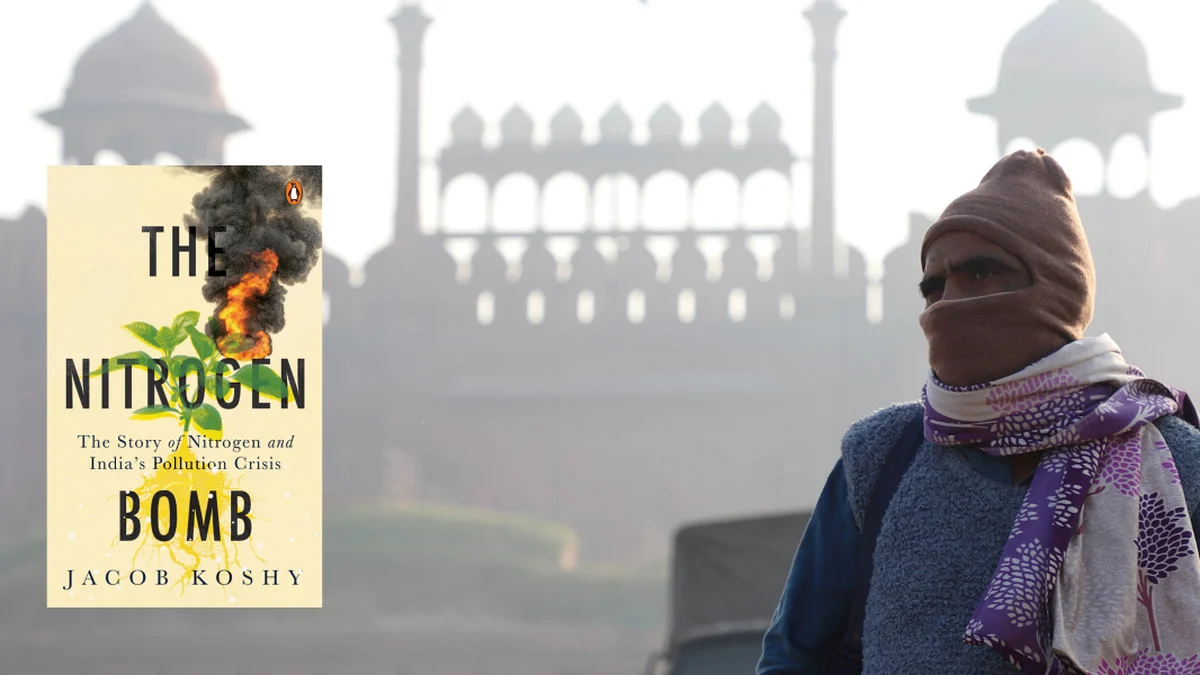
The implications of this "nitrogen bomb" are severe. Unlike large, visible particles that can be filtered by the upper respiratory tract, secondary PM2.5 particles are infinitesimally small. They bypass the body’s natural defenses, entering the bloodstream and causing long-term cardiovascular and neurological damage.
The Indo-Gangetic Plain is currently home to one of the highest concentrations of human population on the planet. If the current trend of chemical loading continues, the region faces a public health burden that could overwhelm even the most robust healthcare systems.
As we look toward the future, the science is clear: the air in the IGP is not just polluted; it is chemically altered. The "silent assembly" of secondary particles means that even if every vehicle were electrified and every coal plant cleaned tomorrow, the massive ammonia load from the agricultural sector would continue to interact with residual background pollutants to keep the air toxic.
Addressing the chemistry of the air—rather than just the smoke—is the next frontier in India’s battle for breathable air. It requires a fundamental rethinking of how we farm, how we fuel our industry, and how we understand the very atmosphere that binds the half-billion residents of the Indo-Gangetic Plain.