For over two decades, the digital marketing playbook has been anchored in a singular obsession: the Search Engine Results Page (SERP). SEO professionals have spent countless hours optimizing for "blue links," chasing Google rankings, and tracking organic traffic. However, the rise of generative AI—embodied by ChatGPT, Gemini, and Perplexity—has fundamentally altered the user journey. Today, buyers are increasingly bypassing traditional search results in favor of AI-generated summaries that synthesize information from across the web.
This shift has birthed a new discipline: Answer Engine Optimization (AEO). As brands realize that their presence in an AI summary is just as critical as their ranking in a traditional search index, the industry is pivoting. Understanding how to command visibility within these AI-driven environments is no longer an experimental luxury—it is a business imperative.
The Evolution of Search: From Links to Synthesis
The fundamental change in search behavior is driven by efficiency. When a potential software buyer or consumer asks an AI model to "compare top CRM platforms" or "identify the best accounting software for small businesses," they aren’t looking for a list of ten websites to click through. They are looking for an immediate, accurate, and comprehensive answer.
This evolution means that if your brand is not being "cited" or "referenced" within the AI’s response, you are effectively invisible to the user. Traditional SEO metrics—rankings, organic traffic, and click-through rates—remain vital, but they are increasingly incomplete. They fail to capture the "dark traffic" of AI platforms, where the brand might be mentioned but the user never clicks through to the website.
Establishing the Baseline: Measuring AI Visibility
Before an organization can optimize its presence in AI-generated answers, it must first quantify its current state. The first step in this new chronology of search is the establishment of a baseline.
Defining Your AI Footprint
To understand how your brand fares in the era of AI, you must answer several fundamental questions:

- Which answer engines currently surface your brand?
- Which specific prompts or queries trigger these citations?
- How does your brand’s visibility compare to your direct competitors?
- What sources—be it your blog, third-party reviews, or social channels—are the engines prioritizing?
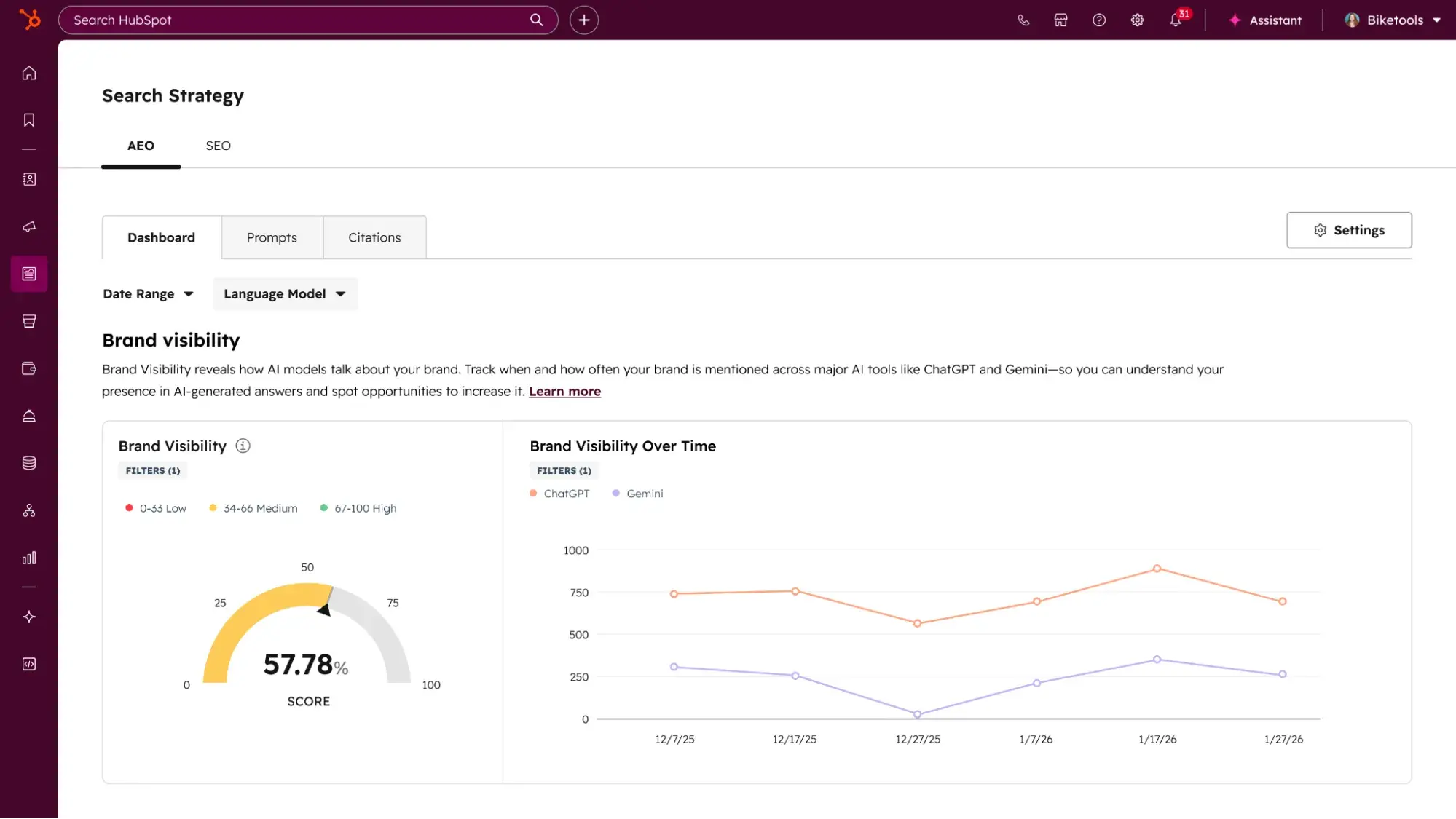
These questions cannot be answered by conventional search console tools. A brand might hold the number one spot on Google for a high-volume keyword while remaining completely absent from the answers provided by Perplexity or Gemini. By utilizing specialized tools like HubSpot’s AEO suite, teams can generate a "Brand Visibility Score"—a metric representing the percentage of tracked prompts where the brand is featured.
The Power of Daily Tracking
Consistency is the cornerstone of effective AEO. Because AI models update their underlying data and reasoning patterns regularly, a single snapshot is insufficient. HubSpot’s approach, which runs tracked prompts on a daily basis, allows teams to move beyond anecdotal evidence and identify long-term trends. By reviewing data across several weeks, marketers can see which content adjustments move the needle, providing a scientific basis for their optimization strategy.
The Mechanics of Citations: How AI "Reads" Your Content
AI engines do not "browse" the web in the way human beings do; they synthesize vast datasets. Understanding what earns a citation is the core of AEO. Citations are the new backlinks.
Categorizing the Source Material
When an AI engine constructs an answer, it pulls from a diverse array of sources. These typically include:
- Owned Assets: High-authority pages on your primary domain.
- Industry Publications: Trusted third-party news or research sites.
- Social Platforms: Discussions and posts that signal current relevance.
- User-Generated Content: Reviews and community forum threads that provide "social proof."
The challenge for large enterprises is the scale of their content library. Manually auditing every piece of content to see if it is being cited by AI is inefficient and prone to human error. Centralized citation views allow teams to compare the performance of different content types side-by-side. For instance, a whitepaper might rank well in Google, but a specific case study page might be the one consistently cited in AI responses. Knowing the difference allows teams to allocate their resources more strategically.
Leveraging Recommendations for Optimization
With the help of advanced AEO platforms, teams can move from passive observation to active optimization. The "Recommendations" framework uses data from site audits and citation patterns to prioritize actions. This might involve updating legacy content with more structured, answer-friendly data, or engaging in PR efforts to increase mentions on high-authority external sites that the AI engines clearly favor.

Connecting AEO to Business Outcomes
One of the most persistent criticisms of "new" digital marketing trends is the difficulty of connecting them to the bottom line. However, the integration of AEO with CRM data changes the narrative.
The "AI Referral" Data Point
HubSpot has pioneered the identification of "AI Referrals" within traffic source properties. By categorizing visits from ChatGPT, Gemini, and other platforms separately from organic search, teams can finally see the ROI of their AEO efforts. When these sources are tied to specific contacts and deals in the CRM, marketing and sales leadership can observe a clear correlation between AI visibility and revenue pipeline.
The Benchmark for Success
Data indicates that organizations that actively invest in AEO are seeing tangible results, with internal HubSpot data suggesting that AEO-focused customers generate 2.6x more leads. This is a critical benchmark. While an individual citation or a single mention in a chatbot response is not a direct conversion, the cumulative effect of being the "trusted source" for AI engines builds brand authority and drives high-intent traffic.
Implications for the Future of Search
The shift toward AI-generated answers is not a temporary trend; it is the next phase of the internet’s evolution. For SEO teams, the implication is clear: the role must expand.
A Holistic Strategy
AEO should not exist in a silo. It must be woven into the broader fabric of a brand’s digital marketing strategy. The most successful companies will be those that treat AEO and SEO as complementary pillars of a unified "Visibility Strategy."
As we look toward the future, the question for leadership is changing. A few years ago, the question was, "Should we invest in SEO?" Today, the question has shifted to, "Why haven’t we started optimizing for AI yet?"

The Path Forward
To remain competitive, organizations must:
- Invest in AEO-specific tooling: Use platforms that can track prompts and citations across multiple LLMs.
- Audit Content for "Answerability": Focus on creating content that is clear, concise, and structured, as these formats are more easily ingested and cited by AI.
- Align Sales and Marketing: Use CRM data to prove that AI-driven visibility is contributing to the sales pipeline.
- Adopt a Long-term Mindset: AEO is an iterative process. It requires constant monitoring, testing, and refining of the content strategy.
The digital landscape is becoming increasingly automated. While the "blue link" will likely remain a fixture of the web for some time, the primary gateway to information is shifting toward the conversational, synthesized intelligence of the answer engine. By mastering AEO now, forward-thinking brands can ensure they remain the source of truth, regardless of how the user chooses to ask their question.
The era of merely ranking for keywords is over; the era of being the "cited authority" has begun. Brands that recognize this shift will capture the next generation of buyers, while those that cling solely to traditional SEO metrics risk being left behind in the silent corners of the internet.