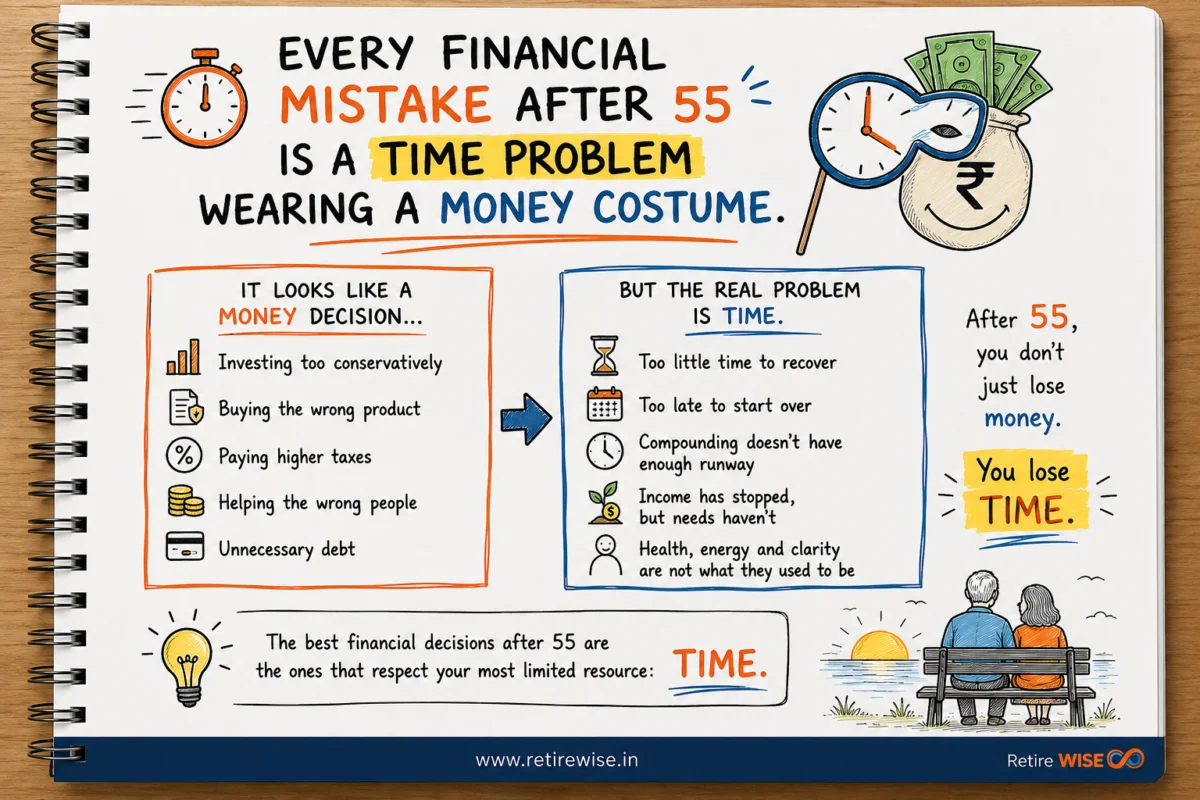
In the landscape of personal finance, the age of 55 serves as a silent but significant frontier. Before this threshold, the primary vocabulary of wealth is "growth," "accumulation," and "opportunity." After this point, however, the lexicon shifts toward "sustainability," "preservation," and, most critically, "time."
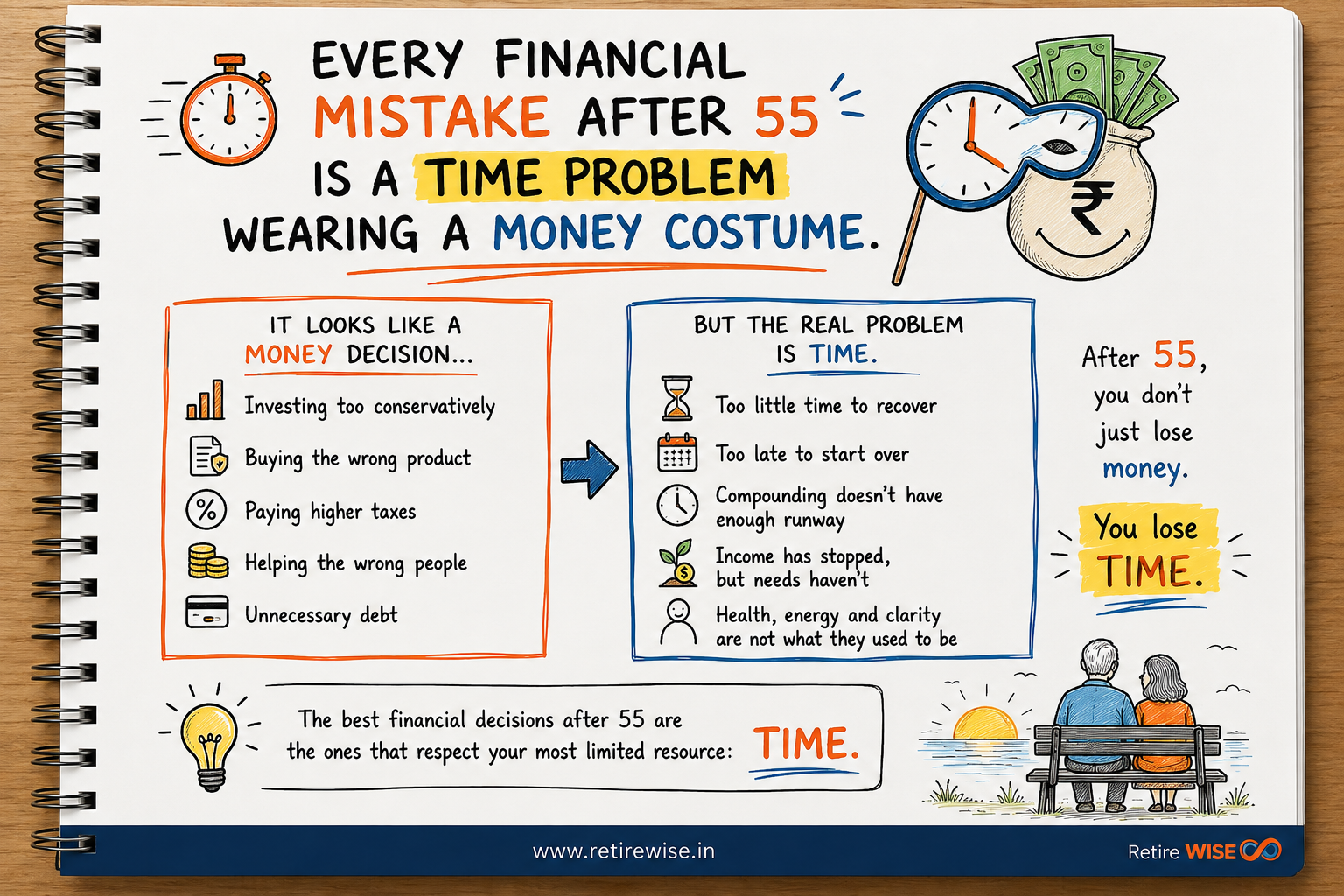
As investors approach and cross the mid-fifties, the fundamental nature of risk undergoes a metamorphosis. What was once a manageable setback in one’s thirties becomes a structural failure in one’s sixties. This shift occurs because, after 55, financial mistakes cease to be merely about the loss of currency; they become about the depletion of the one resource that cannot be replenished: time.
Main Facts: The Anatomy of Post-55 Risk
The central challenge of late-stage financial planning is the "Runway Paradox." When a 35-year-old investor loses 20% of their portfolio in a market downturn, they possess approximately 30 years of future earnings and compounding interest to recover. When a 65-year-old faces the same loss, the "runway" for recovery has largely vanished.
The Three-Resource Framework
Financial experts suggest that post-55 investors are managing three distinct resources:
- Capital (Money): The tangible assets available for spending.
- Health: The physical capacity to enjoy those assets.
- Time: The remaining duration to both recover from mistakes and utilize wealth.
While capital can be rebuilt through aggressive saving or market rebounds, health and time are non-renewable. Therefore, any financial decision that jeopardizes capital after 55 is effectively a gamble with the investor’s remaining time.
The Illusion of Safety
A common phenomenon among retirees—particularly successful professionals and Non-Resident Indians (NRIs) returning home—is an over-reliance on "safe" assets. Many hold 80% to 90% of their corpus in fixed deposits or bank savings. While this provides emotional comfort and eliminates market volatility, it introduces "Inflation Risk." If a portfolio does not outpace inflation, the investor is losing purchasing power every year. This is a "slow-motion mistake" that only becomes visible when it is too late to fix.
Chronology: The Evolution of Financial Recovery
To understand why 55 is the critical pivot point, one must examine the chronology of an investor’s recovery capacity over a 40-year career span.
Phase I: The Resilience Era (Ages 25–45)
During these two decades, the investor’s greatest asset is their human capital—their ability to earn a salary. Mistakes made here (poor stock picks, overspending, or lack of insurance) are "learning costs." The market’s historical tendency to trend upward over 20-year periods ensures that even mediocre strategies can be salvaged by the sheer volume of time.
Phase II: The Transition Zone (Ages 45–55)
This is the "pre-retirement" window. The focus begins to shift from pure growth to "de-risking." However, there is still enough time (10–15 years) to weather one full economic cycle. A mistake made at 48 can often be corrected by 58.
Phase III: The Critical Runway (Ages 55–70)
At this stage, the transition from "Accumulation" to "Distribution" begins. The investor starts drawing from the corpus rather than adding to it. This is the period of "Sequence of Returns Risk." If a significant financial mistake occurs early in retirement, the combination of portfolio losses and regular withdrawals can lead to a "death spiral" where the corpus is depleted far faster than projected.
Phase IV: The Legacy and Sustainability Era (70+)
In this phase, the ability to pivot is almost non-existent. Financial stability depends entirely on the decisions made during Phase III.
Supporting Data: The Mathematical Weight of Delay and Inflation
The urgency of post-55 planning is supported by several key economic indicators that highlight the "Time Problem."
1. The Inflation Compounder
In many developing economies, including India, medical inflation can hover between 10% and 12% annually. If a retiree keeps their entire corpus in a bank deposit yielding 6-7% (pre-tax), they are effectively losing 3-5% of their purchasing power every year. Over 20 years, a "safe" strategy can reduce a retiree’s standard of living by half.
2. The Cost of Procrastination
Data shows that delaying the transition from a "savings mindset" to a "structured withdrawal mindset" by just five years (from age 55 to 60) can result in a 15-20% reduction in the total "safe" spendable income over a 30-year retirement. This is due to the lost opportunity to optimize tax structures and asset allocation early.
3. Market Recovery Timelines
Historical data from the S&P 500 and the Nifty 50 shows that while markets always recover, the "break-even" time after a major crash can range from 3 to 7 years. For a 65-year-old, waiting seven years just to get back to "zero" is not just a financial loss; it is the loss of nearly a decade of their most active retirement years.
Official Responses and Expert Frameworks
Financial planners and wealth managers have developed specific frameworks to address the "Time Costume" problem. The consensus among experts suggests a shift away from binary thinking (Safe vs. Risky) toward a "Segmented Time-Horizon" approach.
The Bucket Strategy
Top-tier financial advisors recommend dividing the corpus into three "buckets" to manage the time risk:
- The Immediate Bucket (0–3 years): Kept in liquid, ultra-safe instruments (Cash, Liquid Funds) to cover immediate living expenses. This protects the investor from being forced to sell assets during a market downturn.
- The Intermediate Bucket (3–10 years): Invested in high-quality debt and hybrid funds to outpace inflation while maintaining moderate stability.
- The Long-term Bucket (10+ years): Invested in equities. This portion of the money has the time to weather volatility, ensuring that the investor does not run out of money at age 85.
The Tax Efficiency Mandate
Experts emphasize that after 55, "Return on Investment" (ROI) is less important than "Post-Tax Yield." Many retirees mistakenly hold assets that are taxed annually (like FDs), which creates a "tax drag." Shifting to capital-gains-oriented investments allows the investor to control when they pay taxes, preserving more capital for the "runway."
Implications: The High Cost of Inaction
The implications of viewing financial mistakes through the lens of time are profound for the modern retiree.
1. Prudence Must Be Redefined
Being "prudent" no longer means avoiding all volatility. It means avoiding the risk of outliving one’s money. A 100% debt portfolio for a 55-year-old with a 30-year life expectancy is, by definition, a high-risk strategy because it almost guarantees a loss of purchasing power.
2. The Psychological Trap of "Doing Nothing"
After 55, "doing nothing" is a proactive decision. Every year an investor delays fixing a flawed allocation or avoiding a difficult conversation about estate planning, they are spending their most limited resource. In the context of retirement, inertia is the most expensive luxury.
3. The Intergenerational Shift
For those with children, the "Time Problem" extends to the next generation. If a retiree’s portfolio is too conservative, they may eventually become financially dependent on their children, effectively "stealing" time and compounding power from their children’s own retirement journeys. Conversely, assets intended for heirs should be invested according to the heir’s time horizon (30+ years), not the retiree’s.
4. Quality of Life vs. Portfolio Size
Ultimately, the "Money Costume" hides the fact that the goal of retirement planning is not to die with the largest possible bank balance, but to ensure that one’s time is never compromised by financial anxiety. The most successful retirees are those who recognize that at 55, they are no longer just managing a portfolio; they are managing the remaining chapters of their lives.
Conclusion
The transition into the mid-fifties requires a fundamental rewiring of the investor’s brain. The aggressive pursuit of wealth must be replaced by a sophisticated management of time. Whether it is the mistake of being "too safe" (and losing to inflation) or "too risky" (and losing the ability to recover), both are symptoms of the same underlying failure: a lack of respect for the diminishing runway.
As the financial landscape becomes increasingly complex with fluctuating interest rates and rising costs of living, the advice for those over 55 is clear: Do not merely ask what a decision costs in dollars or rupees. Ask how many years it will take to earn that back—and then look at the calendar to see if you can afford the price.