Welcome back to TechCrunch Mobility, your definitive source for the evolution of transportation and the increasingly central role artificial intelligence plays in moving the world. As we gear up for Disrupt 2026 in San Francisco, the industry is buzzing with a level of activity that mirrors the rapid pace of technological innovation.
Whether you are deep in the trenches of robotics or a casual observer of the shifting transport landscape, there is much to unpack this week—from landmark regulatory victories in autonomous trucking to significant shake-ups in the battery recycling sector and major capital infusions for robotaxi leaders.
The Great Regulatory Pivot: A Victory for Autonomous Trucking
The path to commercializing self-driving technology is paved with more than just software updates and sensor arrays; it is heavily obstructed by legacy regulations designed for a world of human-operated vehicles. This week, the autonomous trucking sector secured a massive win that addresses one of its most persistent bureaucratic hurdles.
Removing the Human-Triangle Barrier
For decades, federal motor carrier regulations have mandated that if a commercial big rig encounters a mechanical failure or emergency, the human driver must pull over, engage hazard lights, and manually place reflective warning triangles on the road within a strict 10-minute window. This protocol is intended to alert oncoming traffic to a stationary hazard.
However, for autonomous trucking companies like Aurora Innovation and Kodiak AI, this requirement presented a fundamental paradox: how does a vehicle without a human driver satisfy a regulation that requires a human to perform a manual safety task?

The Legal and Regulatory Path
The hurdle was significant enough to trigger a legal battle. Aurora Innovation previously challenged federal safety regulators in court, arguing that the rule was incompatible with the operational reality of Level 4 autonomous systems. After an initial setback in district court, the company escalated the dispute to the District of Columbia Court of Appeals.
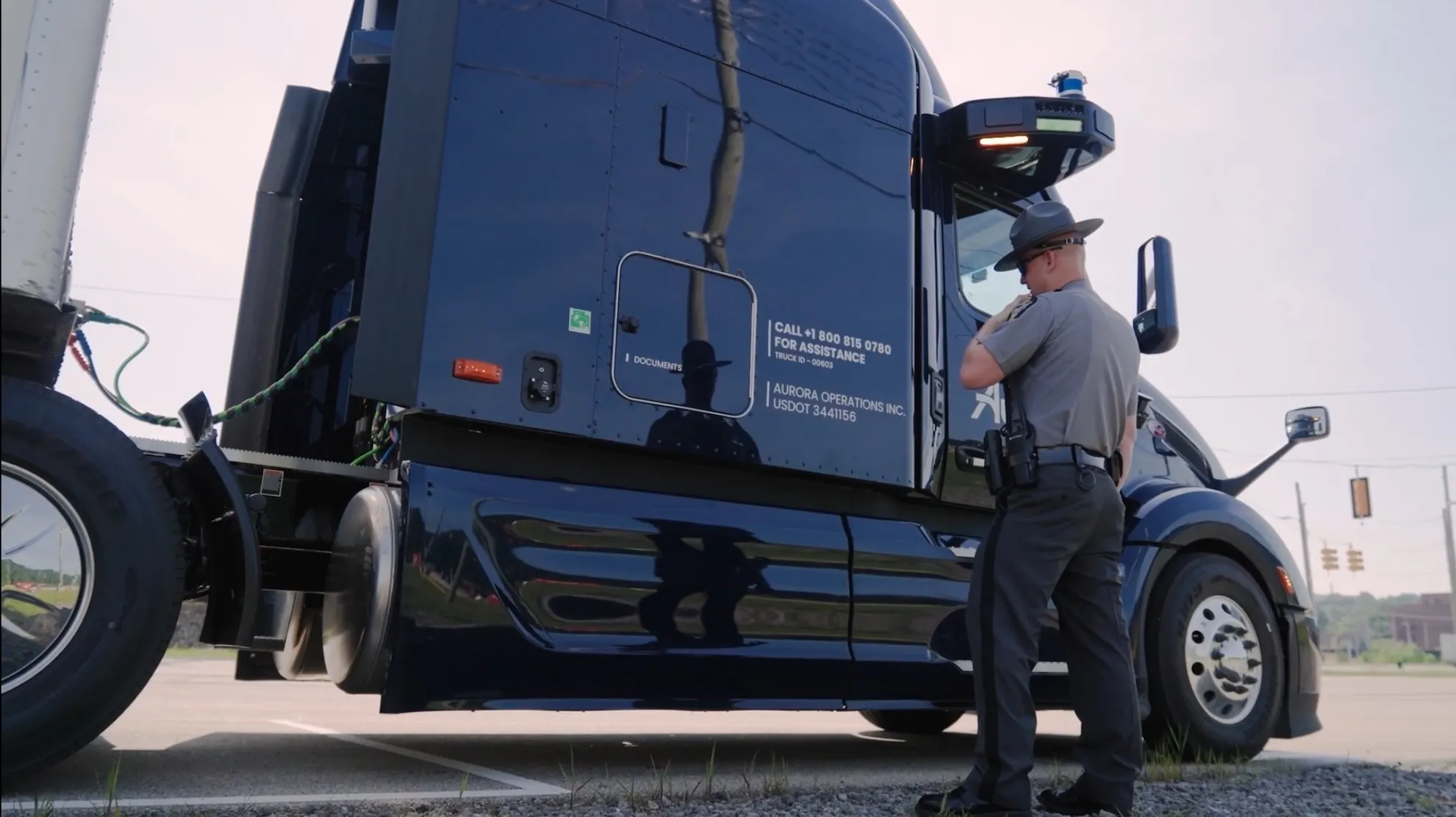
Following a period of temporary waivers, the Federal Motor Carrier Safety Administration (FMCSA) has finally provided a definitive path forward. The agency has granted a five-year exemption allowing companies to replace those physical, human-deployed warning triangles with cab-mounted, high-visibility warning beacons.
Implications for the Industry
This decision is more than just a procedural change; it is a validation of the "autonomous era." By authorizing these beacons, the FMCSA is acknowledging that technology can provide a safety standard equal to, or potentially better than, manual methods.
Gerardo Interiano, head of government relations and public affairs at Aurora, noted that the decision underscores the government’s recognition of the economic and community benefits of autonomous freight. "These high-visibility, cab-mounted warning beacons are a critical, 21st-century solution that enhances roadside safety by immediately alerting other road users without ever needing to put a person in harm’s way," Interiano said.
Daniel Goff, VP of external affairs at Kodiak AI, echoed these sentiments, framing the exemption as a catalyst for a new era of logistics. "This helps us usher in an autonomous era of freight movement on U.S. roads, one that can save lives and improve the efficiency of goods delivery."

The broader question remains: will these beacons become the standard for the entire trucking industry, including human-driven fleets, as a way to further reduce roadside fatalities?
Corporate Realignment: Turbulence at Redwood Materials
While the autonomous sector celebrates regulatory tailwinds, the energy storage supply chain is seeing some internal friction. Redwood Materials, the battery-recycling powerhouse founded by Tesla co-founder JB Straubel, has been undergoing a quiet but significant transformation.
The Restructuring Strategy
Earlier this year, Redwood pivoted its core business model to focus more aggressively on energy storage solutions. As part of this transition, the company initiated a restructuring phase that included the layoff of approximately 135 employees—roughly 10% of its total workforce.
Leadership Exodus
The restructuring appears to have extended into the executive suite. Recent reports indicate that the company has parted ways with several key leaders, including the vice presidents of engineering, operations, treasury, and external affairs. Such a broad departure of top-level talent, occurring in the wake of a strategic pivot, suggests that Redwood is seeking a lean, singular focus as it attempts to scale its battery-reclamation and material-production capabilities to meet the insatiable demand of the EV market.
Capital Flows: The Multi-Billion Dollar Bet on Autonomy
If you needed evidence that the "robotaxi winter" is over, look no further than the balance sheets of the industry’s biggest players.

Waymo’s $5 Billion Milestone
In a historic move, Waymo—the Alphabet-owned subsidiary—has moved beyond relying solely on internal capital or equity rounds. The company successfully closed a $5 billion debt financing deal this week. The list of lenders reads like a "who’s who" of global finance: Blackstone, PIMCO, and Sixth Street led the round, with participation from major institutions including Fidelity, Apollo, and T. Rowe Price.
This capital is explicitly earmarked for the rapid commercial expansion of its robotaxi services across the U.S., with eyes set on expansion into European and Japanese markets.
Other Notable Deals
- Parallel Systems: The rail-freight startup, founded by SpaceX alumni, secured $100 million in Series C funding. They are rethinking the logistics of short-haul freight through autonomous, modular rail vehicles.
- Flai: The AI-for-dealership startup raised $27 million to scale its appointment-booking software.
- Bloom: The "Alibaba of American manufacturing" secured $3.6 million in seed funding.
- Uber’s Massive Acquisition: In a move to dominate the B2B food logistics space, Uber has agreed to acquire catering platform ezCater in an all-cash deal valued at $2.3 billion.
Market Tidbits and Global Shifts
The mobility landscape is as volatile as it is innovative. Here are the key updates from the week:
- Surveillance Backlash: Flock, a prominent manufacturer of license-plate reading technology, has cut its workforce by 18% (270 employees) amid mounting public and legal scrutiny regarding privacy concerns.
- Lucid Motors: The luxury EV maker reported a 54% decline in production year-over-year, citing a deliberate strategy to limit output to align with actual consumer demand rather than overstocking.
- Autonomous Expansion: Kodiak AI has launched a new 435-mile autonomous freight route between Dallas and Laredo, Texas, in partnership with Carrier Charger USA.
- Tesla’s Rebranding: Following pressure from the German transportation ministry, Tesla has officially dropped the "Full Self-Driving (Supervised)" moniker in Europe, rebranding it to "Tesla Assisted Driving."
- Transatlantic Robotaxis: In an interesting partnership, Uber and Pony.ai have announced plans to bring driverless robotaxi services to London, marking a significant step in Uber’s European autonomous strategy.
Disrupt 2026: The Future Converges
As we approach Disrupt 2026, the agenda is packed with the thinkers and doers shaping the next decade of transportation.
I am particularly excited to kick off the conference on October 13 with Rivian CEO RJ Scaringe. We will be diving into his vision for the convergence of EVs, robotics, and autonomy. Other highlights include:

- Engineering for Failure: A high-stakes discussion on building AI systems where there is zero room for error, featuring Shield AI CTO Nathan Michael, Waabi founder Raquel Urtasun, and GM’s Mikell Taylor.
- From Prototype to Product: A deep dive into physical AI with Foxglove CEO Adrian MacNeil and Bedrock Robotics CTO Kevin Peterson.
- The Robot Revolution: Hello Robot CEO Aaron Edsinger will be showcasing the Stretch 4, and we’ll have a fireside chat with Agility Robotics CTO Jonathan Hurst.
With representatives from OpenAI, Nvidia, Anthropic, and a host of top-tier VC firms, this year’s Disrupt is shaping up to be the most critical gathering of the decade for mobility and AI.
Want to join the conversation? Use code mobility30 for 30% off your tickets.
Got a tip or a story you think I should be covering? Email me at [[email protected]] or hit me up on Signal at kkorosec.07. See you in San Francisco!
Disclaimer: When you purchase through links in our articles, we may earn a small commission. This does not affect our editorial independence.