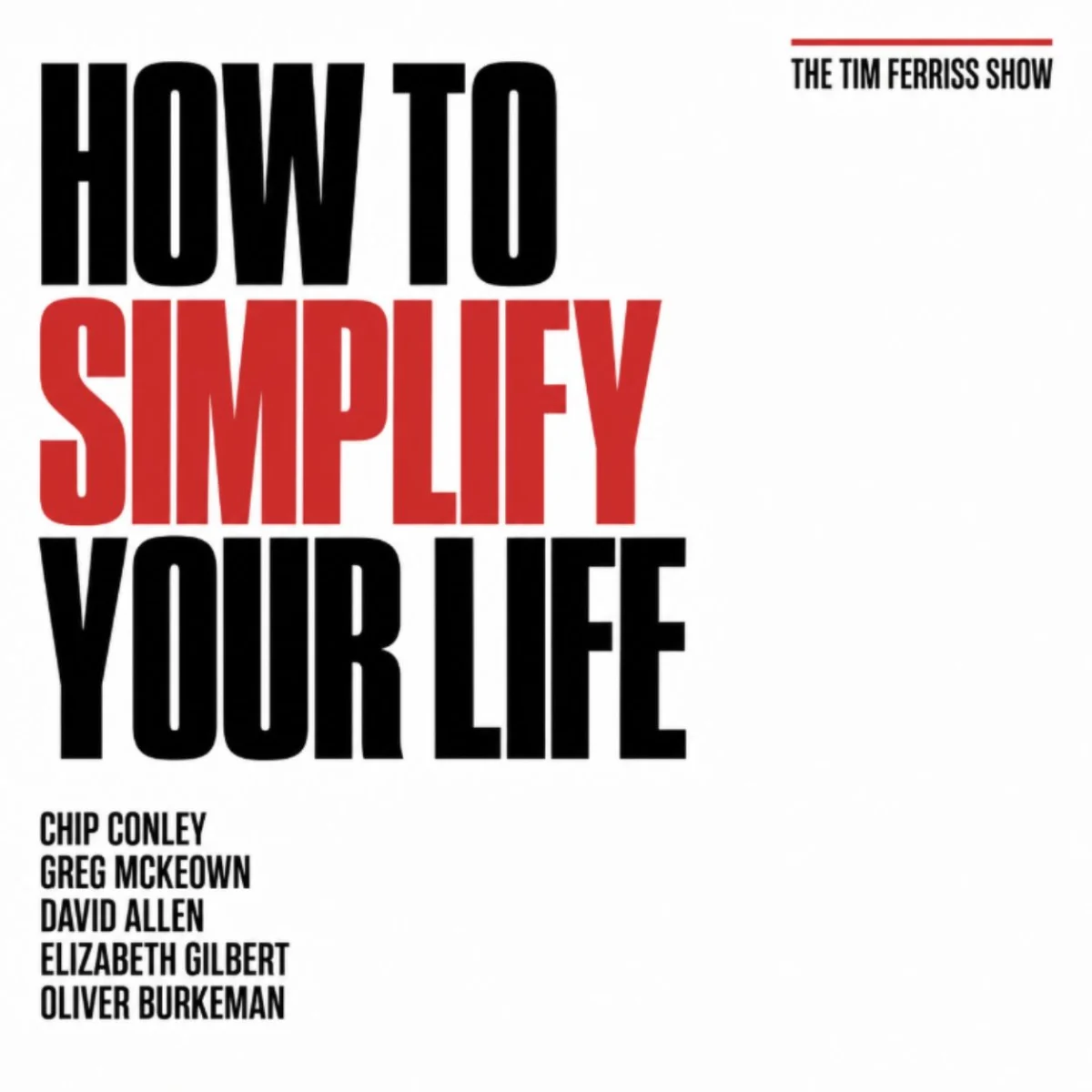
In an era defined by relentless digital noise, constant connectivity, and the glorification of "busy," the quest for simplicity has shifted from a luxury to a psychological necessity. A recent special compilation episode of The Tim Ferriss Show brought together a cohort of renowned thinkers—Chip Conley, Greg McKeown, David Allen, Elizabeth Gilbert, and Oliver Burkeman—to dismantle the complexities of modern existence.
The consensus among these experts is clear: simplifying life is not merely about clearing a closet; it is an act of radical prioritization and internal recalibration. By examining the psychological traps that force us to accumulate unnecessary burdens, these contributors offer a blueprint for reclaiming time, energy, and mental clarity.
The Philosophy of Distillation: Lessons from the Experts
The core argument presented across these interviews is that simplicity is the hallmark of wisdom. While knowledge is additive—the accumulation of facts and skills—wisdom is subtractive. It is the ability to distill the essential from the trivial.
Chip Conley: The Power of Mindful Decoupling
Chip Conley, the hospitality entrepreneur and founder of the Modern Elder Academy (MEA), approaches simplicity through the lens of midlife transitions. Conley describes "mindful decoupling" as the process of intentionally stripping away outdated identities. After a health scare forced him to evaluate his high-pressure career as a hotelier, Conley recognized that his attachment to "VIP status" was a barrier to genuine contentment.
His strategy involves creating "atrium spaces"—intentional gaps in one’s calendar—that allow for curiosity and discovery. His current practice, "holy urgency," seeks to bridge the gap between his awareness of mortality (due to a stage-three cancer diagnosis) and his desire for a peaceful, slowed-down existence. By instituting "Sunday sabbaticals" and engaging in "social eulogies"—where he gathers friends to express gratitude while living—Conley demonstrates that simplicity is the most effective way to honor the present moment.
Greg McKeown: Combating the Endowment Effect
Best-selling author Greg McKeown focuses on the cognitive biases that prevent us from letting go. He highlights the "Endowment Effect"—a psychological phenomenon where we overvalue items or opportunities simply because we possess them.
McKeown uses the metaphor of the "closet of life" to explain why we struggle to prune our commitments. He suggests that to overcome this, one must ask a counter-intuitive question: "If I did not already have this opportunity, how much would I be willing to sacrifice to obtain it?" This reframe forces an objective evaluation, stripping away the emotional weight of ownership and allowing for the pruning of "stormtrooper" goals—ambitions that no longer serve our current selves.
David Allen: The Psychology of Unfinished Agreements
David Allen, the pioneer of the Getting Things Done (GTD) methodology, argues that complexity is often a byproduct of broken self-agreements. When we keep tasks swirling in our minds, we effectively agree to do everything at once—a cognitive impossibility that leads to anxiety and diminished self-esteem.
Allen advocates for "capturing"—the externalization of every commitment onto paper. By moving tasks out of the brain, we regain the ability to prioritize and renegotiate. "You can only feel good about what you’re not doing when you know what you’re not doing," Allen notes. Simplification, in his view, is a systematic clearing of the mental workspace.
Elizabeth Gilbert: The Art of the "Simple No"
For Elizabeth Gilbert, author of Big Magic, simplicity is a matter of personal integrity and boundary setting. She treats her personal communication channels as an extension of her home. If an invitation or inquiry lacks a personal invitation, she feels no obligation to respond.
Gilbert emphasizes the power of a "simple no"—a phrase devoid of excuses or elaborate justifications. Drawing on the teachings of Byron Katie, she highlights that explanations often provide "manipulators" with leverage to argue against your decision. A simple, polite "no" is not just a time-saving tactic; it is a declaration of autonomy.
Oliver Burkeman: Simplicity as an Attitude
Journalist and author Oliver Burkeman offers a cautionary perspective on simplicity-seeking. He warns that rigid systems designed to simplify life—such as extreme minimalism or rigid time-blocking—often create more overhead and maintenance than they save.
For Burkeman, true simplicity is not a technique but an internal state. Drawing on Zen principles, he suggests it is the ability to "not mind what happens." It is the transition from trying to control reality to being fluid within it. By unclenching our grip on how we think our lives should look, we become more capable of taking vigorous action on what truly matters.
Chronology of Concepts: From Collection to Execution
The process of simplifying one’s life, as detailed in the podcast, follows a logical progression:
- The Recognition Phase: Acknowledging the "flatline" or "clutter" moments—the realization that the current trajectory is unsustainable (Conley).
- The Audit Phase: Identifying the "stormtroopers" or non-essential commitments that are held only due to the Endowment Effect (McKeown).
- The Capture Phase: Externalizing all mental open loops to alleviate cognitive load (Allen).
- The Boundary Phase: Implementing the "simple no" to protect one’s time and energy (Gilbert).
- The Integration Phase: Moving beyond systems to a state of internal flexibility and acceptance (Burkeman).
Supporting Data and Psychological Implications
The implications of these strategies are backed by significant behavioral research. The "Endowment Effect," first coined by Richard Thaler, is a well-documented economic bias that explains why people demand more to give up an object than they would be willing to pay to acquire it. By applying this to "opportunities," McKeown is essentially advocating for a more rational economic approach to personal time management.
Furthermore, David Allen’s focus on "open loops" aligns with the Zeigarnik effect—a psychological principle stating that people remember uncompleted or interrupted tasks better than completed ones. By "closing the loop" through writing things down, individuals reduce the "mental noise" that contributes to burnout.
Finally, the research from the Stanford Center on Longevity, referenced by Conley, underscores the "socioemotional selectivity theory." As humans perceive their time as limited, they naturally shift their focus from long-term information gathering to present-moment emotional satisfaction. Simplifying one’s life is, in essence, an acceleration of this natural maturation process.
Official Responses and Practical Application
The podcast participants acknowledge that these practices are not "simple" to implement. Elizabeth Gilbert notes that the closer the relationship, the harder it is to maintain boundaries. Similarly, Oliver Burkeman admits that he has often fallen into the trap of over-complicating his life in the name of simplicity.
How to Apply These Insights:
- The In-Tray Exercise: Dedicate one to six hours to list everything currently on your mind. Do not organize it; simply capture it.
- The Reversal Test: Look at a current project or possession and ask: "If I didn’t have this, would I fight to get it?" If the answer is no, consider letting it go.
- The Simple No: When faced with a request you do not want to fulfill, offer a polite, "Thank you, but I am not able to do this at this time," and refrain from offering further justifications.
- The Sunday Sabbatical: Create a "chrysalis" period each week where you disconnect from digital inputs to allow for organic, creative emergence.
Implications for Modern Living
The collective wisdom shared by these thinkers suggests that our current obsession with optimization is often a distraction from the fundamental task of living. The goal of simplification is not to achieve a perfectly ordered life—which is an illusion—but to create enough space for the things that provide meaning.
As Chip Conley concludes, "Knowledge is something you accumulate, you add. Wisdom is something you distill, you simplify." In a world that rewards us for adding more, the most counter-cultural and effective path to success may well be the courageous act of doing less. By embracing these principles, individuals can transition from a life of frantic, unmanaged complexity to one of focused, intentional action.