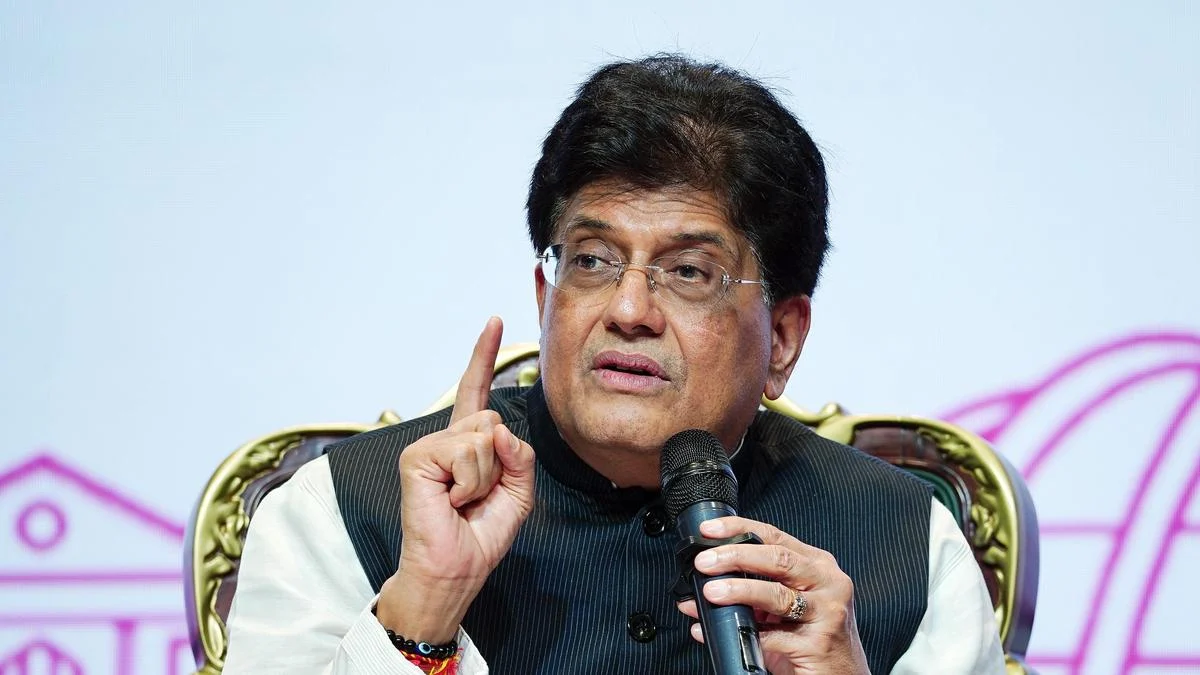
NEW DELHI – In an era defined by geopolitical volatility and shifting economic alliances, the strategic partnership between India and the United States stands as a bedrock of global stability. Union Minister for Commerce and Industry Piyush Goyal, speaking at the prestigious Bloomberg New Economy event, reinforced the narrative of an enduring bilateral bond, asserting that the India-US relationship is “substantive, consequential, and poised for exponential growth.”
Despite the natural ebb and flow of political transitions in both Washington and New Delhi, Minister Goyal signaled that the structural alignment between the world’s two largest democracies is built on foundations far deeper than mere transactional politics. As the global economy faces headwinds, the synergy between India’s burgeoning market and the United States’ technological prowess remains a pivotal engine for the future.
The Strategic Core: Beyond Trade
While trade statistics often dominate the headlines, Minister Goyal was quick to clarify that the India-US narrative is multifaceted. Addressing concerns regarding potential political shifts, he emphasized that the relationship is anchored in a comprehensive framework that spans across critical domains:
- Defense and Security: The two nations have moved beyond traditional buyer-seller dynamics, fostering deep interoperability through joint military exercises and co-production of defense technologies.
- Technology and Innovation: Collaborative efforts to secure supply chains for semiconductors, artificial intelligence, and telecommunications are central to the bilateral agenda.
- Critical Minerals: As the world transitions toward green energy, India and the US are actively exploring partnerships to secure supply chains for essential minerals required for electric vehicles and renewable energy storage.
- People-to-People Ties: The cultural and demographic bridge, built by the robust Indian diaspora and shared democratic values, remains the most significant intangible asset of the alliance.
"It is about trade, it is about defense partnership, it is our technology partnership, it is our critical minerals partnership, it is our people-to-people engagement," Goyal noted, dismissing concerns that political cycles might derail the momentum of this partnership.
Chronology of the Modern Partnership
The current state of the India-US relationship is the culmination of decades of steady warming, transitioning from a "estranged democracies" phase during the Cold War to a comprehensive global strategic partnership.
- February 2026: The two nations announced a framework for a long-awaited Bilateral Trade Agreement (BTA). This move was seen as a significant step toward formalizing the economic relationship.
- Mid-2026: Discussions began to encounter friction as the global tariff landscape shifted, necessitating a recalibration of expectations on both sides.
- October 2026: Finance Minister Nirmala Sitharaman acknowledged that negotiations had reached a "plateau," signaling that while both sides are committed, the room for further concessions has narrowed.
- October 14, 2026: Minister Piyush Goyal provided a definitive reassurance to the global community, stating that the relationship is "very safe" and independent of political changes in either nation.
Supporting Data: The Economic Reality
The trade relationship between the two nations is both voluminous and complex. According to the most recent fiscal data, the United States remains India’s largest trading partner.
Trade Performance Snapshot (2025-26 Fiscal Year)
- Indian Exports to the US: Reached USD 87.3 billion, representing a marginal growth of 0.92% despite high tariff barriers.
- US Imports to India: Surged by 15.95%, reaching USD 52.9 billion.
- Trade Surplus: India’s surplus narrowed to USD 34.4 billion in 2025-26, down from USD 40.89 billion in the previous fiscal year.
The narrowing trade surplus highlights a growing Indian appetite for American goods and services, reflecting the maturing nature of the Indian market. However, the plateau mentioned by Finance Minister Sitharaman underscores the difficulty in bridging the gap between India’s desire for preferential market access and the US administration’s focus on protecting domestic industrial interests.
Official Responses and Diplomatic Nuance
The diplomatic airwaves between New Delhi and Washington have been busy. US Trade Representative Jamieson Greer recently noted that while both nations are working diligently to finalize a deal, a breakthrough is not currently "imminent." This measured tone contrasts with the high-energy political rhetoric often seen on campaign trails.
Minister Goyal’s recent comments serve as a strategic counter-narrative to these reports. By framing the relationship as "consequential for the world," he elevates the bilateral trade discussions above the level of bureaucratic haggling. He effectively argued that the necessity of a stable India-US axis—to balance global geopolitical threats and economic instability—supersedes any single tariff dispute.

"The US and India have a very, very consequential relationship and it’s only going to get better irrespective of changes in political thinking… It’s a very safe relationship. I don’t think the rest of the world needs to worry about it," Goyal reaffirmed.
Implications for the Global Economy
The durability of the India-US partnership has profound implications for global supply chains and regional security.
1. Diversification of Supply Chains
With the global move toward "China Plus One" strategies, India is positioning itself as a reliable, democratic manufacturing hub. The US, in turn, is leveraging this to reduce its reliance on adversarial or single-source supply chains. The success of this transition is largely dependent on the ongoing technology transfer and the stability of the bilateral trade framework.
2. Geopolitical Stability in the Indo-Pacific
Both nations view the Indo-Pacific as a critical theater for economic and security cooperation. The strengthening of the Quad (India, US, Japan, Australia) and the deepening bilateral defense ties serve as a cornerstone for maintaining a "free and open" region. Goyal’s emphasis on "security imperatives" suggests that the defense partnership will continue to evolve, regardless of which political party holds power in the US.
3. Economic Integration
The "plateau" in trade negotiations is not necessarily a failure; rather, it represents the maturity of the relationship. Both sides are no longer seeking quick wins but are instead navigating the complex realities of their respective economies. The continued growth in trade volume, even in the absence of a comprehensive BTA, suggests that the private sector on both sides has found ways to thrive within the existing framework.
Conclusion: A Future-Proof Relationship
As the global order faces unprecedented challenges, from the rapid integration of AI to the urgent need for climate-resilient energy systems, the India-US partnership is evolving into a model for 21st-century diplomacy.
Minister Piyush Goyal’s message is clear: The partnership is not a fragile artifact of political convenience, but a robust engine of global progress. While tariff negotiations may continue to be a site of friction, the structural alignment in defense, technology, and strategic security ensures that the partnership remains on an upward trajectory.
For international investors and geopolitical analysts, the takeaway is one of optimism. The "consequential" nature of this relationship means that both Washington and New Delhi have too much at stake to allow the partnership to falter. As India continues its ascent as a global economic powerhouse, its integration with the US economy will likely define the trajectory of the 21st century, making the bilateral bond not just "very good," but indispensable.