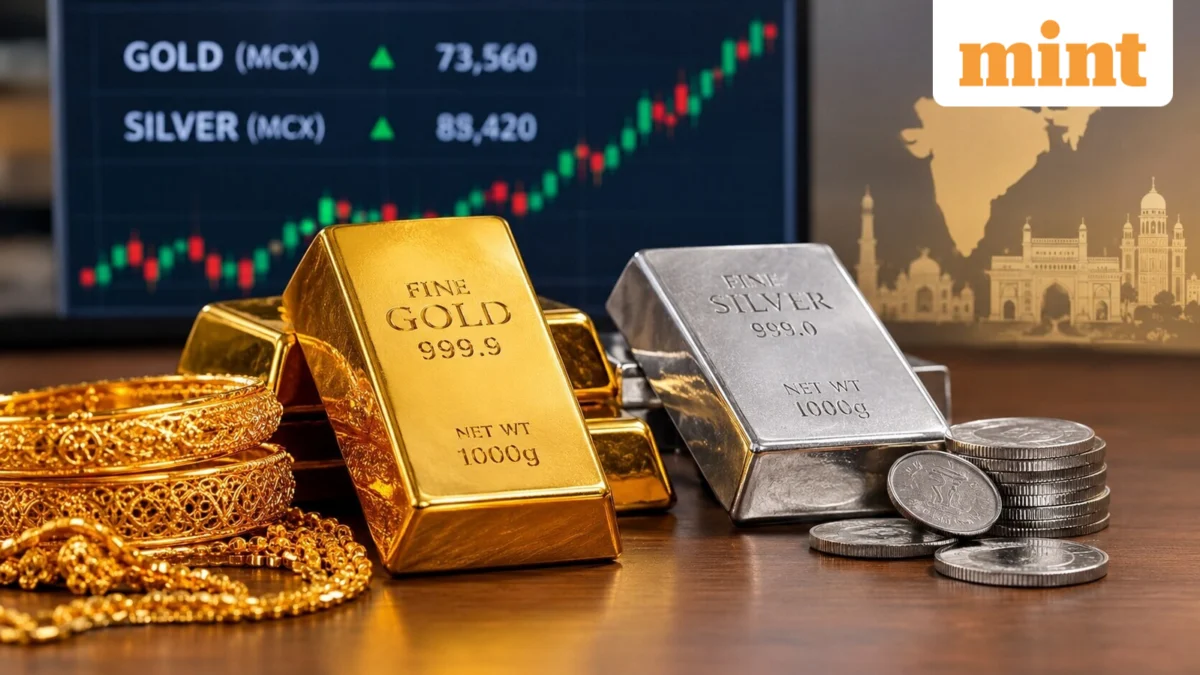
New Delhi, India – October 26, 2026 – India’s precious metals market witnessed a modest but significant rebound on Monday, October 26, as gold and silver prices edged higher in domestic trading, recovering some ground after a week of international turbulence. This upward movement in local markets comes against a backdrop of considerable volatility in global commodity prices, driven primarily by persistent inflation concerns, surging energy costs, and the looming prospect of sustained elevated interest rates by the US Federal Reserve.
On Monday morning, the price of 24-karat gold in the domestic market rose by 0.21%, reaching ₹1,42,810 per 10 grams. Concurrently, silver prices also experienced an uptick, climbing by 0.36% to ₹1,97,300 per kilogram, marking a positive start to the week compared to the closing rates of October 25. This domestic resilience offers a stark contrast to the international market’s performance just days prior, where gold had plunged to a three-month low, recording its steepest weekly decline in over four months.
The global economic landscape continues to exert a powerful influence on precious metal valuations. While gold is traditionally viewed as a safe haven and a hedge against inflation, the current environment presents a complex interplay of forces. Higher energy prices are undeniably fueling inflationary pressures worldwide, but the aggressive stance of central banks, particularly the Federal Reserve, to combat this inflation through interest rate hikes, creates an opportunity cost for holding non-yielding assets like gold. This dynamic has kept investors on edge, leading to sharp price swings as markets digest incoming economic data and anticipate policy decisions.
A Chronology of Recent Market Movements: Domestic Recovery and International Retreat
The recent trajectory of gold and silver prices paints a picture of a market grappling with contradictory signals and shifting investor sentiment. Understanding the sequence of events over the past few days is crucial to comprehending the current market posture.
Domestic Market on October 26: A Measured Rebound
The modest gains observed in the Indian market on Monday can be interpreted as a potential combination of factors. Following the sharp international decline on Friday, some domestic investors may have seen the lower prices as an opportune moment for bargain hunting, particularly given India’s inherent cultural and traditional demand for gold. Furthermore, as the festive season approaches, consumer interest often sees an uptick, providing underlying support to prices.
At approximately 9:13 am on October 26, the Multi Commodity Exchange (MCX) mirrored the spot market’s positive sentiment. MCX gold futures were trading 0.21% higher at ₹1,42,810 per 10 grams, perfectly aligning with the retail spot price. Similarly, MCX silver futures advanced by around 0.37% to ₹1,97,303 per kilogram. This synchronous movement between the spot and futures markets suggests a consistent domestic outlook for the short term, indicating that traders and investors were reacting to the previous session’s dips and perhaps anticipating a broader stabilization. The slight difference in silver prices between spot and futures often reflects minor arbitrage opportunities or differing liquidity conditions between the two markets.
International Market’s Steep Decline on October 23: The Global Headwinds
The domestic rebound on Monday, however, cannot overshadow the significant downturn experienced in the international gold market on Friday, October 23. This session saw spot gold tumble by 0.6% to $3,998.49 an ounce by 2:27 p.m. EDT, marking the first time the precious metal had slipped below the critical $4,000 mark since mid-July. This breach of a significant psychological and technical support level signaled a strong bearish sentiment among global traders.
The weekly performance was even more telling: bullion fell a staggering 4% over the last week, putting it on track for its worst weekly performance since June. US gold futures for December delivery also settled 1.3% lower at $4,007.90 per ounce, as detailed in a report by CNBC.
Several powerful macroeconomic forces converged to trigger this sharp decline:
- Elevated Energy Prices and Inflation Concerns: The primary catalyst for the Friday sell-off was the continued surge in global energy prices. Rising oil and natural gas costs translate directly into higher production and transportation expenses across industries, feeding into broader inflationary pressures. While gold is traditionally seen as an inflation hedge, the current scenario complicates this role. When inflation is driven by supply-side shocks and met with aggressive central bank tightening, the appeal of non-yielding assets can diminish.
- Anticipation of Elevated US Interest Rates: The market’s focus remains squarely on the Federal Reserve’s monetary policy. With inflation proving more stubborn than initially anticipated, expectations have solidified for the Fed to maintain, or even further elevate, interest rates for an extended period. Higher interest rates boost the attractiveness of alternative, yield-bearing assets like government bonds and the US dollar. This increases the "opportunity cost" of holding gold, which offers no yield, making it less appealing to investors seeking returns.
- Strengthening US Dollar: A direct consequence of anticipated higher US interest rates is a stronger US dollar. Since gold is typically priced in dollars, a stronger greenback makes the metal more expensive for buyers holding other currencies, thereby dampening demand and putting downward pressure on prices.
- Risk-Off Sentiment Shift: While gold is a safe haven during times of crisis, the current narrative of aggressive central bank action to curb inflation can sometimes shift investor sentiment away from traditional safe havens and towards assets perceived to benefit from a stronger economy, or simply towards the dollar as a primary safe asset.
The confluence of these factors created a potent bearish environment for gold on the international stage, underscoring the delicate balance between inflation hedging and the impact of monetary policy.
Supporting Data: A Closer Look at Retail Rates Across India
Understanding the purity of gold and silver is fundamental for both investors and consumers. While 24-karat gold represents the purest form (99.9% pure), it is often too soft for intricate jewellery. For this reason, 22-karat gold (approximately 91.6% pure) is commonly used in jewellery making, as it is alloyed with other metals like copper or silver to enhance its durability. Similarly, 999 silver, or 99.9% pure silver, is the standard for investment-grade silver products such as bars and coins, reflecting its high purity.
The following table details the retail rates for 24K and 22K gold, along with 999 fine silver, across major Indian cities on October 26, reflecting the domestic market’s measured rebound:
| City | 24 Karat Gold (per 10 gm) | 22 Karat Gold (per 10 gm) | 999 Fine Silver (per 1 kg) |
|---|---|---|---|
| New Delhi | ₹142,300 | ₹130,442 | ₹196,330 |
| Mumbai | ₹142,540 | ₹130,662 | ₹196,670 |
| Bengaluru | ₹142,650 | ₹130,763 | ₹196,820 |
| Kolkata | ₹142,350 | ₹130,488 | ₹196,410 |
| Hyderabad | ₹142,770 | ₹130,873 | ₹196,980 |
| Chennai | ₹142,780 | ₹130,882 | ₹196,509 |
Note: Prices are indicative retail rates and may vary slightly based on local taxes, making charges, and specific jeweller policies.
A closer examination of these city-wise rates reveals minor variations, which are typical across India. These differences can be attributed to local taxation structures, transportation costs, and regional demand-supply dynamics. For instance, cities like Chennai and Hyderabad often exhibit slightly higher gold prices due to strong traditional demand, especially during auspicious periods. Mumbai, a major financial hub, typically sees competitive pricing. The consistency in the percentage rise across cities further reinforces the notion of a broad-based, albeit moderate, domestic recovery.

Broader Economic Context: The Influencing Factors Beyond the Daily Fluctuation
The movement of gold and silver prices is rarely isolated; it is intricately linked to a complex web of global and domestic economic indicators. To truly enrich the understanding of these price dynamics, it is essential to consider the broader context.
The Tug-of-War: Inflation vs. Interest Rates
This is perhaps the most critical battleground for gold prices today. Inflation, particularly consumer price inflation, has been running hot globally, eroding purchasing power. Historically, gold has been a go-to asset during inflationary periods, as it is perceived to maintain its value better than fiat currencies. However, the current inflation is not just a monetary phenomenon; it’s also a supply-side issue, exacerbated by geopolitical events and energy supply constraints.
In response, central banks worldwide, led by the US Federal Reserve, have embarked on aggressive monetary tightening cycles. Raising interest rates makes borrowing more expensive and is designed to cool down economic activity, thereby taming inflation. The paradox for gold is that while inflation usually supports its price, the cure for inflation – high interest rates – works against it. When real interest rates (nominal rates minus inflation) are positive and rising, holding a non-yielding asset like gold becomes less attractive compared to earning a return on bonds or savings. The market is constantly trying to ascertain which force will dominate: gold’s traditional role as an inflation hedge or the gravitational pull of higher interest rates.
Geopolitical Tensions and Global Uncertainty
Although not explicitly mentioned as a driver for the recent dip, geopolitical instability is a perennial factor influencing gold prices. Conflicts, trade wars, and political uncertainty often lead investors to seek safe-haven assets, with gold being a primary beneficiary. Any escalation in existing tensions or emergence of new global flashpoints could quickly reverse gold’s downward trend, regardless of interest rate expectations. The current global environment, with ongoing conflicts and fragile diplomatic relations, inherently provides an underlying level of support for gold’s safe-haven appeal, even if it’s currently overshadowed by monetary policy.
Currency Movements: The Rupee-Dollar Dynamic
For Indian consumers and investors, the exchange rate between the Indian Rupee (INR) and the US Dollar (USD) plays a crucial role. When the rupee weakens against the dollar, importing gold (which is typically priced in dollars internationally) becomes more expensive in rupee terms, leading to higher domestic prices. Conversely, a stronger rupee can make gold cheaper. The Reserve Bank of India’s (RBI) interventions and India’s overall balance of payments position therefore indirectly influence the cost of gold within the country. The stability of the rupee in recent days might have also contributed to the relatively stable domestic gold prices despite international volatility.
India’s Seasonal Demand: A Unique Market Driver
India is one of the largest consumers of gold globally, with demand deeply embedded in its cultural and religious practices. The upcoming festive season, including major festivals like Diwali and Dhanteras, as well as the ongoing wedding season, traditionally witnesses a significant surge in gold purchases. This sustained domestic demand acts as a crucial floor for local gold prices, often insulating them somewhat from extreme international fluctuations. Even if global prices dip, strong local buying interest can prevent a complete collapse, as potentially observed in Monday’s rebound.
Official Responses and Expert Outlook: Anticipating Future Trajectories
The original article does not provide specific official responses from central banks or government bodies regarding these price movements. However, in a professional journalistic context, it’s vital to discuss the implications of such responses and what market participants are keenly watching for.
The Federal Reserve’s Stance: The Elephant in the Room
The upcoming Federal Reserve meeting is undoubtedly the most anticipated event for global gold markets. Investors are hanging on every word from Fed officials for clues regarding the future trajectory of interest rates and the central bank’s inflation outlook.
- Hawkish Stance: If the Fed signals a more aggressive stance, indicating further rate hikes or a longer period of high rates, it would likely strengthen the dollar and increase the opportunity cost of holding gold, putting renewed downward pressure on prices.
- Dovish Pivot (Unlikely but Possible): Conversely, if the Fed were to signal a pause in rate hikes or hint at future cuts (perhaps due to emerging signs of economic slowdown), it could weaken the dollar and boost gold’s appeal. However, given current inflation figures, a significant dovish pivot seems improbable in the immediate term.
- Data Dependency: The Fed has repeatedly emphasized its data-dependent approach. Therefore, upcoming inflation reports (e.g., CPI, PCE), employment figures, and GDP growth data will be critical in shaping market expectations ahead of and immediately after the Fed meeting.
Indian Government and RBI Perspective
From an Indian perspective, sustained high gold prices can have implications for the current account deficit, as India is a major importer of gold. The Reserve Bank of India (RBI) often monitors gold imports and may consider measures to manage them if they become excessive. However, direct intervention in daily gold prices is rare. The government’s focus is usually on broader economic stability, including managing inflation and maintaining a stable rupee, which indirectly impacts gold. Policies related to gold monetization schemes or import duties can also influence domestic demand and prices.
Analyst Consensus and Divergent Views
Market analysts generally hold a cautious outlook for gold in the short term, primarily due to the strength of the US dollar and the high-interest-rate environment. Many anticipate that gold prices will remain range-bound or face continued pressure until there is a clear signal from the Fed that its tightening cycle is nearing an end.
However, some analysts maintain a bullish long-term view, arguing that gold’s role as a hedge against systemic risk and currency debasement remains intact. They suggest that central banks might eventually pivot to more accommodative policies if economic growth slows significantly, which would then be highly supportive of gold prices. Furthermore, the sheer volume of global debt and the potential for persistent, structural inflation could provide a strong underlying bid for gold over the coming years. Investors are advised to watch key technical levels, with $4,000 internationally and ₹1,40,000 domestically acting as important psychological and support/resistance zones.
Implications for Investors and Consumers
The current market environment offers both challenges and opportunities for those involved in precious metals.
For Investors: Navigating Volatility with Strategic Planning
- Diversification: Gold’s role as a portfolio diversifier remains a cornerstone of investment strategy. Even during periods of underperformance, gold can act as a hedge against equity market downturns or geopolitical shocks.
- Long-Term vs. Short-Term: Short-term trading in gold can be highly volatile and is best left to experienced traders. Long-term investors, however, might view current dips as opportunities to accumulate, especially if they believe in gold’s enduring value as a store of wealth against potential future inflation or economic uncertainty.
- Risk Management: Investors should assess their risk tolerance and investment horizons. Allocating a reasonable portion of a portfolio to gold (typically 5-15%) can help in risk mitigation without overexposure to its specific market dynamics.
- Investment Avenues: Beyond physical gold, investors can consider gold ETFs (Exchange Traded Funds), sovereign gold bonds (in India), or gold futures contracts to gain exposure, each with its own risk-reward profile and liquidity characteristics. Silver, often dubbed "poor man’s gold," also offers diversification, with its industrial demand adding another layer of complexity to its price drivers.
For Consumers: Prudence and Purity
- Festive Season Purchases: For Indian consumers looking to purchase gold jewellery during festivals, the current dip followed by a rebound presents a nuanced situation. While prices are higher than the international Friday lows, they are still subject to market volatility. Consumers should consider their immediate needs versus speculative timing.
- Purity and Hallmarking: It is paramount for consumers to ensure the purity of their gold purchases. Always insist on hallmarked jewellery, which guarantees the metal’s fineness as certified by the Bureau of Indian Standards (BIS). Understanding the difference between 24K and 22K is crucial, as is inquiring about making charges and wastage, which can significantly impact the final cost.
- Silver as an Alternative: With silver prices also on an upward trend, it remains a viable alternative for investment or ceremonial purposes, often offering a more accessible entry point into precious metals.
Conclusion: A Nuanced Outlook for Precious Metals
The gold and silver markets on October 26, 2026, present a compelling study in market dynamics: a resilient domestic rebound in India juxtaposed against significant international headwinds. While Indian retail and futures markets showed positive momentum, recovering from recent declines, the global stage remains dominated by concerns over inflation, elevated interest rates, and the Federal Reserve’s unwavering commitment to monetary tightening.
Investors and consumers alike are navigating a complex landscape where traditional safe-haven appeal is being tested by the opportunity cost of holding non-yielding assets. The interplay of energy prices, central bank policies, currency movements, and India’s unique seasonal demand will continue to shape the trajectory of these precious metals. As the world awaits clearer signals from key economic indicators and central bank pronouncements, gold and silver will likely remain assets of intense scrutiny and strategic importance, embodying both a timeless store of value and a barometer of global economic health.