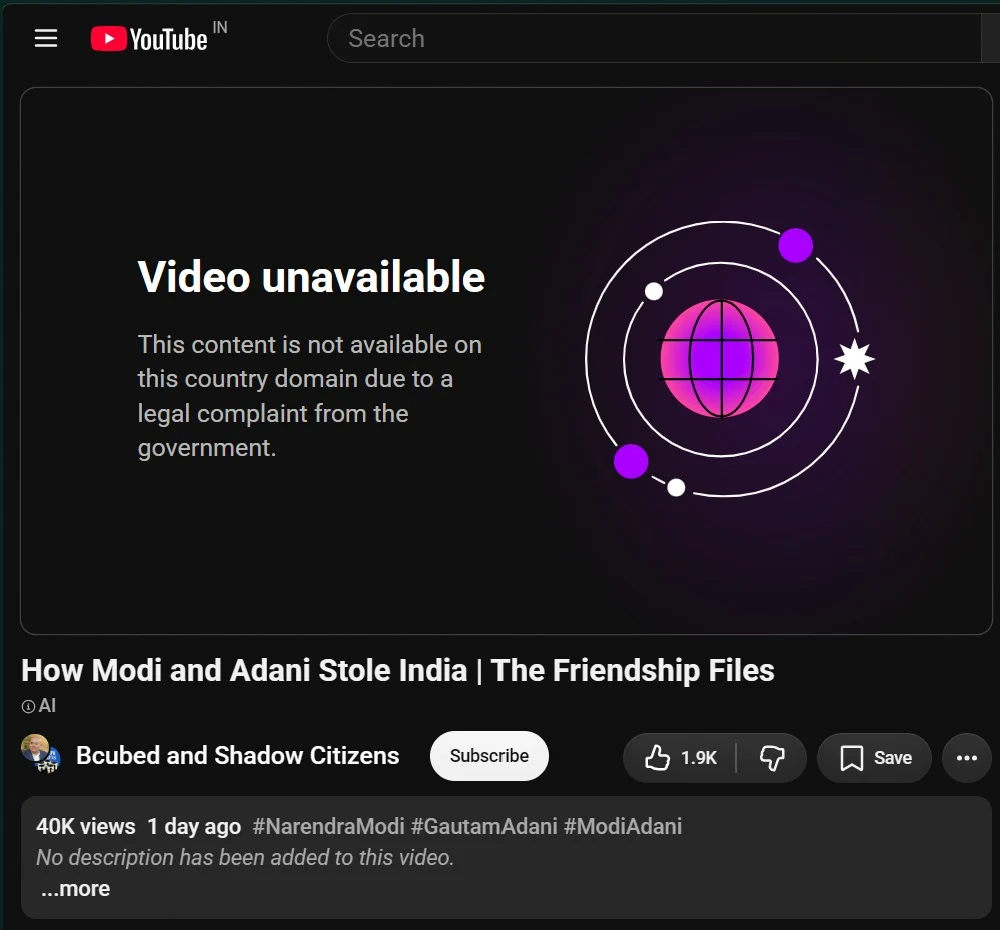
In a move that has ignited fresh debates regarding digital autonomy and the suppression of investigative commentary in India, YouTube has restricted access to a video essay titled “How Modi and Adani Stole India | The Friendship Files.” The documentary, produced by Hotmail co-founder and tech entrepreneur Sabeer Bhatia, was blocked within days of its October 9, 2026, release, following what the platform described as a formal legal complaint from an unnamed government entity.
While the video remains viewable to global audiences, the regional blockade highlights the deepening tension between digital platforms and Indian regulatory authorities. As the content remains accessible via Virtual Private Networks (VPNs) and mirror links, the incident serves as a bellwether for the increasingly constrained environment for political critique in the world’s largest democracy.
The Takedown: An Anatomy of Digital Suppression
The video, which garnered approximately 45,000 views on YouTube before the restriction was imposed, is a sharp critique of the alleged proximity between Prime Minister Narendra Modi and industrialist Gautam Adani. Following the “review” process mandated by its internal policies, YouTube issued a notice stating that the content was blocked in India due to a “legal complaint from a government entity.”
Notably, the notice was opaque. It failed to specify which government department initiated the request or the specific provisions of the Information Technology (IT) Act or other legal frameworks invoked to justify the removal. This lack of transparency has become a recurring theme in India’s digital governance, where “blocking orders” are often issued under the veil of confidentiality, leaving creators and citizens with limited avenues for recourse.
Despite the official platform takedown, the video has effectively gone viral through decentralized channels. Sabeer Bhatia, refusing to let the content disappear, reposted the video on his X (formerly Twitter) account, where it has surpassed 1.8 million views. Furthermore, the video has been mirrored across Google Drive and iCloud, while influential political figures, such as Member of Parliament Mahua Moitra, have actively shared the content, effectively circumventing the regional firewall.
A Pattern of Precedent: The Chronology of Censorship
The restriction of the Bhatia documentary is not an isolated event but rather the latest entry in a long, documented history of attempts to insulate the Adani Group and the Modi government from critical scrutiny.
2017: The EPW Controversy
The trend of silencing investigative journalism concerning the Adani Group arguably gained national attention in 2017. The Economic and Political Weekly (EPW), a prestigious academic journal, removed an article scrutinizing Adani Power after receiving a legal notice from the conglomerate. The fallout was significant: the publication’s editor, veteran journalist Paranjoy Guha Thakurta, resigned, sparking a nationwide protest over academic freedom and corporate interference in media.
2023: The Wikipedia Allegations
Concerns regarding the group’s digital footprint extended to the world’s largest encyclopedia. A 2023 report by The Signpost—a community-run publication for Wikipedia—alleged that individuals linked to the Adani Group were editing entries to provide a “non-neutral PR spin,” essentially scrubbing negative information and inflating the group’s public image.
2025: The MIB Takedown Order
In September 2025, the Ministry of Information and Broadcasting (MIB) escalated the pressure by ordering 12 prominent news publishers—including digital-first journalists like Ravish Kumar, Abhisar Sharma, and outlets like The Wire and Newslaundry—to remove content deemed “defamatory” toward the Adani Group. While a Delhi court eventually intervened and set aside the restraining order, the incident underscored the use of administrative muscle to stifle critical reporting.

2026: Criminalization and the IT Act
The year 2026 has been particularly difficult for independent media. In February, journalist Ravi Nair was sentenced to one year in prison in a criminal defamation case filed by Adani Enterprises. By August, reports surfaced that the Gujarat police were utilizing the IT Act to compel platforms like X to remove posts that combined political satire with environmental critique. One such instance involved the removal of a cartoon depicting the Adani Group’s mining interests in the “ecologically critical” Hasdeo Forest, illustrating how environmental journalism is frequently bundled into the category of “defamatory” or “malicious” speech.
Implications for Democracy and Digital Rights
The systemic removal of content critical of corporate-government alliances raises fundamental questions about the health of India’s democratic discourse.
1. The Chilling Effect
When journalists, entrepreneurs, and independent creators are consistently targeted through legal notices and criminal defamation suits, the immediate consequence is a “chilling effect.” Smaller publications and individual creators, lacking the legal resources of major media houses, may self-censor to avoid the financial and psychological toll of prolonged litigation.
2. The Weaponization of the IT Act
The reliance on the IT Act to block content suggests a shift in how the state manages online dissent. Critics argue that the government is increasingly using the law not to combat misinformation or threats to national security, but to manage political narratives. When legal provisions are invoked without public disclosure of the “reasoning” or the “entity” behind the request, the process lacks the accountability required in a constitutional democracy.
3. The Limits of Censorship
The resilience of the "Friendship Files" video—which continues to circulate despite the YouTube ban—suggests that in the digital age, traditional censorship methods are becoming less effective. As content migrates to decentralized platforms, private servers, and social media threads, the state’s ability to "erase" information is being countered by a tech-savvy public that views such bans as an invitation to engage further with the prohibited content (the Streisand Effect).
Official Responses and the Road Ahead
As of this writing, neither the Ministry of Information and Broadcasting nor representatives from the Adani Group have provided detailed public commentary on the specific legal grounds for the Bhatia video takedown. YouTube, for its part, remains tethered to its policy of compliance with local laws, often finding itself caught between the demands of sovereign governments and its commitment to global information accessibility.
For independent journalists like Aditi Agarwal and outlets tracking these developments, the focus remains on the judiciary. The Karnataka High Court, currently reviewing challenges to the Sahyog Portal and other government-mandated takedowns, remains the primary venue where the balance between national security regulations and the fundamental right to free speech will be negotiated.
The incident involving Sabeer Bhatia’s video is more than a dispute over a single documentary; it is a manifestation of a struggle for control over the digital public square. Whether the state continues to pursue an aggressive policy of content suppression, or whether the courts eventually impose stricter standards for transparency in takedown notices, will determine the trajectory of digital rights in India for years to come.
As the digital ecosystem continues to evolve, one thing remains clear: the attempt to control the narrative in an age of instant, decentralized sharing is becoming an increasingly arduous—and often counterproductive—endeavor for those in power.