
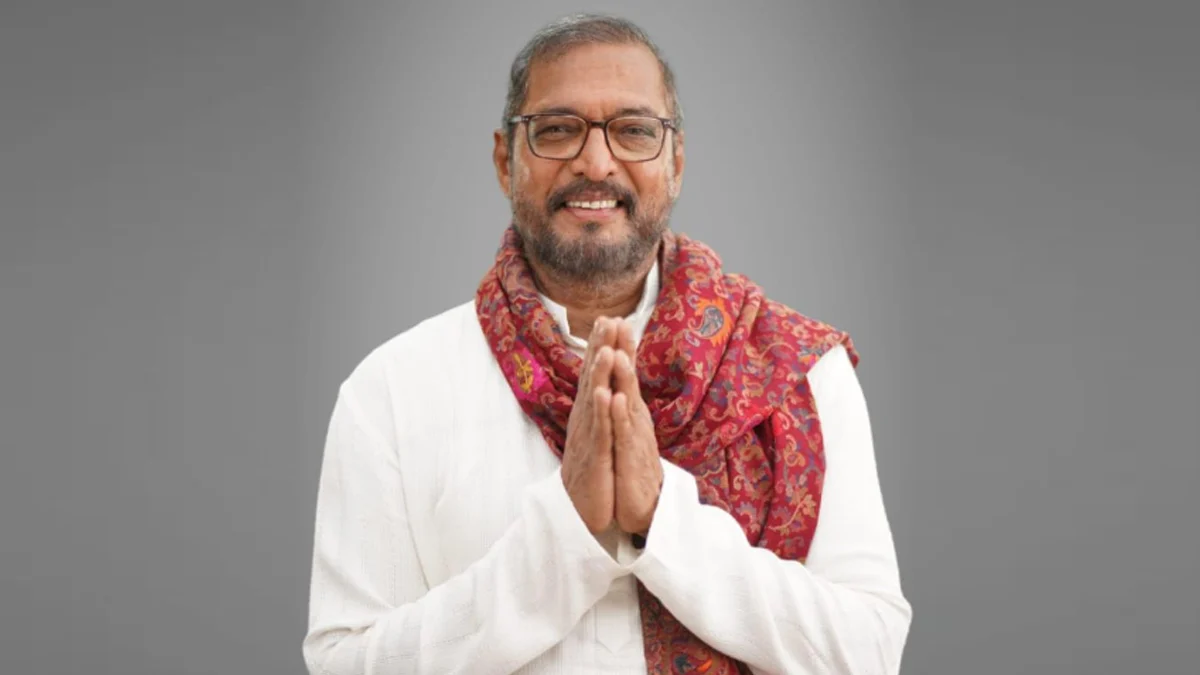
MUMBAI: The landscape of Indian cinema has lost one of its most formidable and distinctive architects. Nana Patekar, the mercurial actor, filmmaker, and humanitarian whose performances redefined the boundaries of raw intensity and emotional depth in Hindi and Marathi cinema, passed away on Thursday. He was 75.
Patekar, who had been residing in the serene coastal town of Dona Paula, Goa, suffered a severe cardiac arrest at his residence. According to reports from Manipal Hospital, he was discovered unconscious by his staff and rushed to the facility. Despite a valiant 45-minute resuscitation effort by the medical team, led by Dr. Shekhar Salkar, the veteran actor was declared dead at 5:20 a.m. Authorities have since registered a medico-legal case, and a standard post-mortem examination is underway to confirm the clinical specifics of his passing.
His death marks the end of an era—a career spanning over four decades that transitioned from the gritty realism of parallel cinema to the high-octane spectacle of commercial blockbusters, all while maintaining a personal life defined by disciplined eccentricity and quiet philanthropy.
A Life Forged in Resilience: The Early Years
Born Vishwanath Patekar on January 1, 1951, in the coastal village of Murud-Janjira, Maharashtra, Nana Patekar’s journey to stardom was anything but conventional. He was not a product of the industry’s gilded corridors; rather, he was a self-made artist who understood the struggles of the working class intimately.
His early life was defined by financial instability, which necessitated an early entry into the workforce. A student of the prestigious Sir J.J. Institute of Applied Art in Mumbai, Patekar’s initial creative outlets were far removed from the silver screen. He spent his formative years painting cinema posters and crafting intricate stage backdrops. This background in visual arts would later inform his acting style—he approached characters as a painter approaches a canvas, layering them with subtle, often jagged, strokes of realism.
His transition into theatre served as the crucible for his legendary dialogue delivery. On stage, Patekar learned to command silence as effectively as he commanded volume. This mastery of pace and inflection would eventually become his trademark, separating him from the melodic, rhythmic acting styles popular in the 1970s and 80s.
Chronology of a Cinematic Force
Patekar’s entry into film was gradual, characterized by his refusal to play the conventional romantic lead. He sought out the jagged edges of the human condition.
The Rise (1970s–1980s)
He made his mark with films like Gaman (1978) and Govind Nihalani’s Ardh Satya (1983). These roles established him as a pioneer of the "angry young man" persona, but with a psychological depth that felt more fragile and volatile than his contemporaries. His performance in Mira Nair’s Salaam Bombay! (1988) garnered international acclaim, showcasing his ability to inhabit the dark, claustrophobic realities of urban poverty.
The Watershed Moment: Parinda (1989)
If there is one role that defines the "Patekar phenomenon," it is that of Anna Seth in Vidhu Vinod Chopra’s Parinda. As the menacing, underworld kingpin with a pathological obsession with hygiene, Patekar created a villain that was terrifyingly unpredictable. He was awarded the National Film Award for Best Supporting Actor, cementing his status as a performer who could steal the screen with a mere flicker of his eyes.
The Multi-Hyphenate Era (1990s)
In 1991, Patekar moved behind the camera for Prahaar: The Final Attack. This was not merely a directorial debut; it was an obsession. Reflecting his lifelong fascination with the military, Patekar underwent grueling commando-style training to portray a Major in the Indian Army. The film remains a cult classic, celebrated for its unflinching look at military discipline.
He followed this with his tour-de-force performance in Krantiveer (1994), where his portrayal of the principled, volatile common man, Pratap Narayan Tilak, earned him the National Film Award for Best Actor. He achieved a rare trifecta of critical success shortly after, winning another National Film Award for Best Supporting Actor for his haunting performance as a deaf-mute father in Sanjay Leela Bhansali’s Khamoshi: The Musical (1996).
Commercial Versatility (2000s–Present)
While he never abandoned his intense dramatic roots, the latter half of his career saw him display a surprising aptitude for deadpan comedy and high-stakes ensemble thrillers. From the gritty police drama Ab Tak Chhappan to the comedic timing showcased in Welcome and the complex political maneuvering of Raajneeti, Patekar proved that his range was as broad as it was deep.
The Soldier Behind the Actor
Patekar’s relationship with the Indian Armed Forces was perhaps the most significant aspect of his public life. It was not a performative gesture; it was a deeply held conviction.
Following the physical and mental rigors of filming Prahaar, Patekar felt an irrepressible pull toward the border. During the 1999 Kargil War, he bypassed the safety of the rear lines to visit troops in the most volatile sectors of Dras, Kupwara, and Baramulla. He wasn’t there for a photo opportunity; he lived with the soldiers, shared their rations, and spent hours listening to their grievances and stories.
This dedication was formally recognized when he was conferred with the honorary rank of Lieutenant Colonel in the Territorial Army. For many in the forces, he was more than an actor—he was a comrade. This connection informed his public persona, giving him an air of stoic patriotism that resonated with millions of Indians.
Philanthropy and the Naam Foundation
Beyond the arc lights, Patekar was a man driven by the realities of rural India. Witnessing the catastrophic effects of the agrarian crisis and recurring droughts in his home state of Maharashtra, he co-founded the Naam Foundation alongside actor Makarand Anaspure.
The foundation became a lifeline for thousands of farming families, providing financial aid, infrastructure for water conservation, and agricultural support. Unlike many celebrity-led charities, Patekar was frequently seen on the ground, working alongside volunteers to desilt riverbeds and distribute aid. His philanthropic work was a testament to his belief that a public figure’s responsibility extends far beyond the entertainment industry.
Official Responses and Public Grief
The news of his passing has sent shockwaves through the corridors of power and the film industry.
The Prime Minister’s Office issued a statement praising Patekar’s "unparalleled contribution to the arts and his unwavering commitment to the welfare of our soldiers and farmers." Colleagues and contemporaries have taken to social media to express their grief. Veteran director Govind Nihalani remarked, "Nana was not just an actor; he was an elemental force. He operated on a frequency that most of us could only aspire to reach. His loss is irreparable."
Fans have gathered outside his Mumbai residence, with tributes pouring in from across the nation, reflecting the impact he had on generations of cinema-goers who grew up watching his fire-brand performances.
The Implication: A Cultural Void
The death of Nana Patekar leaves a vacuum in Indian cinema that is unlikely to be filled. In an age of manufactured celebrities and polished PR personas, Patekar remained a relic of an era where an actor’s integrity was measured by the intensity of their craft.
He was never comfortable with the "star" label. He lived a life of relative austerity, often stating that his work was his only true identity. His legacy is not just in the awards—the three National Film Awards, the Padma Shri—but in the way he taught audiences that a hero could be flawed, that a villain could be human, and that an artist’s duty is to the society that shapes them.
As India mourns, it reflects on a career that was defined by "raw force." Nana Patekar did not merely recite lines; he inhabited them. He did not merely play characters; he gave them a soul. The curtain has fallen on one of the most unmistakable voices in the history of the industry, but the echoes of his performances—the sharp, clipped dialogue, the intense gaze, and the profound empathy—will remain a permanent fixture in the annals of Indian culture.
The post-mortem results are expected in the coming days, but for the millions who admired him, the cause of death is clear: he gave his heart to his craft, his country, and his people, until there was nothing left to give.