Ten years ago, on October 3, 2016, a small team of eight writers launched a daring experiment in the Indian media landscape. With a simple, singular promise—one high-quality, long-form business story delivered every weekday—The Ken set out to prove that readers would pay for substance in an era of free, click-driven content. Today, that experiment has matured into a cornerstone of independent journalism, having evolved from a "fledgling startup" into a multifaceted media ecosystem. As the publication enters its second decade, it stands as a testament to the power of a subscription-first model built on trust, intellectual rigor, and an unwavering commitment to original reporting.
The Genesis: A Bet on Deep Journalism
In 2016, the digital media landscape was dominated by ad-supported models that prioritized volume and speed over depth. The Ken flipped this script. The foundational premise was a "bet and a seed": a bet that subscribers would value the time-intensive process of reporting, fact-checking, and editing (producing stories of 1,800–2,000 words), and a seed of a business model that relied entirely on upfront, annual payments.
At 8:03 a.m. on that October morning, the message sent to the team was clear: "It’s done. There’s no going back now." Two minutes later, at 8:05 a.m., the first subscriber signed up, paying Rs 2,750 for an annual subscription. This single act of purchase validated a model that would sustain the company for the next decade. By refusing to follow the industry standard of "rehashing" news from wire services or other outlets, The Ken established a brand identity rooted in original, "sharp" business storytelling.
Chronology: From Trunk to Canopy
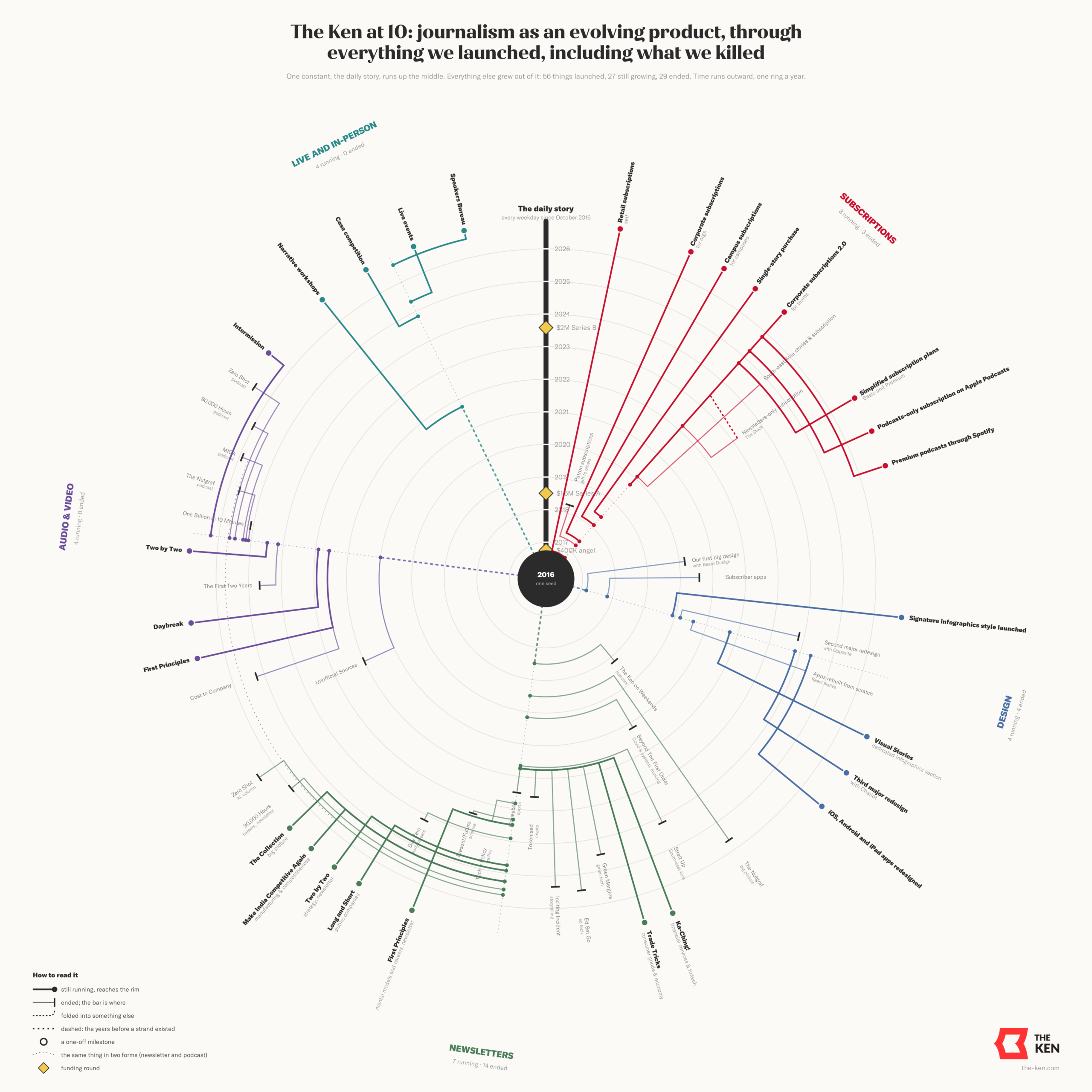
The evolution of The Ken can be visualized as the growth of a tree. The "trunk" of this metaphorical tree was the daily weekday story—the one constant that provided stability. This stability allowed the publication to branch out into new products and market experiments.

- The Early Years (2016–2018): Focus was primarily on establishing the editorial rhythm and building the subscriber base. The "trunk" was the sole focus, ensuring the promise of daily, distinctive journalism was kept.
- The Expansion Era (2019–2022): With the core product solidified, the team began testing "adjacencies." This period saw the launch of newsletters, podcasts, and the extraction of high-value infographics into dedicated browsing experiences.
- The Diversification Phase (2023–2026): The business matured to include institutional subscriptions, live events, corporate workshops, and case competitions. Not every experiment succeeded; of the approximately 56 initiatives launched over the decade, 29 were eventually discontinued. This failure rate is framed not as a setback, but as a necessary component of innovation.
Supporting Data: Innovation Through Subscriber Feedback
The success of The Ken is intrinsically linked to its "compelled innovation" cycle. The publication does not innovate in a vacuum; it does so in direct response to subscriber behavior and requests.
When subscribers asked for an audio format to consume journalism on the go, The Ken launched its podcast division. When users expressed interest in the vast repository of visual data created by the team, the company built a dedicated, flowing page for its signature infographics. Similarly, the evolution of subscription plans—from simple annual models to a mix of quarterly, monthly, and bundle-based options—reflects an ongoing, data-driven effort to balance simplicity, value, and convenience.
The business model has remained remarkably lean. Over the past ten years, The Ken has spent nothing on traditional advertising or customer acquisition, relying entirely on the quality of its journalism and the organic growth of its product suite to speak for itself.
The Second Decade: Navigating a Shifting Landscape
As The Ken looks toward 2036, the editorial team acknowledges that the challenges of the future are markedly different from those of 2016. With the emergence of Gen Z and Gen Alpha as key consumer segments, the definition of "business news" is undergoing a radical reassessment.

The publication notes that what seemed settled in 2016—the formats, styles, and lenses through which we view entrepreneurship and the future of work—is once again open to interpretation. The "next 10 rings" of the tree represent a period of high ambition. The goal is to provide a uniquely Indian lens to global business challenges, catering to a diverse cohort of subscribers ranging from Boomers to the digital-native youth.
Recruitment: Building for the Future
A critical component of The Ken’s future strategy is its aggressive push to hire talent that thrives on ambiguity and high-intensity work. The organization is currently seeking to fill ten key roles, with a specific focus on the editorial core.
The Search for Senior Editorial Talent
The newsroom is actively recruiting a Senior Staff Writer and a Desk Editor to be based in Bengaluru.
- The Senior Staff Writer: The ideal candidate will possess 10–12 years of experience, a history of deep-sector coverage, and the ability to connect the dots in a way that transcends traditional newspaper reporting. Beyond the craft of writing, this individual is expected to serve as a mentor to younger reporters and eventually transition into a leadership role as Chief of Bureau for Bengaluru.
- The Desk Editor: With 3–5 years of experience, the successful candidate must be a skeptic of "lazy conclusions." The role requires a rigorous approach to editing—questioning assumptions, challenging data, and, crucially, knowing when to cut 700 words to improve a story. In the age of AI, the publication emphasizes that editing is no longer about polishing prose, but about sharpening the intellectual edge of the reporting.
Implications: The Value of Independent Journalism
The journey of The Ken offers several profound implications for the media industry:

- Product-Led Journalism: By owning and controlling their tech stack, media companies can iterate faster and build deeper relationships with their readers.
- The Necessity of "High-RPE" Work: The publication’s insistence on "High-RPE" (Revenue Per Employee) and "high-rep" work suggests that the future of journalism lies in lean, highly skilled, and intellectually demanding teams rather than bloated, generalist newsrooms.
- The Power of Subscriptions: A subscription model does more than secure revenue; it creates a feedback loop that forces the publisher to remain relevant and accountable to the reader. If the product falters, the subscriber leaves—a harsh but necessary discipline.
Conclusion: A Call to Build
As The Ken enters its next decade, the message to potential employees and readers alike is one of active participation. The organization is not merely offering jobs; it is offering a platform to build, experiment, and own the work. For those interested in joining this mission, applications are open until October 31, 2026.
The history of The Ken is a narrative of proving that even in a noisy, cluttered digital world, there is a space for the patient, the original, and the sharp. The tree has been planted, and for the next ten years, the focus shifts to how its branches will continue to shape the future of the Indian business discourse. Whether through podcasts, newsletters, or long-form investigative journalism, the mandate remains the same: "Our work is our product."