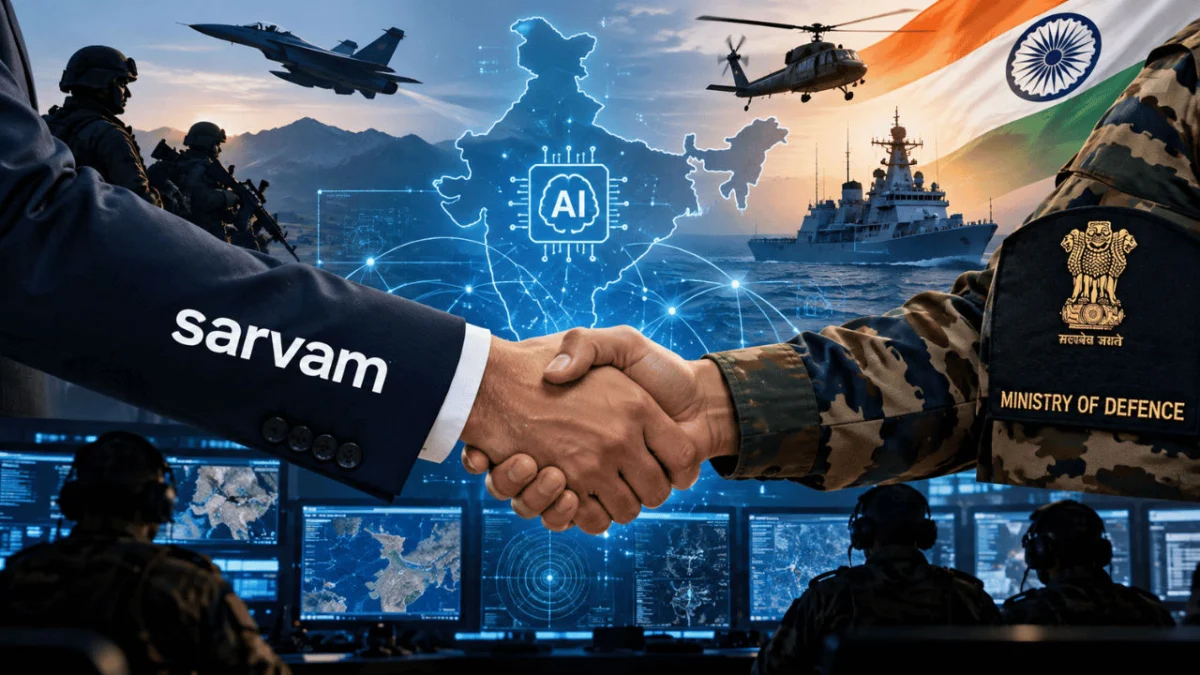
In a landmark move for India’s defense sector, the Ministry of Defence has entered into a five-year strategic partnership with homegrown artificial intelligence startup Sarvam AI. This collaboration, led by the Headquarters Integrated Defence Staff (HQ IDS), aims to integrate advanced AI capabilities across the Army, Navy, and Air Force, signaling a major shift toward indigenous technological sovereignty in modern warfare.
Introduction: A Paradigm Shift in National Security
The landscape of global conflict is undergoing a radical transformation, moving away from traditional kinetic warfare toward a domain dominated by data, algorithms, and rapid decision-making. Recognizing this shift, the Indian Ministry of Defence (MoD) has officially solidified a five-year Memorandum of Understanding (MoU) with Sarvam AI, one of India’s most prominent artificial intelligence startups.
This partnership is not merely a procurement contract; it represents a foundational shift in how the Indian Armed Forces intend to leverage technology. By tasking a domestic startup with the development of critical AI tools, the Indian government is doubling down on its "Atmanirbhar Bharat" (Self-Reliant India) initiative, ensuring that the "brain" of its future defense systems is built, hosted, and secured within national borders.
Main Facts: The Scope of the Agreement
The agreement was signed between Sarvam AI and the Headquarters Integrated Defence Staff (HQ IDS), the body responsible for ensuring synergy and integration between the three branches of the Indian military. While the financial specifics of the deal remain classified, the operational scope is vast and ambitious.
Key Objectives of the Partnership:
- Tri-Service Integration: The AI tools will be developed for the Indian Army, Indian Navy, and Indian Air Force, ensuring a unified approach to technological adoption.
- Operational Support: Development of AI applications to assist in real-time battlefield operations and logistics.
- Training and Simulation: Leveraging AI to create advanced training modules and situational simulations for personnel.
- Decision-Support Systems: Providing commanders with data-driven insights to enhance the speed and accuracy of decision-making in high-pressure environments.
- The "AI Fabric": A central pillar of the deal involves creating an "AI Fabric"—a digital connective tissue designed to link various sensors, weapon systems, and communication nodes across the Indian defense ecosystem.
Chronology: From Startup Success to Strategic Asset
To understand the significance of this deal, one must look at the rapid ascent of Sarvam AI. Founded by Vivek Raghavan and Pratyush Kumar—both of whom played pivotal roles in the AI4Bharat initiative at IIT Madras—Sarvam AI emerged with the goal of building "sovereign AI" tailored for the Indian context.
- December 2023: Sarvam AI makes headlines by raising $41 million in Series A funding led by Lightspeed, with participation from Peak XV Partners and Khosla Ventures. This remains one of the largest early-stage rounds for an Indian AI company.
- August 2024: The company launches "Sarvam 2B," a small language model optimized for Indian languages, followed by the announcement of "Sarvam 105B," a massive foundational model designed to handle complex reasoning.
- Late 2024: Recognizing the need for specialized applications, Sarvam establishes "Chanakya," a dedicated, firewalled division focused exclusively on national security and defense.
- Present Day: The signing of the five-year MoU with HQ IDS marks the formal entry of Sarvam’s technology into the core of India’s defense infrastructure.
Supporting Data: The Technical Foundation
The partnership will leverage Sarvam’s full-stack AI capabilities, specifically utilizing their foundational models and the specialized expertise of the Chanakya division.
The Role of "Chanakya"
The Chanakya division operates under strict security protocols, functioning as a "firewalled" entity. This ensures that the sensitive data generated by the military remains isolated from the startup’s commercial ventures. Chanakya is tasked with adapting Sarvam’s Large Language Models (LLMs) to the specific vernacular and technical jargon of the Indian military, ensuring that the AI understands the nuances of local operational environments.
The Sarvam 105B Model
At the heart of this technological push is the Sarvam 105B foundational model. With 105 billion parameters, this model is designed to process vast amounts of unstructured data. In a military context, this could mean:
- Data Fusion: Aggregating data from satellites, drones (UAVs), ground sensors, and intercepted communications to provide a "Common Operational Picture" (COP).
- Sensor-to-Shooter Loop: Reducing the time it takes to identify a target (sensor) and relay that information to a combat unit (shooter).
- Predictive Maintenance: Analyzing data from aircraft engines or naval vessels to predict failures before they occur, significantly increasing fleet availability.
Human Oversight and Ethics
A critical component of the MoU is the explicit requirement for "human oversight." In line with global ethical standards for AI in the military, the tools developed by Sarvam are intended to assist—not replace—human commanders. All operational decisions, especially those involving the use of force, will remain under the strict control of human officers.
Official Responses: Voices from the Frontline of Innovation
The leadership at Sarvam AI has expressed a deep sense of national duty regarding the partnership.
Pratyush Kumar, Co-founder of Sarvam AI, stated:
"Working with the three Services on the nation’s defense is an honor and a privilege. Sarvam exists to build AI in India, for India. We are grateful to HQ IDS for their trust in our vision and our technology. Our goal is to ensure that the Indian Armed Forces are equipped with the most advanced digital tools to protect our sovereignty."
Officials from the Ministry of Defence noted that this partnership is a testament to the growing maturity of the Indian startup ecosystem. By choosing a domestic partner over global tech giants, the MoD is prioritizing data security and strategic autonomy. "The integration of AI is no longer an option but a necessity for modern defense. Partnering with homegrown innovators like Sarvam ensures that our AI infrastructure is built on our terms, using our data, and serving our specific strategic interests," a senior official commented during the announcement.
Implications: What This Means for India and the World
The deal between Sarvam AI and the MoD carries profound implications for the future of warfare and India’s position on the global stage.

1. Strategic Autonomy in the Age of AI
By developing an indigenous "AI Fabric," India reduces its reliance on foreign software providers. In a conflict scenario, relying on foreign-coded AI carries the risk of "backdoors" or the sudden withdrawal of support. Sarvam’s tools will be deployed on sovereign infrastructure, ensuring that the Indian military maintains full control over its digital assets.
2. Algorithmic Warfare and Regional Balance
India’s neighbors, particularly China, have made massive investments in "Intelligentized Warfare." This partnership allows India to narrow the technological gap. AI-driven data fusion will be particularly useful in monitoring the long and difficult terrains of the Line of Actual Control (LAC) and the maritime expanses of the Indian Ocean Region (IOR).
3. Boosting the Defense-Tech Ecosystem
This five-year deal acts as a signal to other Indian startups. It proves that the Ministry of Defence is willing to trust young, innovative companies with mission-critical projects. This is likely to spur further investment in the Indian "Defense-Tech" sector, encouraging a new generation of engineers to build for national security.
4. Training and Language Capabilities
India’s military is diverse, with personnel from various linguistic backgrounds. Sarvam’s expertise in Indian languages (Indic AI) will be invaluable in developing training manuals and voice-activated interfaces that can be used by soldiers across the country, regardless of their primary language.
Conclusion: The Road Ahead
The next five years will be a period of intense development and testing. As Sarvam’s Chanakya division begins deploying tools within HQ IDS, the focus will be on "ruggedizing" AI for the battlefield. The challenges are significant—from ensuring AI works in "denied environments" with low connectivity to preventing adversarial attacks on the algorithms themselves.
However, the signing of this MoU marks a point of no return. India has officially entered the era of AI-augmented defense. By marrying the agility of a high-growth startup with the strategic depth of the Ministry of Defence, India is not just preparing for the wars of tomorrow—it is actively shaping the technology that will define them.
As the "AI Fabric" begins to weave together the Army, Navy, and Air Force, the world will be watching to see how an indigenous startup can transform one of the world’s largest standing militaries into a data-driven, technologically superior force.