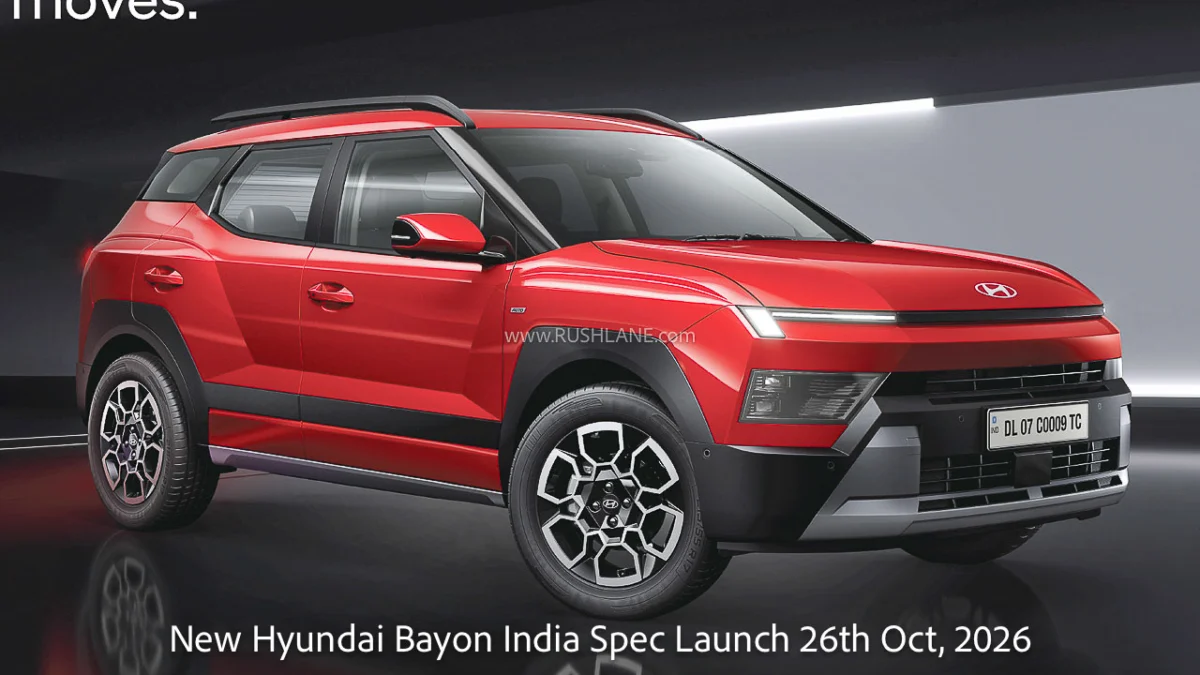
Hyundai Motor India Limited (HMIL) has officially pulled the covers off the highly anticipated India-spec Bayon, a vehicle the automaker is branding not merely as an SUV, but as an "Intelligent Utility Vehicle" (IUV). With its market debut set for October 26, 2026, the Bayon is positioned to bridge the gap between the compact Venue and the segment-leading Creta. By blending cutting-edge generative AI, advanced NVIDIA-backed connectivity, and a robust powertrain, Hyundai aims to redefine the expectations of the mid-size SUV segment in India.
Main Facts: A Technological Leap in Mid-Size Mobility
The India-spec Bayon arrives at a pivotal moment for Hyundai, which recently celebrated its highest-ever monthly sales of 77,916 units in September 2026. Measuring 4.2 meters in length, the Bayon adopts a bold, futuristic design language. Its exterior is characterized by an upright stance, aggressive sculpting, and a signature H-Edge LED lighting profile that gives it a distinct road presence.

Under the hood, the vehicle is powered by a proven 1.5-litre MPi four-cylinder petrol engine—the same reliable powerhouse found in the Creta—delivering 115 PS and 144 Nm of torque. Customers can choose between a six-speed manual transmission or an Intelligent Variable Transmission (IVT). Beyond mechanical specs, the Bayon’s primary differentiator is its "intelligence-first" approach. The cabin is dominated by a curved panoramic panel housing dual 12.3-inch displays, serving as the nerve center for the vehicle’s infotainment and instrument cluster.
Prospective buyers can now secure their unit with a booking amount of Rs 11,000, available through both official dealership networks and Hyundai’s online portal.

Chronology of Development and Arrival
The journey toward the Bayon’s Indian debut has been marked by strategic anticipation. While the global version of the Bayon has been present in international markets, the India-spec iteration required significant localization to meet the unique preferences and safety mandates of the local demographic.
- Mid-2026: Initial reports emerge regarding a new SUV project aimed at the 4.2m to 4.5m segment, filling the void between the sub-compact Venue and the mid-size Creta.
- September 2026: Hyundai India hits a historic sales milestone, providing the company with strong market momentum and the fiscal confidence to launch a new premium offering.
- Early October 2026: Teasers are released, confirming the "Intelligent Utility Vehicle" moniker and hinting at advanced AI integration.
- October 2026 (Pre-launch): Official images are unveiled, detailing the exterior design and the tech-heavy interior layout.
- October 26, 2026: The official launch event, where pricing, variant-wise feature distribution, and specific delivery schedules will be finalized.
Supporting Data: Engineering and Connectivity Specs
The Bayon is built on Hyundai’s Global K Enhanced Platform, which has been rigorously stress-tested to align with the five-star Bharat NCAP safety ratings. The vehicle’s dimensions and chassis architecture are optimized for both urban maneuverability and highway stability.

The Power of Generative AI
Perhaps the most ambitious feature of the new Bayon is its integration of generative AI. By partnering with Perplexity and utilizing SoundHound’s advanced voice technology, Hyundai has created a voice assistant that transcends standard command-response loops. Users can engage in natural, conversational exchanges to request complex information, such as multi-stop travel itineraries, local restaurant recommendations, or real-time sports updates.
Connectivity and Software
The vehicle’s "Connected Car Navigation Cockpit" (ccNC) is powered by NVIDIA’s high-performance hardware, ensuring that the interface remains fluid even with split-screen multitasking. Key technical specifications include:

- Over-the-Air (OTA) Updates: Capability to update 19 distinct vehicle controllers, future-proofing the car against software obsolescence.
- Bluelink Integration: Over 70 connected features including remote engine start/stop, vehicle health diagnostics, and smartwatch integration.
- Multilingual Support: The system supports English, Hindi, Hinglish, Tamil, Bengali, and Telugu, with an additional 10 regional language interfaces available on the digital displays.
- Offline Functionality: 500+ embedded voice commands remain fully functional even when the vehicle is in areas with poor cellular reception.
Official Responses: "Intelligence That Moves"
During the unveiling, Mr. Tarun Garg, Managing Director and CEO of Hyundai Motor India Limited, emphasized that the Bayon is a response to the evolving needs of the modern Indian consumer.
"With the Hyundai Bayon, we are introducing an Intelligent Utility Vehicle that places technology and convenience at the heart of the customer experience," said Mr. Garg. "Guided by the philosophy of ‘Intelligence That Moves,’ the Bayon seamlessly integrates artificial intelligence, advanced connectivity, and software-driven innovation. This is not just a car; it is a mobile extension of the user’s digital lifestyle. By leveraging NVIDIA-accelerated architecture and our first-ever generative AI assistant, we are setting a new benchmark for what Indian customers should expect from their vehicles."

The emphasis on "evolving mobility" suggests that Hyundai intends to use the Bayon as a testbed for software-defined vehicle features in India, with the expectation that future OTA updates will unlock new capabilities long after the vehicle has been purchased.
Implications for the Indian SUV Market
The introduction of the Bayon is set to send ripples through the highly competitive mid-size SUV segment. By targeting the 4.2-meter segment, Hyundai is creating a "Goldilocks" zone—offering more space and prestige than the Venue, but at a more accessible price point than the flagship Creta.

Impact on Competition
The current market is saturated with strong contenders like the Kia Seltos, Toyota Hyryder, and the Mahindra Thar Roxx. The Bayon, however, enters with a distinct advantage: the "tech-first" value proposition. For a younger, tech-savvy demographic, the inclusion of generative AI and NVIDIA-powered cockpits may prove more compelling than raw engine displacement or off-road capability.
Shifts in Customer Expectations
Hyundai’s strategy highlights a broader trend in the automotive industry: the shift from "mechanical excellence" to "digital experience." As cars become increasingly software-dependent, the ability to provide seamless OTA updates and human-like AI assistance will become a primary factor in brand loyalty. If the Bayon proves successful, it will likely force competitors to accelerate their own digital transformation timelines.

Sustainability and Manufacturing
Built on the Global K Enhanced Platform, the Bayon also aligns with India’s push for higher safety standards. By aiming for a five-star Bharat NCAP rating, Hyundai is addressing a growing consumer demand for safety, moving beyond cosmetic features to prioritize structural integrity.
Conclusion: A New Era for Hyundai in India
As the clock ticks down to the October 26, 2026 launch, all eyes are on the pricing strategy. If Hyundai manages to position the Bayon aggressively, it could become the defining vehicle for the Indian festive season. The Bayon represents more than a new model; it is a declaration of intent. Hyundai is signaling that it intends to lead not just in sales volume, but in the technological sophistication of the cars it delivers to the Indian public.

For the prospective buyer, the choice is no longer just about horsepower and fuel efficiency; it is about how well the vehicle integrates into their connected life. With the Bayon, Hyundai seems confident that it has provided the perfect answer to the question: "How smart can a car truly be?" As the festive season approaches, the Bayon is poised to be one of the most significant automotive launches of the decade, potentially resetting the bar for the entire Indian passenger vehicle industry.