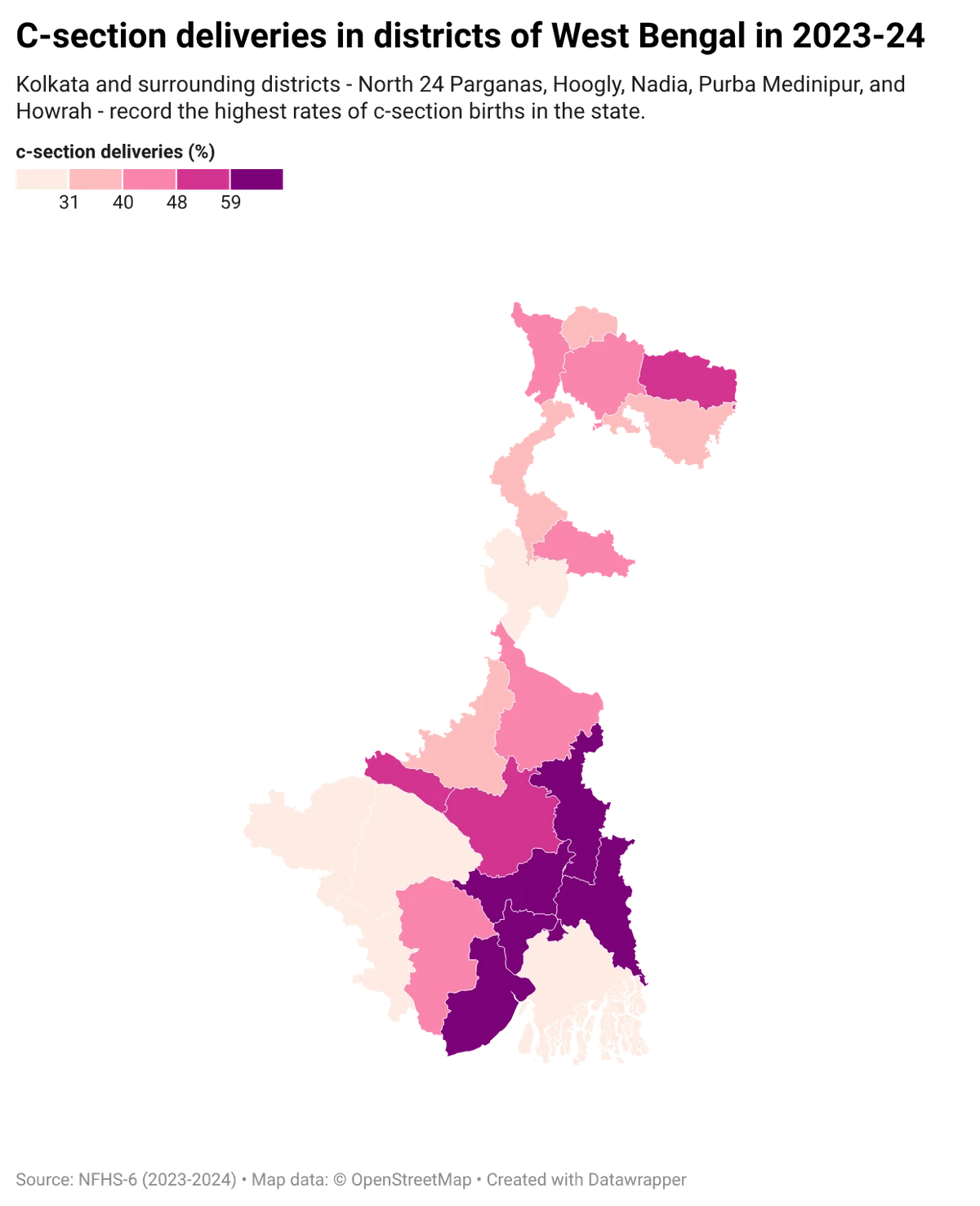
In the corridors of West Bengal’s healthcare system, a quiet but profound transformation has taken place over the last decade—one that has fundamentally altered the way babies are born in the state. Once tracking closely with national averages, West Bengal has undergone a dramatic shift toward surgical deliveries, a trend that public health experts are now viewing with deep concern. Data from the latest National Family Health Survey (NFHS-6, 2023-24) reveals that a staggering 44.5% of all births in the state are now conducted via Caesarean section (C-section), nearly double the national average of 27.2%.
This shift is not merely a statistical anomaly; it represents a significant departure from standard obstetric care, raising urgent questions about medical necessity, the role of financial incentives in private healthcare, and the long-term health outcomes for mothers and infants across the state.

A Historical Chronology: From Stability to Surge
To understand the current crisis, one must look back to the early 2000s, when West Bengal’s maternal health indicators were largely aligned with the rest of India. In 2005-06, during the NFHS-3 cycle, the state’s C-section rate stood at 10.2%, barely above the national average of 8.5%. For years, the state maintained a stable trajectory, with surgical interventions reserved primarily for high-risk pregnancies where medical necessity was clear.
The inflection point arrived shortly after 2015. On September 29 of that year, the West Bengal Health Department, headquartered at Swasthya Bhawan, issued a seminal memo to all medical college principals and Chief Medical Officers of Health (CMOH). Driven by warnings from the Union Health Ministry regarding the unnecessary proliferation of surgical births, the memo formally advised district authorities to implement "prescription audits" for C-sections in both private and government facilities. The department explicitly invoked World Health Organization (WHO) guidelines, which warn that population-level C-section rates exceeding 10% do not correlate with improved maternal or newborn mortality outcomes.

However, the directive appears to have had little effect on the state’s trajectory. Instead of stabilizing, the rate of C-sections accelerated. By the time of the NFHS-4 (2015-16) survey, the rate had jumped to 23.8%. By the NFHS-5 (2019-21) survey, it reached 32.6%. The most recent data from NFHS-6 confirms that the surge is intensifying, with an 11.9 percentage point increase occurring in just four to five years—a much steeper climb than the decade prior.
Supporting Data: The Private Sector’s Dominance
The most striking aspect of the current data is the vast disparity between private and public healthcare facilities. In West Bengal’s private sector, the situation has reached an extreme: 87.7% of all births are now delivered via C-section. To put this in perspective, nearly nine out of every ten women who choose a private hospital for childbirth undergo major abdominal surgery. This figure dwarfs the national private-sector average of 54.1%.

While the public sector reports lower rates, it is not immune to the trend. Government facilities in the state saw their C-section rates climb from 18.8% in 2015-16 to 28.8% in the latest survey. The situation is particularly acute in urban hubs; in Kolkata and North 24 Parganas, the prevalence is a staggering 67.5%, meaning two out of every three births are surgical.
The data also highlights a migration of patients from public to private care. Between the last two surveys, the share of births occurring in private facilities rose from 19% to 29%. This transition is a primary driver of the overall state-level increase, accounting for roughly 6.6 percentage points of the 11.9-point rise, while the remaining increase is attributed to higher surgical rates within the public sector itself.

The Geography of Intervention
The geographic distribution of these rates forms a distinct "belt" of high-intervention childbirths. A contiguous zone encompassing Kolkata, North 24 Parganas, Hooghly, Nadia, Purba Medinipur, and Howrah reports rates ranging from 58.5% to 67.5%.
Interestingly, urbanization does not fully explain this phenomenon. Purba Medinipur, a largely coastal and rural district, exhibits higher surgical rates than the heavily industrialized district of Paschim Bardhaman. Conversely, the western districts of Purulia and Jhargram report the lowest rates in the state—21.6% and 27.4%, respectively. While these lower numbers might appear positive at first glance, researchers warn that they could mask a different problem: a lack of access to emergency surgical care in remote, underserved areas. In these regions, the challenge is not preventing unnecessary surgery, but ensuring that when a genuine medical emergency arises, the infrastructure exists to perform a life-saving procedure.

The Catalyst: Why the Rates Are Climbing
Experts point to a "perfect storm" of factors fueling this rise. The most prominent is the role of health insurance. The expansion of the Swasthya Sathi scheme, which became universal in late 2020, covers up to ₹5 lakh per family annually. While the scheme was designed to increase access to healthcare, the influx of insurance-backed patients into private hospitals has created a financial environment where surgical deliveries—which are generally more expensive and lucrative for institutions—are prioritized over standard vaginal births.
Furthermore, there is a "cycle of surgery" at play. A woman who undergoes a C-section for her first birth is significantly more likely to require one for subsequent pregnancies, as many district-level hospitals in India lack the specialized staff and protocols required to safely manage a "vaginal birth after Caesarean" (VBAC).

Finally, changing maternal demographics are playing a role. The prevalence of obesity and higher levels of education—both of which have increased among women of childbearing age in West Bengal—are statistically linked to higher odds of surgical delivery, as medical practitioners often opt for the lower-risk, shorter-duration C-section in cases involving gestational complications or maternal preference.
Implications and the Need for Reform
The implications of this trend are profound. A C-section is major abdominal surgery; it carries inherent risks, including infection, hemorrhage, and longer recovery times for the mother. It also impacts future reproductive health, as the uterine scar can lead to complications in subsequent pregnancies. When performed without medical indication, the procedure subjects women and infants to unnecessary risks and places an unsustainable financial burden on the state’s health insurance infrastructure.

The path forward, according to public health researchers, requires a return to the transparency promised in the 2015 memo. The following steps are critical:
- Mandatory Audits: The state must initiate and publish periodic, facility-level audits of surgical births. Utilizing the "Robson Classification"—a system that categorizes births into ten groups based on clinical characteristics—would allow authorities to compare hospitals fairly and identify where surgery is being performed on low-risk patients.
- Insurance Oversight: Swasthya Sathi claims records must be scrutinized to correlate surgical interventions with medically indicated codes. If a private hospital shows a statistically abnormal rate of C-sections compared to its peers, it must be held accountable.
- Strengthening Labor Wards: To reduce the dependence on C-sections, the government must invest in labor wards that are equipped to manage normal, physiological births. Providing the necessary support for women to attempt vaginal births safely is the only way to break the current cycle.
- Clinical Protocols: The state must standardize protocols for when a C-section is truly necessary, ensuring that obstetricians are guided by clinical urgency rather than convenience or revenue.
As West Bengal stands at a crossroads, the message from the data is clear: the current trajectory is not sustainable. While the ability to perform a Caesarean section remains a hallmark of modern, life-saving medicine, its overuse is a failure of public health management. Ensuring that every woman receives the care she needs—and only the care she needs—must become the central pillar of the state’s maternal health strategy. The goal for the coming years should not be the proliferation of surgical births, but the restoration of safe, evidence-based, and patient-centered maternity care.