The Maruti Suzuki WagonR, often affectionately dubbed the “Tall Boy” of the Indian automotive landscape, has remained a fixture of the country’s roads since its debut in 1999. Over the past 26 years, it has served as the quintessential family car, offering a reliable, pragmatic, and budget-friendly solution for millions. However, as the automotive world pivots toward a cleaner, electrified future, internal combustion engine (ICE) vehicles—even the most reliable ones—face an uncertain horizon. While Maruti Suzuki continues to dominate the market with petrol and CNG variants, an official electric production model remains elusive.
In the absence of a factory-produced electric WagonR, a burgeoning subculture of aftermarket engineers and garage enthusiasts has begun to take matters into their own hands. A recent project by Sriaan Electric Vehicle has brought this trend into the spotlight, successfully converting a 17-year-old 2009 petrol-powered WagonR into a fully functional electric vehicle (EV) for a modest investment of approximately ₹2.25 lakh. This feat raises significant questions about sustainability, circular economy practices, and the role of Original Equipment Manufacturers (OEMs) in the transition to green mobility.
Chronology of a Transformation: From Petrol to Electric
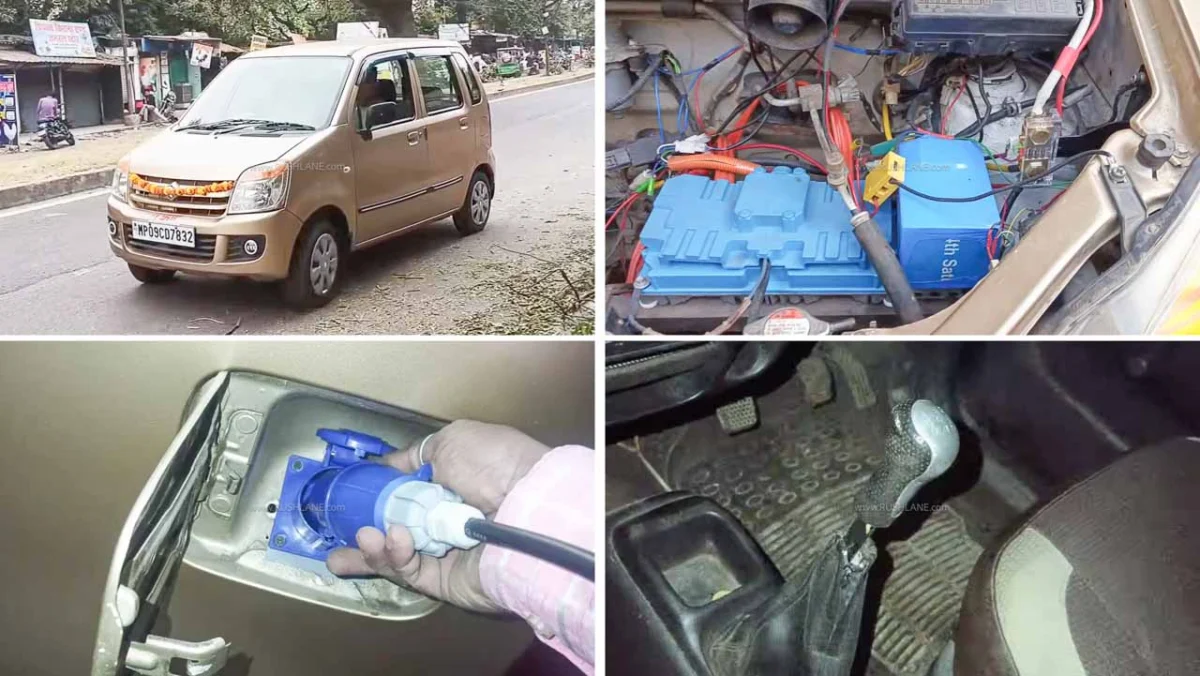
The conversion process documented by the workshop is a testament to both mechanical ingenuity and the adaptability of legacy platforms. The subject vehicle, a 2009 Maruti WagonR sourced from Madhya Pradesh, had reached the end of its typical operational lifecycle in the eyes of many. Instead of being relegated to a scrapyard, the car underwent a rigorous “electrification surgery.”

The Mechanical Overhaul
The first phase involved the complete removal of the internal combustion engine. This was not merely an engine swap; it required the extraction of the entire suite of auxiliary components, including the fuel tank, exhaust system, radiator, and the complex plumbing of an ICE vehicle.
Intriguingly, the engineers chose to retain the original transmission. In modern EVs designed by OEMs, a single-speed transmission is standard. However, the Sriaan EV team opted to keep the stock flywheel, clutch, and gearbox. The electric motor was coupled directly to the existing gearbox, allowing the driver to shift through the conventional manual ratios. This setup, while unorthodox compared to modern EV design, offers a unique driving experience and simplifies the mechanical integration by utilizing the car’s existing drive shafts and differential.
Powering the Cabin
One of the most complex challenges in an EV conversion is managing auxiliary systems. In an ICE car, the alternator powers the air conditioning and electricals. In this converted WagonR, the team implemented a clever workaround: a dedicated 1kW motor, sourced from an electric rickshaw, was installed to drive the AC compressor. This ensures that the cabin remains cool without taxing the primary traction battery during idling or low-speed maneuvers.

Electronics and Integration
The vehicle’s "brain" is a sophisticated controller that manages the flow of energy. To monitor the health of the system, a smart display was integrated into the dashboard, providing the driver with real-time feedback on battery state-of-charge (SoC), motor temperature, and power consumption. The controller was programmed to offer Neutral, Drive, and Reverse modes, complementing the existing mechanical reverse gear found in the manual transmission.
The charging architecture is equally pragmatic. Eschewing the complex and costly CCS2 fast-charging infrastructure, the team opted for an industrial 16A port concealed within the original fuel filler cap. This allows the owner to plug the vehicle into standard high-power domestic sockets, emphasizing the "DIY-accessible" nature of the build.
Supporting Data: Performance and Cost-Efficiency
The conversion of the 2009 WagonR provides a fascinating case study in the economics of retrofitting. With a total conversion cost of ₹2.25 lakh, the project stands in stark contrast to the price of a new electric vehicle, which can cost anywhere from ₹10 lakh to ₹20 lakh.

Performance Benchmarks
- Top Speed: The converted WagonR hits a respectable 75 km/h, which is more than sufficient for urban commuting—the primary use case for such a vehicle.
- Range: On a single full charge, the vehicle achieves a range of approximately 100–110 kilometers. While this may not be suitable for highway intercity travel, it covers the daily requirements of the average office commuter or grocery shopper.
- Sustainability Metric: By repurposing an existing chassis, the project effectively saves a vehicle from the carbon-intensive process of scrapping and recycling, and avoids the environmental toll of manufacturing a brand-new car from scratch.
The Industry Stance: Should OEMs Offer Conversion Kits?
The success of such conversions highlights a massive gap in the automotive market. While manufacturers like Tata Motors, Mahindra, and even Maruti Suzuki themselves are heavily invested in developing all-new electric platforms, there is a distinct lack of support for the millions of perfectly functional ICE vehicles currently on the road.
The Argument for Manufacturer-Backed Kits
If an OEM were to develop a standardized, safety-certified, and RTO-approved conversion kit, it could revolutionize the Indian automotive sector. Currently, aftermarket conversions exist in a legal and technical gray area. Safety standards, battery fire protection, and insurance coverage remain significant hurdles for DIY owners. An OEM-backed kit would ensure:
- Safety Certification: Rigorous testing of high-voltage (HV) wiring and battery containment.
- Standardized Parts: Using off-the-shelf, mass-produced components would likely bring the cost of conversion down even further.
- Regulatory Compliance: Factory-sanctioned kits could be easily registered and approved by the Ministry of Road Transport and Highways (MoRTH), encouraging widespread adoption.
Official Responses and Government Policy
To date, the government has focused primarily on incentivizing the purchase of new EVs through subsidies like FAME-II (Faster Adoption and Manufacturing of Hybrid and Electric Vehicles). While the government has expressed interest in circular economy principles, there has been limited formal policy support for retrofitting. The prevailing sentiment among major automakers is that existing legacy platforms are not optimized for the weight distribution or thermal management required by battery packs. However, as the push for “Net Zero” emissions intensifies, the narrative may shift toward supporting the electrification of the existing fleet.

Implications for the Future of Mobility
The 17-year-old WagonR, now humming quietly with an electric motor, is more than just a hobby project; it is a symbol of a potential shift in consumer behavior. The “Right to Repair” movement and the push for sustainable consumption suggest that consumers are becoming increasingly wary of the “planned obsolescence” of modern vehicles.
Environmental Impact
Manufacturing a new car consumes an enormous amount of raw materials, particularly for the production of the lithium-ion batteries. By extending the life of a car like the WagonR, we minimize the "embodied carbon" of the vehicle. If a conversion kit could add 10 years of life to a 15-year-old car, the cumulative reduction in waste and resource depletion would be astronomical.
Challenges to Widespread Adoption
Despite the benefits, challenges remain. The primary barrier is the regulatory framework. Currently, getting an "EV conversion" approved for road use in India is a bureaucratic ordeal. Furthermore, the lack of standardized battery warranties and the risk of battery degradation in older, unoptimized frames mean that owners are often taking a significant gamble.

Moreover, the performance gap between a modern EV and a converted ICE vehicle is substantial. Modern EVs feature regenerative braking, advanced driver-assistance systems (ADAS), and superior thermal management, none of which are present in a retrofitted 2009 hatchback.
Conclusion: A Blueprint for the Circular Economy
The WagonR conversion by Sriaan Electric Vehicle serves as a compelling proof-of-concept. It demonstrates that the technology to electrify our existing fleet is not only available but accessible and cost-effective. While it may not be the solution for long-range, high-speed travel, it represents a viable pathway for the urban middle class to participate in the electric revolution without the prohibitively high entry price of a new electric car.
As we look toward 2030, the automotive industry must decide if it will continue to push for the replacement of every vehicle on the road or if it will embrace a more sustainable, hybrid approach that includes retrofitting. For now, the humble, tall-boy WagonR continues to prove its worth—not just as a reliable petrol car, but as a blank canvas for the next generation of engineers and environmentalists. The road ahead may be electric, but it doesn’t necessarily have to be paved with entirely new vehicles. Sometimes, the most sustainable car is the one you already own.