The Indian new-age tech sector endured a brutal week, as a broader equity market downturn triggered a significant valuation erosion. The combined market capitalisation of the 67 tech stocks tracked by Inc42 plummeted by over $11 billion, reflecting a widespread loss of investor appetite for high-growth, high-burn assets.
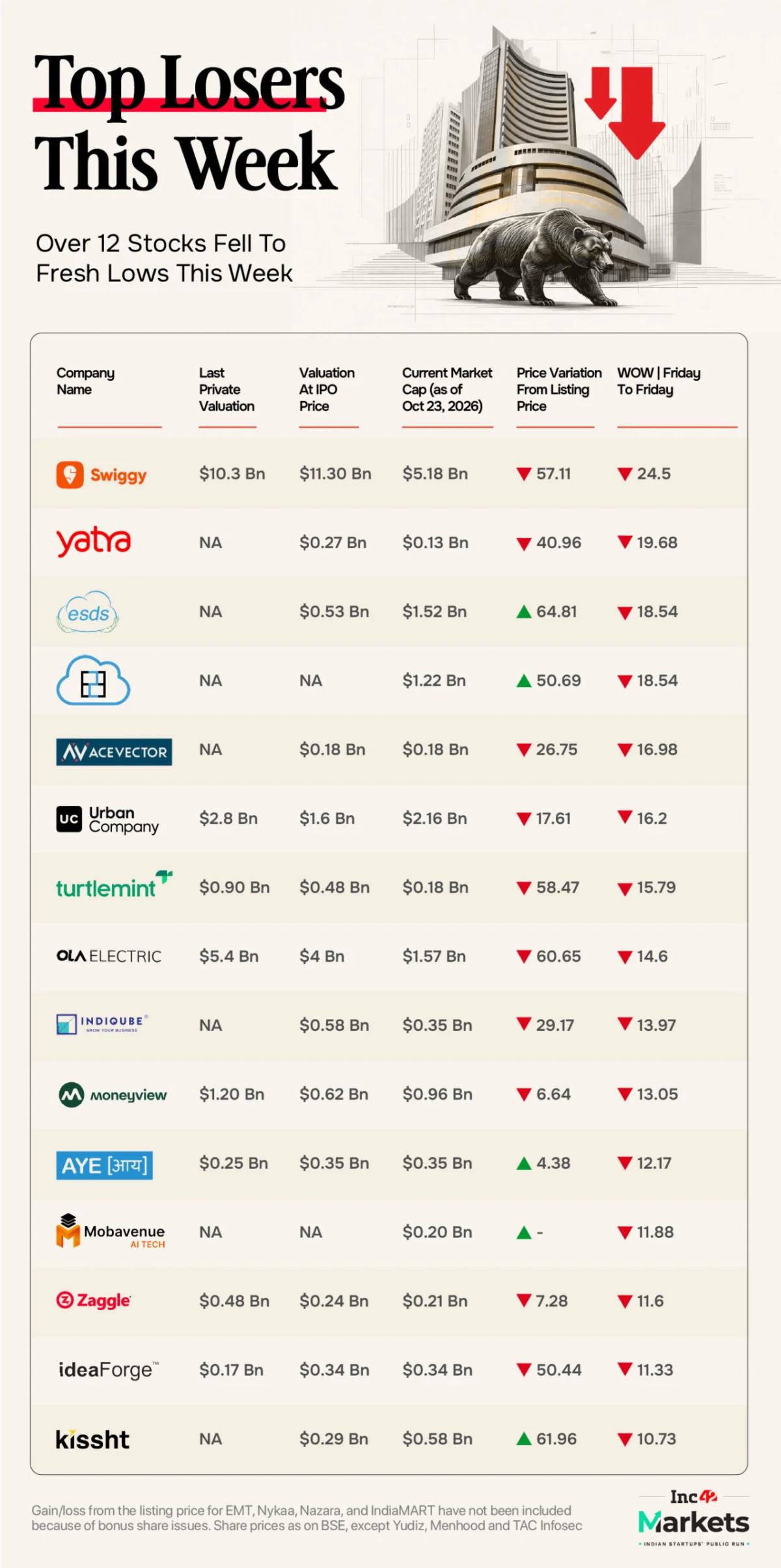
As of the close of this holiday-shortened week, the total market capitalisation for these companies stands at $149.2 billion. Of the 67 companies monitored, 63 witnessed declines ranging from 1.03% to a staggering 24.5%. Amidst the carnage, only a handful of outliers—Yudiz, Capillary, ixigo, and Tracxn—managed to defy the gravity of the market to end the week in the green.
The Epicenter of the Sell-Off: Swiggy’s Record Low
The primary casualty of the week was food-tech and quick-commerce giant Swiggy. Shares of the company nosedived 24.5%, closing at ₹176.70. The stock hit an all-time low during intraday trading, leaving it approximately 54.7% below its IPO price of ₹390.
The sell-off was fueled by the company’s Q2 FY27 financial disclosures, which revealed mounting losses within its quick-commerce arm, Instamart. Despite a 36% year-on-year (YoY) rise in operating revenue to ₹7,571 crore, the company’s consolidated net loss remained a point of concern for investors. While the headline loss narrowed by 16% YoY to ₹922 crore, it marked a 17% sequential widening from the previous quarter’s ₹791 crore.
The market’s primary grievance lies with Instamart’s adjusted EBITDA loss, which ballooned to ₹895 crore, up from ₹849 crore in the same period last year. Swiggy attributed this margin pressure to heavy investments in pricing, shifts in product mix, and the high costs associated with launching new dark stores. Although the company remains optimistic—projecting that Q2 will mark the "peak" of these losses with an anticipated 100-basis-point margin improvement in Q3—brokerages were less convinced. Firms like HSBC and CLSA have already slashed their price targets, citing execution risks and the ongoing cash-burn in the quick-commerce segment.

A Wider Market Retreat
The tech sector’s struggle was symptomatic of a broader malaise in the Indian equity markets. The benchmark indices, Sensex and Nifty 50, recorded significant losses of 2.15% and 2.63%, respectively, over the four trading sessions of the week.
The market’s winning streak was abruptly curtailed by a confluence of macroeconomic headwinds:
- Geopolitical Instability: Rising tensions in West Asia have kept investors on edge.
- Energy Volatility: Brent crude prices are climbing toward $115 per barrel, stoking fears of imported inflation and sustained pressure on corporate margins.
- FII Sentiment: Foreign Institutional Investors (FIIs) continued their exodus, marking their tenth consecutive week of net selling. While the pace of outflows moderated compared to the previous week, the cumulative impact of ₹2,697 crore in net sales contributed to the negative sentiment.
Small-cap and mid-cap stocks bore the brunt of the volatility, with the Nifty Midcap 100 and Smallcap 100 indices falling by 5.6% and 7.3%, respectively. Twelve tech companies, including Yatra, Turtlemint, FirstCry, Unicommerce, and IndiaMART InterMESH, hit fresh 52-week lows, signaling that the correction is broad-based rather than isolated to a few laggards.
New Debuts: A Fleeting Premium
Adding to the list of tracked companies, B2B manufacturing firm Zetwerk and defence-tech specialist Tonbo Imaging made their public market debuts this week. Both stocks opened at a premium, briefly offering hope to the IPO market, but were quickly sucked into the broader vortex. By the end of the week, Zetwerk and Tonbo had closed 13.02% and 2.44% below their BSE listing prices, respectively. These additions pushed the total number of tracked new-age tech stocks to 69, with a combined market cap of $152.32 billion—roughly 3.2% of the total BSE market cap.
Key Developments: Strategic Shifts and Regulatory Hurdles
Eternal’s AI Ambitions and Portfolio Realignment
Despite the market downturn, Eternal reported a robust 92% YoY jump in Q2 net profit, reaching ₹125 crore. Founder Deepinder Goyal seized the spotlight by unveiling "Dark," an end-to-end encrypted AI platform tailored for advanced users, with a global launch slated for late 2026. Simultaneously, the company announced a strategic move to streamline its portfolio by initiating a merger between AdOnMo and the gated-community management platform Mygate. Eternal expects to retain a 4.4% stake in the resulting entity.

Regulatory Pressure on IndiaMART and Justdial
The legal environment for ecommerce platforms intensified this week. The Central Consumer Protection Authority (CCPA) initiated action against seven platforms, including IndiaMART and Justdial, regarding the sale of unauthorized hazardous explosives. The regulatory crackdown forced the removal of nearly 4,000 sellers and listings, further dampening investor sentiment toward these platforms.
ideaForge’s Strategic Pivot
In the defence-tech space, drone manufacturer ideaForge officially terminated its joint venture agreement with US-based First Breach Inc. The partnership, which was signed just over a year ago to manufacture and distribute UAVs in the United States, failed to cross the finish line. The company cited the inability to complete the transaction within the agreed-upon timeframe as the primary reason for the dissolution.
Unicommerce’s Steady Growth
On a brighter note, Unicommerce reported an 11% YoY rise in net profit to ₹6.4 crore, with operating revenue growing 15% to ₹59.1 crore. Although operating expenses grew faster than revenue (19%), the company’s management expressed confidence that profitability would improve in the second half of the year as incremental capital investments begin to moderate.
ixigo: Defying the Trend
Perhaps the most resilient player this week was the online travel aggregator ixigo, which posted a 1.45% gain following its Q2 results. The company staged a significant turnaround, reporting a consolidated net profit of ₹63.4 crore compared to a loss of ₹3.5 crore in the same quarter last year.
While much of this was bolstered by a one-time gain from a stake sale in Freshbus, the underlying business metrics were encouraging. Hotel GTV surged by 158.7%, and train and bus segments showed consistent double-digit revenue growth. However, the company is not without challenges; its flight revenue saw a dip, and margins remain under pressure as the company pours capital into its hotel segment. Brokerages, including Choice Equity, have retained their "ADD" rating, noting that while margin compression is expected in the short term, the company’s multi-engine growth strategy remains intact.

Future Outlook: Navigating the Macro Storm
The week concluded on a somber note, with market analysts warning of continued downside risks. Vinod Nair, head of research at Geojit Investments, noted that while the moderation in FII selling is a positive sign, the "elevated crude prices and sharp broader-market weakness" continue to threaten recovery.
The coming week is set to be a "make-or-break" period for market sentiment. Investors are bracing for a busy calendar that includes:
- Monetary Policy Decisions: Interest rate updates from the US Federal Reserve and the Bank of Japan.
- Economic Indicators: US GDP data and India’s latest industrial production figures.
- Corporate Earnings: Continued scrutiny of Q2 financial performances.
- Global Geopolitics: Continued monitoring of West Asian developments and ongoing India-US trade negotiations.
For the new-age tech sector, the mantra for the next quarter is clear: capital efficiency. As the era of "growth at any cost" gives way to a focus on sustainable margins, companies that fail to provide a clear path to profitability—as evidenced by the current market sentiment toward Swiggy—will likely continue to face a steep uphill battle in the public markets. Investors, now far more cautious, are looking beyond the narrative of innovation to the hard reality of the balance sheet.