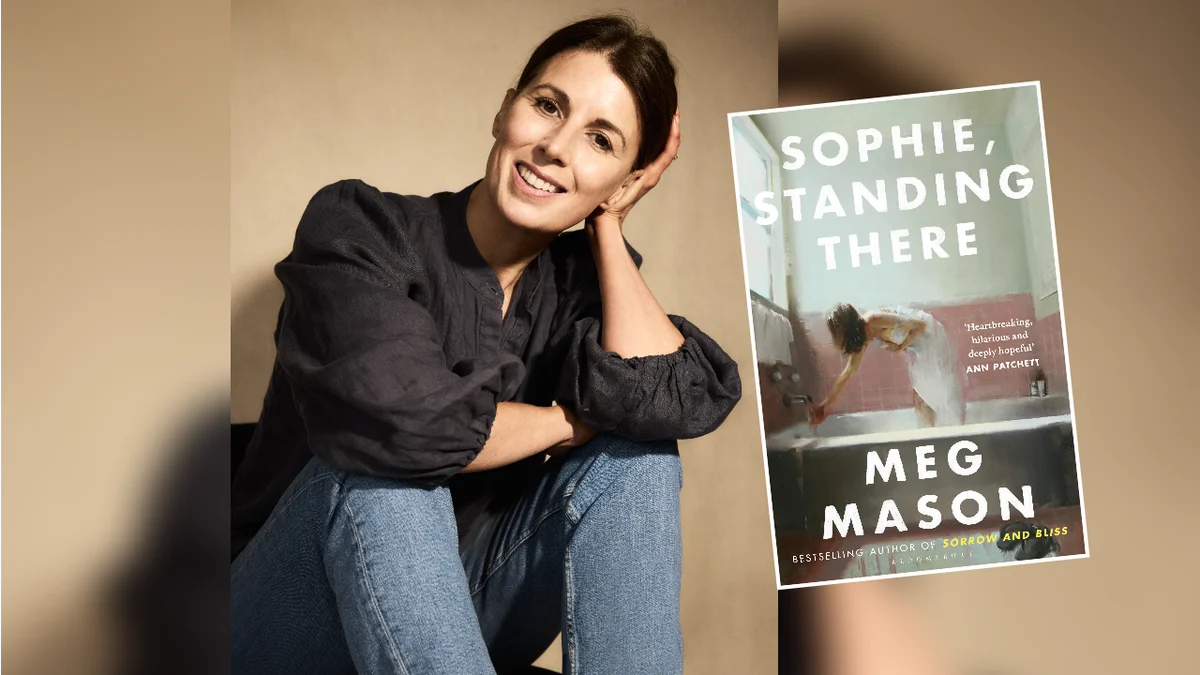
In the landscape of contemporary literature, few authors have managed to capture the frantic, often messy interiority of the human condition with the surgical precision of Meg Mason. Best known for her Women’s Prize-shortlisted 2022 breakout, Sorrow and Bliss, Mason has cultivated a reputation for wielding sharp wit and profound empathy in equal measure. With the release of her latest novel, Sophie, Standing There (published by Bloomsbury), Mason pivots from the domestic fractures of her previous work to examine a more modern, parasocial malady: the volatile intersection of readerly devotion and the haunting reality of the author-figure.
The Premise: When Admiration Becomes All-Consuming
The narrative of Sophie, Standing There centers on its eponymous protagonist, Sophie, a woman whose professional life is defined by the ephemeral world of literary festivals. Tasked with managing celebrities backstage, Sophie finds herself in a position of proximity to the literary elite, yet she remains emotionally tethered to one figure in particular: Lilac Dunne, a celebrated novelist.
As Sophie consumes Dunne’s work, interviews, and podcasts, a void in her own life is gradually filled by the author’s voice. What begins as intellectual admiration swiftly curdles into an all-consuming obsession. The novel poses a central, uncomfortable question: What does it actually mean to "love" an author? Does the intimacy found in the pages of a book grant the reader a legitimate claim to the writer’s soul, or is such a projection merely a manifestation of the reader’s own loneliness?
A Chronology of Inspiration: From New Zealand to the Page
The genesis of Sophie, Standing There is as serendipitous as the creative process itself. In a revealing conversation, Mason details how the spark for her latest work was ignited during a 2024 holiday with a fellow literary titan, Ann Patchett.
The two authors, both friends and creative peers, were traveling through New Zealand when the creative lightning struck. Within a single week, both women found their respective muses. Patchett began formulating the ideas that would become Whistler, while Mason conceptualized the trajectory of Sophie, Standing There.
"It was just for a week, but we both went straight home and got to work," Mason recalls. The result was a remarkable display of literary synchronicity; both novels arrived on bookshelves within a two-month window in 2026, marking a rare moment of creative alignment between two prominent voices in modern fiction.

The Permission of Influence: Addressing the "Real-Life" Cast
One of the most striking stylistic choices in Sophie, Standing There is Mason’s inclusion of actual contemporary authors, including George Saunders and Ann Patchett, within the narrative framework. For many writers, invoking real-world figures—especially one’s contemporaries—is a high-stakes gamble that risks accusations of self-indulgence or, worse, potential legal or interpersonal fallout.
Mason, however, views these inclusions as a necessary act of gratitude. "The authors I mention in the novel, I chose them because they’ve meant something to me, personally, as a reader and a writer," she explains. "So, this was my thank-you note."
When asked if she feared the "untoward comments" that often follow such meta-fictional choices, Mason is candid about the professional etiquette involved. She sought permission from every author mentioned. "Amazingly, they all said yes!" she notes, highlighting the communal, rather than competitive, nature of the literary world she inhabits.
The Reader as Co-Author: The Shift of Ownership
A significant theme Mason explores throughout the novel is the unintentional, often uncontrollable, interpretation of a text once it leaves the writer’s hands. There is an inherent friction between the author’s original intent and the reader’s subjective experience.
"An author feels such possession over a novel when it is still just a manuscript on their laptop," Mason observes. "But as soon as it’s published and out in the world, it belongs to the reader."
This loss of control is, for Mason, one of the "magical things" about fiction. She argues that the reader’s interpretation is fundamentally rooted in their own life experiences, rendering the text a collaborative effort between the creator and the consumer. In Sophie, Standing There, this concept is taken to its logical, if unsettling, extreme: what happens when a reader mistakes their personal interpretation of an author’s work for an intimate understanding of the author themselves?

The "Deep Dive": A History of Devotion
Mason admits that her protagonist’s intense, singular focus is not entirely foreign to her. Reflecting on her own history as a reader, she describes a life punctuated by "literary deep-dives."
Her history of devotion is extensive and varied:
- The University Years: A two-month immersion into the complete works of Evelyn Waugh.
- The Mid-Career Shift: A period of intensive study into the oeuvre of Margaret Drabble.
- The Contemporary Lens: A thorough exploration of Carol Shields.
- The Classic Return: A complete re-reading of Jane Austen earlier this year.
"I think it’s a wonderful way to study an author and how their talent unfolded and skill developed over the course of a career," Mason notes. She describes the practice as a form of intellectual apprenticeship—one that allows a reader to gain a comprehensive understanding of a writer’s evolution, while perhaps fostering the harmless, performative vanity of "pretending you’re an expert in their oeuvre."
The Ethics of Fame: To Meet or Not to Meet?
The late Indian poet Eunice de Souza once famously suggested that it is "best to meet [your favourite authors] in poems." Mason, while respecting the sentiment, offers a more nuanced, modern take on the age-old dilemma of meeting one’s heroes.
"People always say never meet your heroes, but I couldn’t agree less," Mason asserts. She posits two potential outcomes for such encounters: either the author confirms your admiration by being charming and brilliant, or they "liberate you from your fandom" by revealing themselves to be a standard, flawed human being.
Mason’s own brush with fame has left her with a profound, almost protective empathy for those who live in the public eye. She speaks with gravitas about the "unnatural" nature of celebrity. "It’s so unnatural to be the subject of strangers’ adoration, and within a crowd of fans, one can feel so incredibly lonely."

She suggests that the public discourse around authors often ignores the human cost of being a public vessel for other people’s emotions. The criticism, the intense scrutiny, and the existential dread that fame is transient—these are burdens that Mason believes require a unique kind of resilience. "Truly," she adds, "anyone who can navigate all that ought to be admired."
Implications: The Future of the Literary Relationship
As Sophie, Standing There reaches audiences, it serves as a mirror for the digital age, where the barrier between reader and author has never been thinner. Through social media, podcasts, and constant accessibility, the "void" that Sophie feels is one that many readers experience daily.
Mason’s novel does not condemn this fascination; rather, it documents it with an unflinching gaze. By grounding the narrative in the realities of the publishing world and the personal experiences of writers like herself, Mason invites the reader to reconsider the sanctity of the page.
Ultimately, Sophie, Standing There is a testament to the power of stories to sustain us, while simultaneously acting as a cautionary tale about the dangers of seeking salvation in the lives of those who write them. In Mason’s hands, the act of reading is revealed as a double-edged sword: a bridge to profound human connection, and a potential trap for those who forget that behind every voice—no matter how resonant—is a human being just as complicated, lonely, and fallible as the reader themselves.