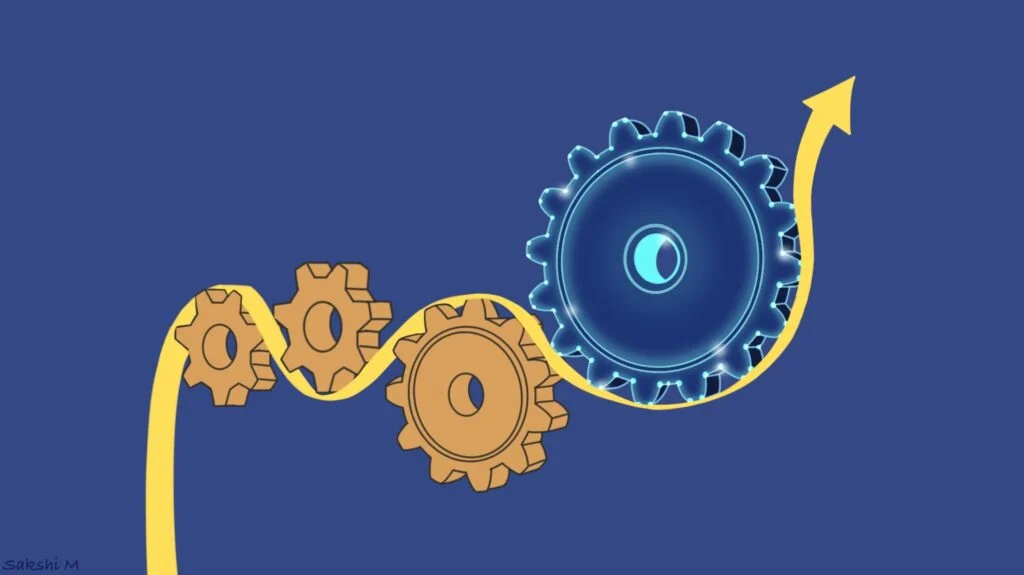
In a decisive maneuver that underscores the shifting priorities of India’s IT and engineering services sector, L&T Technology Services (LTTS) has effectively "bet the house" on Artificial Intelligence. In a move that surprised market analysts and industry insiders alike, the firm offloaded its Smart World and Communication (SWC) business—a unit once considered a cornerstone of its diversification strategy—to Hyderabad-based AMI Paradigm Solutions for approximately Rs 450 crore.
This divestment, which resulted in a staggering Rs 350 crore accounting loss, was not merely a case of corporate spring cleaning. It was a calculated, high-stakes sacrifice. By shedding the low-margin, capital-intensive smart city and telecom infrastructure business, LTTS is clearing the decks to focus exclusively on high-value, AI-driven engineering solutions. The message to the market is clear: the company is shedding its skin to transform from a traditional engineering services provider into a specialized, AI-native powerhouse.
The Anatomy of the Pivot: Why Sell the Crown Jewels?
To understand the scale of this decision, one must look at the financials. At the time of the divestment, the SWC unit was not a "peripheral enterprise." Generating Rs 1,028 crore in revenue, it represented roughly 10% of the company’s total top line and contributed 7% to its bottom line in FY25.
However, in the world of high-end engineering, revenue volume is often a vanity metric; margins are the reality. Smart city projects, while prestigious, are notorious for long gestation periods, high capital expenditure, and razor-thin margins. As the global enterprise landscape underwent an unprecedented pivot toward Generative AI and automated industrial processes, LTTS found its resources—both financial and intellectual—spread too thin.
The rationale for the sale is rooted in the "Engineering Intelligence" thesis. LTTS calculated that the talent and capital locked in the SWC unit could be deployed more effectively in AI-led projects, which offer significantly higher margins and more "sticky" client relationships. While the Rs 350 crore loss looks painful on a balance sheet, the company’s leadership views it as a "strategic haircut"—a necessary cost to enter the AI era without the baggage of legacy infrastructure projects.
Chronology of a Transformation
The transition did not happen overnight, but it gained significant momentum through a series of tactical shifts:

- 2023: LTTS integrates the parent company’s SWC business, attempting to create a synergistic powerhouse covering telecom, cybersecurity, and smart city infrastructure.
- Early 2024: The company begins an internal audit of its project portfolio, identifying a widening gap between the profitability of traditional infrastructure projects and the burgeoning demand for AI-driven industrial solutions.
- September 2024: The official disclosure of the sale of the SWC business to AMI Paradigm Solutions. The market reacts with skepticism initially, but the stock begins to stabilize as the narrative shifts to the company’s AI roadmap.
- Q2 FY27: CEO Amit Chadha confirms that AI-led deals now account for more than 50% of the company’s large-deal technology crossover ventures, which have collectively crossed the $200 million threshold.
The Evidence: Margin Expansion and Revenue Growth
Is the gamble paying off? While it is still early in the transition, the data from the most recent quarters provides a compelling argument for the strategy.
LTTS has reported consistent improvement in its Ebitda margins, climbing from 17.5% in Q2 FY26 to 19.3% in Q2 FY27. Simultaneously, the company has broken through the Rs 3,000 crore quarterly revenue barrier. These metrics suggest that the firm is successfully trading the high-volume, low-margin nature of infrastructure work for the lower-volume, high-margin, and scalable nature of AI software and platform implementation.
Investors and analysts are watching the "crossover ventures" closely. These are projects where traditional engineering meets digital transformation—where AI isn’t just an add-on, but the fundamental tool for solving mechanical or chemical engineering problems.
Engineering Intelligence in Action: The Refinery Use-Case
To understand what "Engineering Intelligence" actually looks like, one needs to look at the shop floor of an American refinery—a project currently being serviced by LTTS.
For decades, industrial plants have relied on physical archives: thousands of hand-annotated schematics, maintenance logs, and equipment datasheets. When a critical component, such as a pressure relief valve, malfunctions, the standard procedure for an engineer involves hours or even days of manual searching to find the original specifications and subsequent modifications.
LTTS’s answer to this is Ainfonix, an AI-based platform designed to structure this chaotic data. By digitizing and processing decades of unstructured logs, the platform allows an engineer to query the system in plain language. Instead of a manual search, the AI suggests the exact part, maintenance history, and replacement protocols in minutes.

This is the "moat" that LTTS is building. It is not a moat based on cheap labor or scale; it is a moat built on the ability to turn deep-domain industrial knowledge into actionable, AI-driven insights. If the company can successfully replicate this model across other verticals like aerospace, automotive, and medical devices, it effectively becomes an indispensable "brain" for global manufacturing.
Implications for the Industry and the Path Forward
The shift at LTTS reflects a broader trend among India’s IT services giants. The era of pure-play "IT outsourcing" is fading, replaced by a demand for "Industry 4.0" expertise. Companies like LTTS, TCS, and Infosys are no longer just writing code; they are designing the digital nervous systems for physical infrastructure.
However, the strategy is not without risks. By betting the house on AI, LTTS faces two significant challenges:
- The Talent War: AI-led engineering requires a hybrid workforce—professionals who are equally comfortable with fluid dynamics as they are with Large Language Models (LLMs). This is a rare, expensive, and highly sought-after skill set.
- The "Rented Moat" Risk: In the AI space, technology is commoditized rapidly. If LTTS’s proprietary platforms are not constantly updated with newer, better models, they risk becoming obsolete. The company must prove that its intellectual property is genuinely defensible and not just a thin layer of code built on top of generic, off-the-shelf AI models.
Conclusion: A New Era for L&T Technology Services
L&T Technology Services has effectively signaled that it is done playing the volume game. By offloading the SWC business, they have moved past the "scale at all costs" mentality that defined the previous decade of Indian IT.
The Rs 350 crore loss will eventually be forgotten if the current trajectory of margin improvement and high-value project acquisition holds. The company has made its move. It has stepped away from the physical world of building smart cities to the digital world of "engineering intelligence." The industry is watching to see if this pivot provides the long-term, sustainable growth that shareholders demand, or if the "AI tag" proves to be a temporary bridge to a future that remains difficult to predict.
For now, the refinery in America, the AI platform on the screen, and the rising EBITDA margins suggest that the gamble was not just a pivot—it was a necessity for survival in a world where physical engineering is increasingly becoming a subset of software. The moat is being built; now, the company must ensure it remains uncrossable.