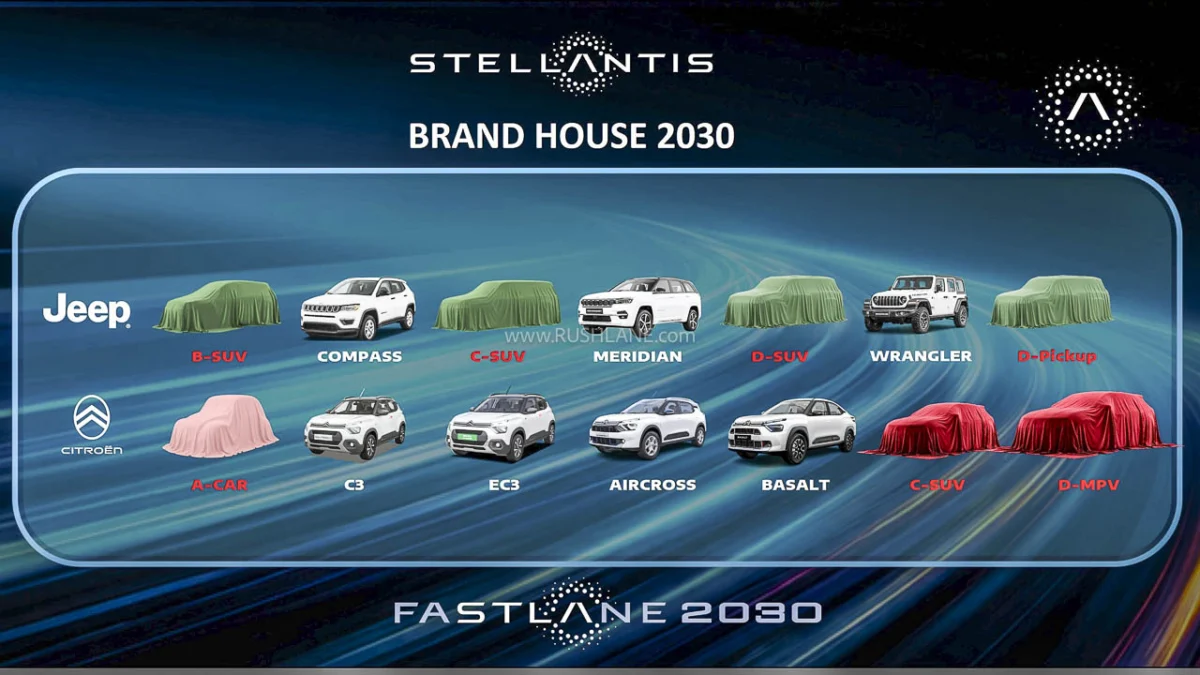
In a decisive move to solidify its foothold in the world’s third-largest automotive market, global automotive conglomerate Stellantis has officially unveiled its "FaSTLAne 2030" roadmap for India. The ambitious strategy promises a transformative era for the company’s dual-brand presence, Jeep and Citroen, backed by a fresh investment commitment of approximately Rs 4,000 crore. This infusion of capital is set to catalyze the launch of 12 distinct product interventions, marking a significant escalation in the company’s competitive stance within the Indian subcontinent.
By 2030, this aggressive expansion will propel the company’s total cumulative investment in India to roughly Rs 15,000 crore, up from its existing investment base of Rs 11,000 crore. As the automotive industry pivots toward electrification, platform sharing, and high-tech localization, Stellantis is positioning India not just as a consumer market, but as a critical node in its global manufacturing and R&D ecosystem.
The Core Mandate: 12 Products and a New Strategic Direction
At the heart of the FaSTLAne 2030 initiative is a structured product offensive spanning the next three years. The roadmap confirms a balanced distribution of resources, with five major initiatives allocated to the premium, off-road-centric Jeep brand, and seven projects earmarked for the mass-market-focused Citroen brand.
The product mix is designed to cover a wide spectrum of the market, ranging from entry-level hatchbacks to premium D-segment SUVs and pickups. According to the roadmap, the rollout will consist of:
- Seven all-new products: Built from the ground up, likely utilizing shared architectures to maximize economies of scale.
- Five major upgrades: Comprehensive mid-cycle refreshes or significant generational leaps for existing models.
The first of these highly anticipated vehicles is scheduled to make its market debut by the second quarter of 2027, setting the stage for a rapid-fire succession of launches that will keep both Jeep and Citroen at the forefront of consumer attention.

Strategic Segmentation: From Entry-Level to Premium Off-Roading
Stellantis has provided a clearer look at how these 12 products will be segmented to challenge established incumbents in India.
The Jeep Offensive: Expanding the Icon
Jeep’s five-product program is poised to diversify the brand’s portfolio significantly. Industry analysts suggest the pipeline includes:
- A B-segment SUV: Designed to take on the hyper-competitive sub-4-meter segment, challenging the likes of the Maruti Brezza, Tata Nexon, and Hyundai Venue.
- A C-segment SUV: Likely to leverage the collaboration with Tata Motors, this vehicle is expected to challenge the dominance of the Hyundai Creta and Kia Seltos.
- A D-segment SUV: Positioned as a direct competitor to the Toyota Fortuner, focusing on Jeep’s core brand values of ruggedness and off-road capability.
- A D-segment Pickup: Aiming to tap into the lifestyle utility vehicle market currently occupied by the Isuzu V-Cross and Toyota Hilux.
- A Major Upgrade: A comprehensive overhaul of an existing model, likely the Jeep Compass, to maintain its premium appeal.
The Citroen Expansion: Scaling the Mass Market
Citroen’s seven-product strategy is aimed at volume growth, focusing on segments where price-sensitivity and value-for-money are paramount. The plan includes:
- An A-segment car: A new entry-level hatchback intended to serve as a gateway to the Citroen brand.
- A C-segment SUV: A crucial play to capture a larger slice of the mid-size SUV segment.
- A D-segment MPV: Targeting the family-mover space currently dominated by the Mahindra XUV700 and the Toyota Innova Hycross.
- Four Major Upgrades: These updates will likely focus on feature-set enhancements, interior ergonomics, and powertrain efficiency, addressing previous consumer feedback regarding the feature-to-price ratio of current Citroen offerings.
A Synergy-Driven Future: The Tata-Stellantis Collaboration
A pivotal element of the FaSTLAne 2030 roadmap is the strategic alliance between Stellantis and Tata Motors. Formalized in previous agreements, this partnership is not merely a supply arrangement but a deep-seated collaboration on vehicle architectures and core technologies.
The synergy is designed to minimize R&D expenditure while accelerating time-to-market. By utilizing Tata’s localized platform expertise and Stellantis’s global engineering prowess, the companies aim to create vehicles that are uniquely suited to Indian driving conditions—characterized by varied terrain, extreme weather, and specific consumer preferences for connectivity and comfort.

The first product born from this partnership—an India-sourced Jeep SUV—is currently on track for a 2028 debut. This project, in particular, is viewed as a litmus test for the success of the collaboration, as it intends to harmonize Jeep’s legendary "Trail Rated" DNA with the cost-efficiencies of an Indian-engineered platform.
Manufacturing Excellence and 90% Localization
Stellantis is doubling down on the "Make in India" philosophy with a bold target of 90% localization across its product range. This is not just a regulatory compliance measure but a strategic hedge against supply chain volatility and a means to ensure competitive pricing.
The company currently operates a robust manufacturing footprint in India:
- Ranjangaon (Maharashtra): The primary hub for vehicle assembly and powertrain production.
- Thiruvallur & Hosur (Tamil Nadu): Facilities focused on high-precision engineering, with Hosur serving as a global export hub for engines and gearboxes.
- Bengaluru & Hyderabad: Supporting the group’s digital transformation, software engineering, and ICT infrastructure.
By tapping into the domestic supplier ecosystem, Stellantis plans to reduce lead times and foster deeper integration with local vendors, which will be essential as the brand scales its output to meet the demands of the 12-product launch cycle.
Market Performance and Growth Trajectory
The FaSTLAne 2030 roadmap arrives on the back of strong momentum for the company. Despite the inherent volatility of the automotive market, Stellantis reported a 35% growth in its overall Indian business during the second quarter of 2026 compared to the first.

Specifically, the Citroen brand has seen a remarkable 68% year-on-year increase in retail sales for Q2 2026. This surge suggests that the brand’s "Brand House" format—a unique retail concept that integrates the sales and service experience—is gaining traction. Stellantis plans to leverage this model to aggressively expand into Tier-2, Tier-3, and Tier-4 markets, where the next wave of automotive growth in India is expected to occur.
India as a Global Export Powerhouse
Stellantis views India as more than a domestic market. With an export footprint spanning approximately 50 countries, the group is already leveraging Indian manufacturing for global markets. A testament to this is the Hosur facility, where 95% of the engines and gearboxes produced are destined for international markets.
Under the FaSTLAne 2030 plan, this role is set to expand. Future vehicles designed and manufactured in India will increasingly be tailored for export, particularly to other Asia-Pacific markets. This shift elevates India from a regional hub to a global manufacturing center within the wider Stellantis network, ensuring that the investments made today yield dividends in both domestic sales and global revenue.
Implications for the Industry and Consumers
The implications of the FaSTLAne 2030 roadmap are profound. For the Indian consumer, the influx of new products promises more choices, particularly in the high-growth SUV and MPV segments. For the industry, the roadmap signals that Stellantis is prepared to play the "long game," moving past the initial teething issues of market entry to become a dominant force.
However, the road ahead is not without challenges. The Indian market is notoriously difficult to crack, characterized by intense competition from domestic giants like Tata and Mahindra, and established foreign players like Hyundai and Suzuki. To succeed, Stellantis will need to maintain a delicate balance between premium brand positioning for Jeep and high-value accessibility for Citroen.

As the company prepares for the first launch in Q2 2027, the automotive world will be watching closely. With a clear roadmap, significant capital backing, and a strong focus on local collaboration, Stellantis has laid the foundation for a new chapter in its Indian journey—one that is defined by ambition, integration, and a clear vision for the future of mobility.