The digital marketing landscape has undergone its most radical transformation in two decades. With the widespread integration of AI Overviews (AIO) into search engine results pages (SERPs), the fundamental contract between search engines and websites has been rewritten. For years, the objective was simple: rank in the top three organic positions to secure a click. Today, that click is no longer guaranteed—or even necessary.
AI Overviews now sit at the apex of the search experience, consolidating information from multiple sources into a single, cohesive answer. While this provides users with immediate value, it poses an existential challenge for brands: how do you measure visibility and drive traffic when your content is being synthesized, summarized, or ignored entirely before a user even reaches your site?
The Anatomy of the New Search Reality
The shift to AI-driven search has created a "ranking-traffic paradox." Marketers frequently report that their keyword rankings remain stable, yet organic traffic is in a steady decline. This phenomenon occurs because the AI Overview now occupies the highest-visibility position, often pushing traditional organic links below the "fold" of the screen.
The Death of the Traditional Click-Through Rate
Historically, Search Engine Optimization (SEO) was binary: you either ranked or you didn’t. In the age of generative search, visibility is non-linear. A brand might be cited in an AI Overview—a "win" for brand authority—but if that citation does not result in a click, traditional attribution models fail to capture the impact. This has forced a shift in focus from "ranking" to "citation candidacy."
Chronology: How Search Evolved into Synthesis
The transition toward AI-generated search was not an overnight event but a calculated evolution:
- Pre-2023: The Era of Blue Links: Search was dominated by a list of links. The primary goal was to provide the "best" answer via a direct website visit.
- 2023: The Featured Snippet Consolidation: Google began emphasizing "Featured Snippets," which provided quick answers, marking the beginning of the "zero-click" trend.
- Early 2024: The AI Overviews Rollout: Google officially integrated generative AI directly into the results page, allowing the engine to synthesize multiple sources into a single response.
- Late 2024 – 2026: The Maturity Phase: As of 2026, AI Overviews are the default for a vast array of informational queries. Brands are now moving past the "shock" phase and into the "tracking" phase, developing sophisticated methodologies to monitor their footprint in AI-generated responses.
Supporting Data: Why Tracking Matters Now
Traditional rank-tracking tools are increasingly obsolete because they measure a static position (e.g., "Position 4"). They cannot account for the dynamic nature of AI, where a page may be cited for one user but not for another, or where the citation order changes based on the user’s specific follow-up questions.
.png)
The Volatility Factor
Unlike organic rankings, which are relatively stable, AI Overview citations are highly volatile. Data suggests that:
- Context Sensitivity: AI Overviews appear significantly more often for "How-to" and informational queries than for high-intent transactional keywords.
- The Citation Gap: A page ranking at position #1 does not guarantee an AI citation. Often, an authoritative, third-party guide or a Reddit thread is cited instead of a corporate product page, signaling that Google’s AI prioritizes "authentic experience" over "commercial authority."
- Measurement Gaps: Organizations currently lack a unified way to attribute "influence." A brand might be mentioned in an AI Overview, leading to a surge in branded searches later that day, even if the direct referral link was never clicked.
Official Stance and Industry Perspectives
Major search engine providers have maintained that the goal of AI Overviews is to improve user satisfaction by reducing the time spent jumping between sites. Google, for instance, emphasizes that their goal is to connect users with the "best information," whether that information comes from a major news outlet or a niche community forum.
However, the industry sentiment is split. Content creators argue that the reduction in referral traffic threatens the economic viability of the open web. Conversely, early adopters of "Generative Engine Optimization" (GEO) argue that brands must stop viewing websites as the destination and start viewing them as the source material for the AI ecosystem.
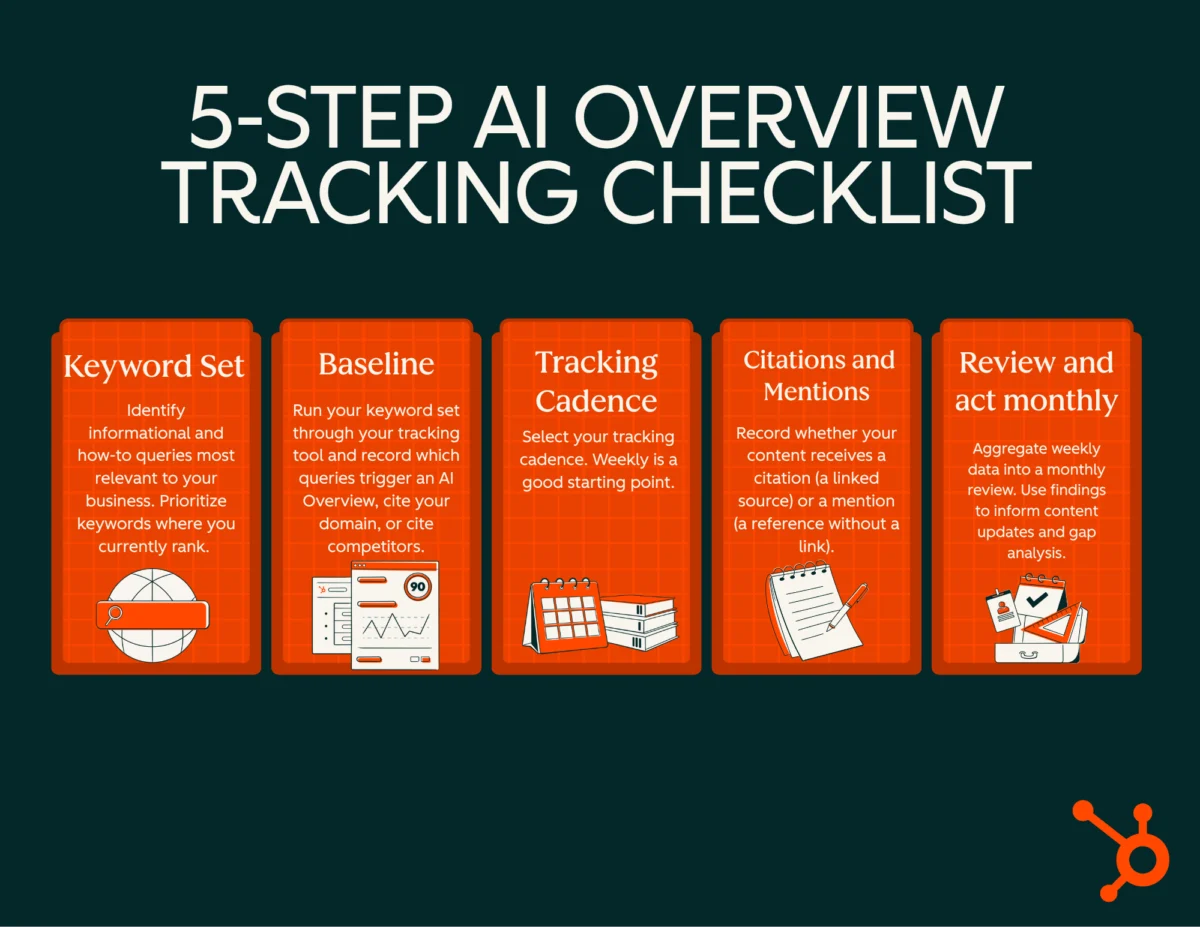
The 5-Step AI Overview Tracking Framework
To navigate this shift, teams must move from reactive monitoring to a structured, data-driven approach.
1. Define the Informational Keyword Set
Filter your keyword research to identify queries that trigger AI Overviews. Focus exclusively on "How-to" and "What is" queries, as these are the primary targets for generative responses.
2. Establish a Baseline
Before implementing changes, you must know your current "Citation Share." Use tools like the HubSpot AI Search Grader to record which queries currently trigger an overview and whether your domain is present as a citation.

3. Implement a Tracking Cadence
Daily tracking is often unnecessary and prone to "noise." A weekly audit is the standard, with daily checks reserved for high-priority, high-volume terms during major Google core updates.
4. Separate "Mentions" from "Citations"
It is critical to distinguish between a linked citation (which can drive traffic) and a brand mention (which builds authority). Use a spreadsheet or specialized tracking software to log both, as they require different content strategies.
5. Monthly Synthesis and Gap Analysis
Aggregate the data once a month. Are you losing ground to competitors? Are you being cited for technical accuracy or for practical, "real-world" experience? Use this to inform your content calendar.
Implications for Future Content Strategy
The era of "thin" or "SEO-optimized" content is effectively over. The AI models prioritize depth, structure, and original research.
Why Structure Wins
AI models are designed to ingest and summarize. Content that is structured with clear, logical headers and step-by-step instructions is significantly easier for an LLM to parse and, consequently, to cite. If your content is buried in long, narrative paragraphs without clear definitions, it is unlikely to be selected.
The Rise of User-Generated Content (UGC)
We are seeing a massive shift toward the inclusion of UGC in AI Overviews. Because AI models are trained to prioritize "first-hand experience," platforms like Reddit, Quora, and YouTube are being cited more frequently. Brands that ignore the importance of being part of these community conversations are losing their ability to influence the AI’s final answer.
.png?width=650&height=502&name=Pastel%20Playful%20Illustrated%20Project%20Stages%20Graphic%20Organizer%20(4).png)
The "Authority" Requirement
Google’s E-E-A-T (Experience, Expertise, Authoritativeness, and Trustworthiness) guidelines have never been more relevant. When the AI synthesizes an answer, it pulls from domains it perceives as authoritative. Building "Topical Authority" is no longer just about volume—it is about being the primary source of truth for a specific, narrow niche.
Conclusion: Adapting to the New Rules
The shift to AI Overviews is not a signal to abandon SEO; it is a signal to evolve it. While we cannot "force" the AI to cite us, we can make our content a superior candidate for inclusion by being more helpful, more structured, and more authoritative than the competition.
By moving away from vanity metrics like "Position #1" and toward sophisticated frameworks that track "Citation Coverage" and "Mention Frequency," marketers can maintain visibility in a landscape that no longer relies on the traditional click. The brands that win in 2026 and beyond will be those that accept that their content must provide value not just to the human reader, but to the machine that interprets the world for them.
The path forward is clear: build for the user, structure for the machine, and track the synthesis.