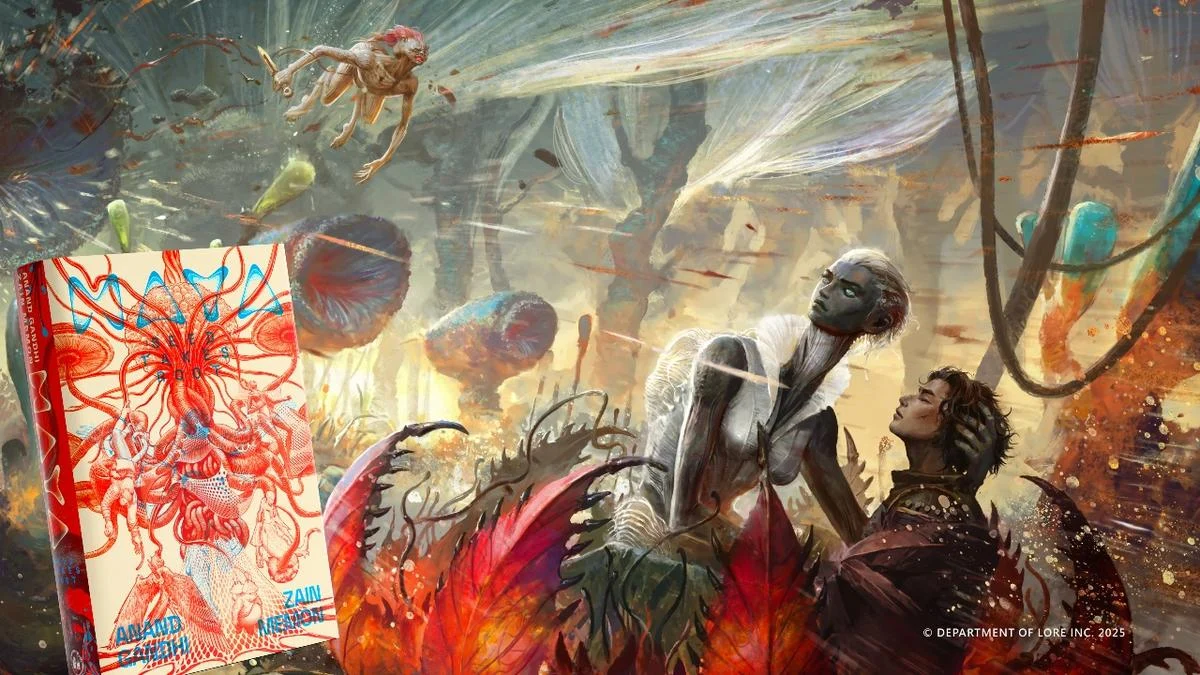
In the landscape of modern Indian speculative fiction, few projects have generated as much intellectual curiosity as Maya: Seed Takes Root. Penned by the visionary filmmaker Anand Gandhi—the mind behind the existential meditations of Ship of Theseus and the genre-bending folk-horror of Tumbbad—alongside game developer Zain Memon, the novel marks the inaugural volume of an ambitious, trans-media trilogy. Set on the distant, biologically interconnected planet of Neh, the book attempts to bridge the gap between hard science fiction and philosophical inquiry. However, as the work hits shelves, it invites a critical examination: can a narrative designed to be a "franchise" ever truly capture the sprawling, messy interiority that defines the greatest works of literature?
The Premise: Surveillance and Agency in the Neh Network
Maya: Seed Takes Root transports readers to Neh, a world where the distinction between biological entity and social structure has effectively collapsed. The inhabitants live within a vast, living biological network that governs the minutiae of their existence—predicting behaviors, organizing rituals, and dictating the rhythms of daily life.
The narrative centers on three primary protagonists, each representing a distinct intersection with the planet’s governing network:
- Yachay: The outlier, representing the anomaly within the system.
- Kshar: The embodiment of predictability, control, and systemic adherence.
- Ayn: The representative of the alternative path, challenging the inevitability of the network’s design.
Through this trio, Gandhi and Memon explore the high-concept pillars of their universe: surveillance, free will, consciousness, and the definition of agency. The book positions itself as a cerebral exploration of what it means to be a "self" when your very thoughts are part of a predictive ecosystem.

A Chronology of the ‘Maya’ Universe
The development of Maya is as much a story of modern creative strategy as it is a literary endeavor.
- The Inception: Long before the first volume hit the printing press, the creative team envisioned Maya not as a book, but as an ecosystem. The project was conceived as a "trans-media" universe, where the lore, setting, and philosophical conflicts would be distributed across different formats simultaneously.
- The Parallel Development: Unlike traditional literary adaptations where a book is optioned for film after its success, the screenplay for the Maya film and the text of the novel were developed in tandem. This unique approach aimed to ensure a cohesive "mythos" across platforms.
- October 2026: The release of Seed Takes Root by Westland Books. The launch marks the first formal entry for the public into this universe, accompanied by the announcement of a forthcoming board game and a feature film.
The Literary Critique: Between Aphorism and Narrative
In the tradition of great literature, novels often find their strength in "wastefulness"—the tendency to linger on a single, seemingly insignificant observation or a quiet, introspective moment. It is in these deviations that characters truly become "human."
Maya: Seed Takes Root takes the opposite approach. It is a lean, deliberate machine of a book. It eschews the meandering quality of classic novels, opting instead for a rapid, focused progression of ideas. While this makes for a breezy read, it creates a palpable tension between the characters and their voices. The writing is heavily aphoristic, filled with polished, philosophical soundbites such as, "If dreams inspire hope, nightmares inform vigilance."
While these lines are undeniably clever, they create a sense of detachment. The protagonists, despite their distinct roles, often speak with a uniform, high-minded intellectualism that makes the reader hyper-aware of the authors’ presence behind the curtain. When a character arrives at a profound realization, it often feels like a preordained step in the narrative architecture rather than a genuine, messy, human epiphany.

Supporting Data: The Franchise Dilemma
The central conflict of Maya as a piece of literature lies in its identity. Is it a novel, or is it a blueprint for a larger intellectual property?
The book is undeniably a product of the "franchise" era. There is a perceptible constraint placed on the prose—a "covert preference" for plot structures that are modular, making them easily adaptable for visual media. This creates a fascinating, if problematic, reading experience. In the 13th chapter, the narrative briefly breaks its own mold, offering a glimpse of what the novel could have been had it fully embraced the literary medium. Yet, for the most part, the plot feels subservient to the needs of the wider Maya universe.
This structural rigidity brings to mind the cautionary tale of George R.R. Martin’s A Song of Ice and Fire. In 2007, Martin famously warned that screenwriters "can’t adapt a book that hasn’t been written." The subsequent divergence of the Game of Thrones television series from its source material—and the resulting decline in narrative quality as the show ran out of source material—highlights the danger of pre-planning a story for the screen. By prioritizing the "architecture" of the franchise over the organic development of the characters, Maya risks falling into the same trap: characters who act because the plot requires them to, rather than because their internal logic dictates it.
The Implications: What ‘Maya’ Means for Indian Speculative Fiction
Despite its flaws, Maya: Seed Takes Root is a significant marker for the Indian publishing landscape. It represents a burgeoning desire for "sophisticated fiction"—works that bridge the gap between high-concept global science fiction and culturally familiar, localized mythos.

For the reader who enjoys the intellectual stimulation of the Dune series or the philosophical density of Ted Chiang, Maya offers a sandbox of high-level concepts. It is an enjoyable, if sterile, experience that succeeds in building a world that is "generative"—that is, it creates a framework that can be expanded upon, iterated, and played with.
However, the implications for the future of literary fiction are complex. If the industry shifts toward a model where novels are primarily developed as "content" for broader trans-media franchises, we may see a decline in the "meandering", character-driven works that define our cultural canon. The beauty of a book, historically, is that it is a closed loop—a space where a single author’s voice can exist without the interference of a production schedule or the need to translate a scene into a board game mechanic.
Maya is a testament to the ambition of its creators, Anand Gandhi and Zain Memon. They have successfully constructed a complex, multi-layered universe. The question remains, however, whether that universe will eventually allow its inhabitants the freedom to be truly messy, unpredictable, and human, or if they will remain forever trapped within the rigid, well-designed architecture of their own creation.
For the reader, Maya: Seed Takes Root is a bold experiment. It is a work that demands to be read, if only to participate in the conversation about where the boundaries of literature, film, and gaming currently sit. Whether it will stand the test of time as a literary masterpiece or serve as a successful, efficient prototype for a new era of trans-media storytelling remains to be seen in the volumes to follow.