For over a decade, digital marketing teams have meticulously refined the art of the funnel. Through a complex ecosystem of paid search, organic SEO, social media, and precision-targeted email campaigns, marketers have built a comprehensive, data-driven picture of the buyer’s journey. However, a silent, tectonic shift in consumer behavior is creating a massive blind spot in this otherwise seamless narrative.
The modern buyer no longer relies solely on traditional search engine results pages (SERPs) to shortlist vendors. They are increasingly turning to generative AI interfaces—platforms like ChatGPT, Gemini, and Perplexity—to synthesize information, compare solutions, and make high-stakes purchasing decisions. These interactions are invisible to traditional analytics tools, leaving marketing leaders with a growing gap in their attribution models and a pressing need for a new discipline: Answer Engine Optimization (AEO).
The Identity Crisis of AEO: Who Owns the AI Revolution?
As organizations scramble to address the rise of AI-assisted discovery, AEO has frequently become an "orphan" within the marketing department. It sits at an uncomfortable intersection of existing silos: SEO teams argue it is a technical search issue; content teams view it as a creative challenge; and demand generation managers—wrestling with rising customer acquisition costs (CAC) and stagnating organic traffic—are left without a clear strategy.
This lack of ownership is more than just a bureaucratic headache; it is a strategic vulnerability. While internal teams debate who should manage AI visibility, potential customers are already vetting competitors within these black-box AI environments. Organizations that fail to establish a clear AEO strategy risk losing the "first-touch" advantage that traditional SEO once guaranteed.
Integrating AEO into the Operational Core
The most successful marketing organizations are not creating separate "AI departments." Instead, they are embedding AEO directly into their existing operational workflows. By treating AEO not as an isolated experiment, but as a critical component of the established marketing stack, these teams are achieving a level of agility that their competitors lack.

This integration manifests in three primary areas:
- Unified Visibility Tracking: Integrating AEO data alongside existing channel dashboards ensures that AI-driven traffic is not viewed in a vacuum.
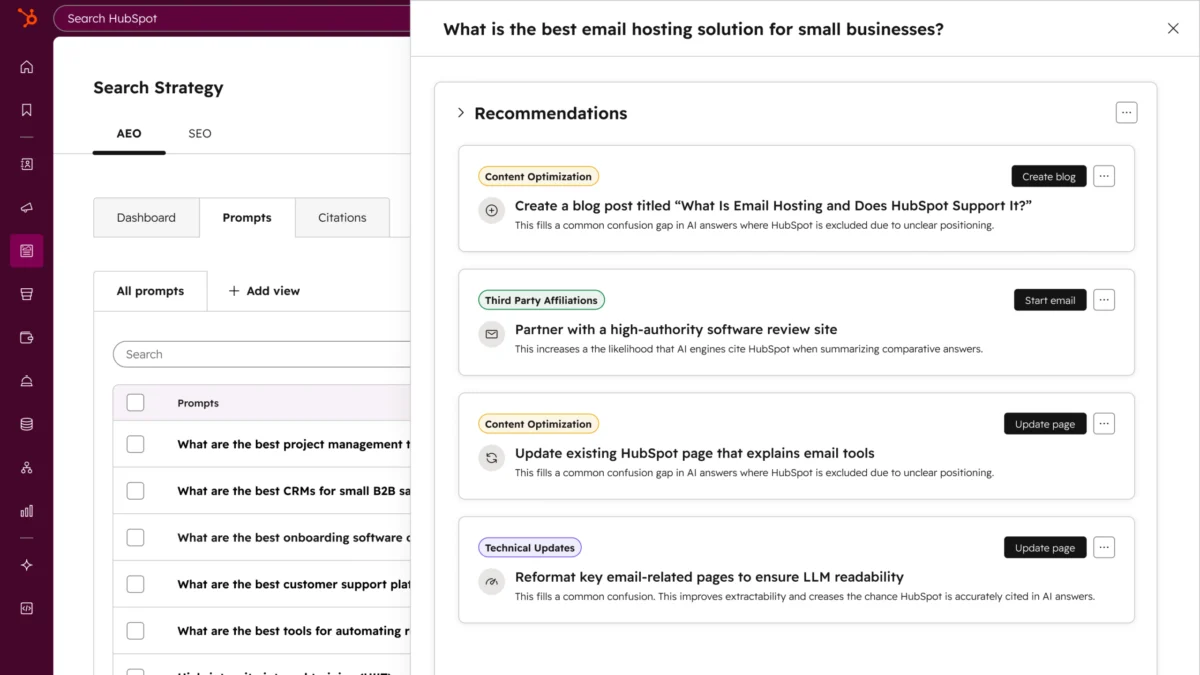
- Embedded Recommendations: Surfacing AEO optimization insights directly within the editorial calendar, allowing content creators to act on AI gaps without switching platforms.
- Holistic Attribution: Connecting AI-generated traffic to the same pipeline reports used for PPC and organic search, providing a unified view of ROI.
A Single View of Brand Visibility: Moving Beyond the Dashboard Fatigue
Most marketing leaders today are inundated with a dozen different dashboards, each offering a sliver of insight into channel performance. Adding another siloed tool for AEO only exacerbates this "dashboard fatigue." When AEO data is siloed, it becomes a static report that is checked sporadically rather than a dynamic signal that informs daily decision-making.
HubSpot’s approach to this challenge involves consolidating AEO visibility within their existing platform. By providing a brand visibility score that trends over time across platforms like ChatGPT, Gemini, and Perplexity, teams can track their AI presence with the same rigor they apply to traditional organic rankings. When this data lives in the same environment as CPL (Cost Per Lead) and conversion metrics, it transforms from a "nice-to-have" metric into a core KPI that leadership can understand and act upon.
The Editorial Workflow: Aligning Content with AI Needs
The primary challenge for content teams is the already overwhelming pressure to produce high-quality assets. Adding "AI optimization" as a separate task is often a recipe for burnout. To be effective, AEO must be woven into the fabric of the editorial process.
When AEO guidance is surfaced directly within content planning tools, teams can move away from the "prioritization tug-of-war." Instead of choosing between optimizing for Google or optimizing for ChatGPT, teams can optimize each page once for both audiences.

Modern platforms now enable this by connecting AEO recommendations directly to content creation tools. For instance, if an AI analysis identifies a content gap—a question that potential buyers are asking but the brand has not answered—the system can prompt the team to draft content addressing that specific need. This keeps AEO work in step with the established editorial cadence, ensuring that every piece of content produced is serving a dual purpose: engaging human readers and satisfying the logic of generative AI models.
Measuring the Impact: Translating AI into Pipeline Revenue
The most significant barrier to AEO adoption is the "fuzzy return" problem. Traditional KPIs like MQLs (Marketing Qualified Leads) and pipeline influenced are the gold standard for executive reporting. Because AI-assisted discovery often obscures the referral source, marketers have historically struggled to prove the value of AEO to the C-suite.
To bridge this gap, organizations are adopting more sophisticated tracking methodologies. Using tools like the HubSpot Smart CRM, teams can now track "AI Referrals" as a distinct traffic source. When a prospect engages with an AI answer and subsequently lands on a brand’s website, that journey is captured, and the contact is tagged with the AI source.
By mapping these AI-driven leads to downstream deal outcomes, marketers can finally answer the question: "How much revenue did our AI visibility generate this quarter?" This transition from vanity metrics to revenue attribution is the final piece of the puzzle, allowing AEO to earn its place as a legitimate, budget-justified line item in the marketing plan.
Implications for the Future of Search
The emergence of AEO represents a fundamental shift in the power dynamics of the internet. We are moving from an era of "search and click" to an era of "ask and receive." In this new paradigm, the brand’s ability to influence the synthesis of information—rather than just the ranking of a link—is the new battleground.

The Competitive Advantage of Early Adoption
Organizations that move quickly to establish their AEO infrastructure will benefit from a compounding advantage. As AI models continue to evolve, the "historical authority" of content within these models will become increasingly difficult to displace. By building a baseline of visibility today, marketers are essentially "training" the AI to recognize their brand as a trusted source for their industry.
The Human Element in the Age of Machines
Despite the automation inherent in AEO, the human element remains vital. AI can identify gaps, suggest topics, and even draft initial outlines, but the strategic direction, the brand voice, and the nuanced understanding of the customer’s emotional journey still require human expertise. The most effective teams will use AEO to handle the heavy lifting of data analysis, freeing their human strategists to focus on creating content that resonates on a deeper, more human level.
Final Thoughts: The Path Forward
The "gap" in the marketing funnel is not a temporary glitch; it is the new reality of how information is consumed in the digital age. Marketing teams that cling to legacy reporting, ignoring the rise of answer engines, will find their organic traffic and pipeline contributions quietly eroding.
Conversely, teams that embrace AEO—integrating it into their existing reporting, editorial, and attribution workflows—will find themselves with a significant competitive advantage. By treating AI-assisted discovery as a measurable, actionable channel, they are not just reacting to the future of search; they are positioning their brands to own it.
The transition will not be overnight, and it will require a shift in both technology and mindset. However, for those who start today, the ability to turn AI-assisted discovery into a predictable engine of growth will be the defining hallmark of the next generation of marketing leaders.