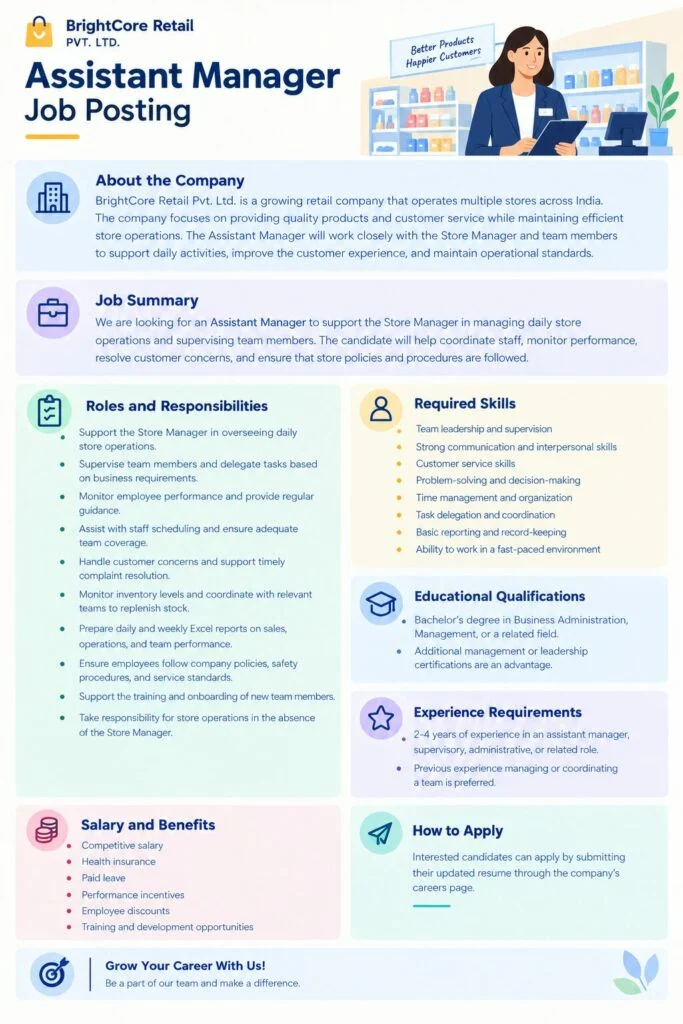
As a business scales, the chasm between high-level executive strategy and the gritty reality of daily operations often widens. To bridge this gap, organizations turn to the Assistant Manager—a linchpin role that serves as both a force multiplier for leadership and a stabilizer for the team. However, finding the right individual to navigate this delicate balance requires more than a standard vacancy post; it demands a surgical approach to role definition.
The Strategic Role of the Assistant Manager
The Assistant Manager is rarely just a "second-in-command." In modern organizational structures, they are the primary architects of team cohesion. When a team grows, managers often find themselves buried in administrative upkeep, losing the capacity for strategic thinking. The Assistant Manager steps in to ensure that employee workflows are optimized, operational bottlenecks are cleared, and company culture remains intact.
Hiring for this role is an exercise in identifying a "bridge builder." The ideal candidate must possess the soft skills to coach junior staff and the hard skills to manage complex reporting, inventory, or operational KPIs. A well-crafted job description (JD) is not merely an administrative requirement; it is a marketing document designed to attract candidates who are ready to assume leadership responsibilities without needing constant supervision.
Anatomical Breakdown: Key Elements of an Effective Job Description
To attract top-tier talent, a job description must move beyond vague bullet points. It should act as a comprehensive map of the candidate’s future within the company.
1. The Company Narrative
Candidates today are looking for more than a paycheck; they are looking for a fit. The company description should articulate the "why" behind your organization. Beyond industry and scale, highlight the culture. Does your team thrive on autonomy, or is it a high-collaboration environment? By painting a vivid picture of the workplace, you filter out candidates who might be technically proficient but culturally misaligned.

2. The Job Summary: Defining Ownership
The summary section serves as the "hook." It should explicitly state the reporting hierarchy and the level of decision-making authority. Does the Assistant Manager have the autonomy to resolve customer disputes? Are they responsible for payroll scheduling? Defining this "scope of ownership" immediately clarifies the role’s gravity.
3. Roles and Responsibilities: Beyond the To-Do List
Rather than a laundry list of tasks, focus on outcomes. Instead of saying "monitor team performance," specify "optimize team productivity through regular feedback loops and KPI tracking." This nuance separates tactical workers from strategic leaders. Responsibilities should span three domains:
- Operational Oversight: Managing the day-to-day mechanisms of the business.
- Team Leadership: Mentoring, conflict resolution, and performance management.
- Strategic Support: Acting as a proxy for the manager during planning or high-pressure periods.
4. Technical and Interpersonal Competencies
An Assistant Manager is often the most visible leader on the floor. Therefore, the "Required Skills" section must be a hybrid of soft and hard skills. While proficiency in project management software or data reporting (such as Excel or CRM tools) is essential, the weight should be placed on emotional intelligence (EQ), conflict resolution, and cross-departmental communication.
The Blueprint: An Adaptable Template
Efficiency in hiring begins with a standardized, yet customizable, framework. Using a template ensures that your company maintains a consistent voice while allowing for the specific nuances of the department being hired for.
[Standardized Template Structure]

- Company Overview: The mission, the vision, and the current market position.
- Role Purpose: A two-sentence synthesis of how this role drives business value.
- Primary Duties: Grouped by category (Operations, Personnel, Strategy).
- Professional Requirements: Hard skills (software, industry certifications) and soft skills (leadership, communication).
- Educational Foundation: The baseline academic requirements versus preferred advanced degrees.
- Experience Threshold: Defining the "years of service" vs. "depth of experience."
- The Value Proposition: Salary, benefits, and growth trajectory.
Industry-Specific Sample: The Retail Paradigm
Consider the retail sector, where the Assistant Manager is the heartbeat of the storefront. A successful job post for this role would emphasize:
- Customer Experience: Managing escalations and maintaining service quality.
- Operational Logistics: Inventory control, visual merchandising, and supply chain coordination.
- Performance Metrics: Driving sales targets and minimizing shrink.
By contextualizing the JD, you ensure that applicants understand that this is not a clerical position, but a commercial one.
Salary Benchmarking and Market Realities
Transparency in compensation is no longer a luxury; it is a competitive necessity. Candidates are increasingly filtering their job searches by salary range. According to current market data, the compensation for an Assistant Manager fluctuates significantly based on experience:
| Experience Level | Average Salary Range (Annual) |
|---|---|
| Entry-Level (Fresher) | ₹6.8 LPA – ₹7.5 LPA |
| Intermediate (2-5 Years) | ₹7.9 LPA – ₹8.7 LPA |
| Senior (5+ Years) | ₹8.9 LPA – ₹9.8 LPA |
Note: These figures are indicative and should be adjusted based on local cost-of-living indices and industry-specific demand.
Implications of a Strong Hiring Process
The impact of hiring an effective Assistant Manager ripples through the entire organization. When a team has a strong, competent leader, turnover rates drop, employee morale stabilizes, and the manager is free to pursue long-term growth strategies.

Conversely, a poor hire—often the result of an ambiguous job description—can lead to "leadership vacuum" scenarios where the manager is forced to micromanage, stifling the growth of the very person they hired to help.
Strategic Tips for Recruitment Success
- Behavioral Interviewing: During the interview process, use the STAR (Situation, Task, Action, Result) method to uncover how the candidate handled past conflicts or operational failures.
- Scenario-Based Assessment: Present the candidate with a real-world problem—such as a sudden drop in productivity or an angry client—and ask them to walk through their resolution process.
- The Cultural "Add" vs. "Fit": Don’t just look for someone who fits the mold; look for someone who adds to the team’s capabilities. If your team is great at operations but weak at mentorship, prioritize a candidate with strong coaching credentials.
- Leverage Digital Platforms: Use tools like Internshala’s Smart Hire to reach a curated pool of candidates, ensuring your job posting isn’t lost in the noise of broad, generic job boards.
Conclusion: The Path Forward
The Assistant Manager is the engine room of the modern enterprise. By meticulously crafting a job description that balances technical requirements with leadership expectations, employers can filter out the noise and identify candidates who are truly prepared to lead.
As you move toward your next hiring cycle, remember that your job description is the first impression your future leader has of your organization. Make it professional, make it clear, and make it compelling. When you define the role with precision, you don’t just fill a vacancy—you invest in the long-term operational health of your team.
Frequently Asked Questions (FAQs)
Q1: How can employers attract the right candidates for an assistant manager role?
A: Focus on clarity and value. Clearly outline the career progression path, the level of decision-making authority, and the specific impact the role will have on the team. Competitive salary ranges and transparent benefits packages also significantly improve the quality of incoming applications.
Q2: Should employers customize an assistant manager job description by industry?
A: Absolutely. A retail Assistant Manager requires a vastly different set of competencies—such as floor management and customer interaction—compared to an Assistant Manager in a software development firm, which would prioritize project management methodologies and sprint coordination.

Q3: How can employers assess candidates for an assistant manager role?
A: Use a combination of structured behavioral interviews and practical skill assessments. Ask candidates to provide examples of how they have handled team conflict or operational inefficiencies in the past. If possible, use a simulated work task to observe their decision-making process in real-time.