For 3D printing enthusiasts, moisture is the silent killer of print quality. Whether you are working with hygroscopic materials like Nylon, PETG, or standard PLA, the absorption of ambient humidity can turn a high-fidelity print into a stringy, porous mess. While the market has long been saturated with "hot-box" style filament dryers, a new entry from the collaborative efforts of Inslogic and Sunlu aims to change the paradigm. The FilaDC i10 Filament Dehumidifying Cabinet moves away from aggressive heat-based drying in favor of a sophisticated, passive-focused approach.
Priced at $199, the i10 is positioned not just as a tool, but as a long-term storage solution. By utilizing a combination of PTC (Positive Temperature Coefficient) heating elements and molecular sieve technology, the unit promises to maintain the integrity of your material library without the risk of thermal degradation.
Main Facts: What is the FilaDC i10?
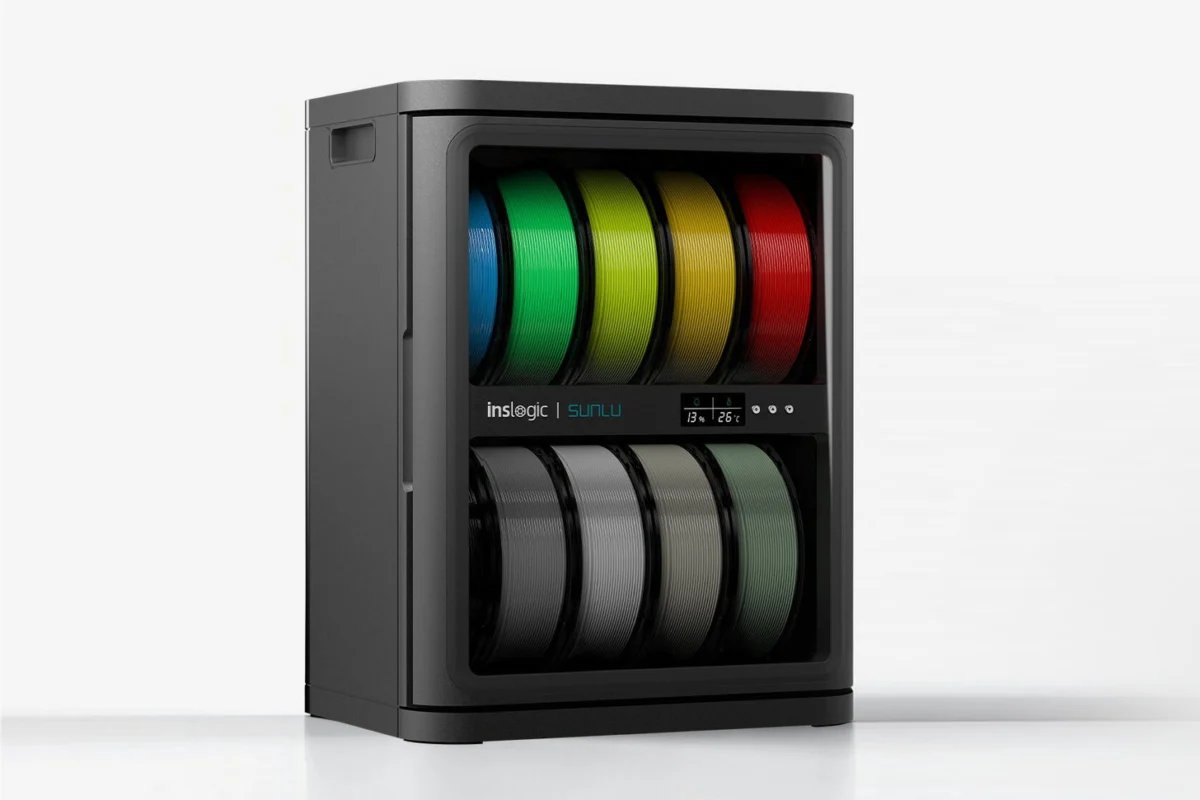
The FilaDC i10 is a dedicated dehumidifying storage cabinet designed to house up to 10 standard 1kg filament spools. Unlike traditional filament dryers that operate by blasting spools with high temperatures—often over several hours—the i10 focuses on maintaining a controlled, low-humidity environment through a dual-effect dehumidification process.
Core Technical Specifications:
- Dehumidification Technology: PTC + Molecular Sieve dual-effect system.
- Capacity: 10 spools (standard 1kg size).
- Operating Philosophy: Room-temperature, non-damaging drying.
- Price: $199 USD.
- Manufacturer: Inslogic / Sunlu.
- User Interface: Digital humidity control with automatic cycling.
The primary appeal of the i10 lies in its "set it and forget it" nature. While traditional dryers are often used as a reactive measure—drying a spool for six hours immediately before a print—the i10 is designed to be a proactive storage environment. By keeping filaments at a consistent, low-humidity level, users can ensure their materials are ready for the printer at a moment’s notice.
Chronology: The Evolution of Filament Care
The history of desktop 3D printing has been defined by a constant battle against material degradation. In the early days of the hobby, users relied on improvised "dry boxes" made from Tupperware containers, silica gel packets, and modified hardware store bins. As the industry matured, the "filament dryer" became a standard accessory.
The Shift to Controlled Storage
For years, the "hot-air" dryer was the undisputed standard. These devices functioned essentially as food dehydrators, using fans and heating elements to bake the moisture out of the plastic. While effective, this approach had several downsides:
- Thermal Fatigue: Repeated heating cycles can eventually alter the chemical properties of the filament, making it brittle.
- Power Consumption: Running a heater for 12+ hours is energy-inefficient.
- Noise: Most active dryers feature loud, buzzing fans that make them unsuitable for long-term use in a home office or bedroom.
The release of the FilaDC i10 marks a turning point in this evolution. By adopting molecular sieve technology—a material with microscopic, uniform pores that trap water molecules—the i10 achieves dry conditions without relying solely on heat. This mirrors the professional-grade dry cabinets used in photography for storing lenses and camera bodies, finally bringing that level of industrial precision to the desktop maker community.
Supporting Data: Testing the Efficacy
In recent testing, the i10 was evaluated based on its ease of setup, operational noise, and its impact on print quality.
Ease of Deployment
The out-of-the-box experience is streamlined. The unit requires minimal assembly: plugging in the power cord and activating the main switch. The accompanying manual is notable for its clarity, providing a comprehensive guide to dehumidification levels. It includes a reference table that maps specific material types to their ideal humidity percentages—a feature often overlooked by budget-friendly manufacturers.
The "Dryness" Benchmark
When testing with five spools of partially used PETG and PLA—materials notorious for stringing when exposed to moisture—the unit performed admirably. Upon placing the spools inside, the cabinet reached the target humidity level with surprising speed.
The most telling metric was the reduction in "oozing" and "stringing." Before using the i10, test prints showed significant webbing between retractions. After 24 hours in the i10 cabinet, those same filaments produced clean, sharp prints with virtually no stringing. This provides objective evidence that the molecular sieve system is effectively drawing moisture out of the filament core without requiring the high-temperature "baking" that often causes the filament to stick to itself on the spool.
Operational Efficiency
The unit features an intelligent "auto-off" cycle. Once the target humidity is reached, the device enters a standby state, periodically waking to monitor and correct the environment. This makes it an incredibly quiet addition to any workspace, a stark contrast to the continuous whirring of traditional dryer fans.

Official Responses and Industry Context
Inslogic and Sunlu have framed the i10 as a "non-damaging" alternative to standard dryers. According to official product documentation, the choice of PTC + molecular sieve technology is intentional to preserve the mechanical properties of the filament.
"Unlike traditional hot-air drying solutions, the i10 introduces a PTC + molecular sieve dual-effect dehumidification technology that enables room-temperature, non-damaging drying," the manufacturers stated. This response suggests an industry pivot toward preservation-first engineering. By avoiding excessive heat, the manufacturer addresses the concerns of high-end users who print with advanced engineering polymers that are sensitive to thermal cycling.
Furthermore, the design choice to allow for 10 spools suggests that the manufacturer views this product as an organizational tool for the "power user." In a market where many users own multiple colors and material types, having a centralized, climate-controlled hub for the entire material library is a significant value proposition.
Implications: Why This Matters for the 3D Printing Community
The introduction of the FilaDC i10 has broader implications for the future of the 3D printing ecosystem.
1. The Death of the "Pre-Print Wait"
One of the greatest frustrations in 3D printing is the need to wait for a spool to dry before starting a project. With the i10, the "wait time" is eliminated. Because the cabinet acts as an active storage solution, the user’s material library is perpetually in a state of readiness. This shifts the workflow from Reactive (Print -> Fails -> Dry -> Print) to Proactive (Storage -> Print).
2. Economic Efficiency
At $199, the i10 is an investment. However, for a user who loses hundreds of dollars in failed prints due to stringing, brittle filament, or layer adhesion issues caused by moisture, the cabinet pays for itself quickly. Furthermore, because it does not require continuous high-heat operation, the long-term energy savings compared to traditional dryers are measurable.
3. Material Longevity
Filament is not cheap. The ability to store 10 spools in a controlled environment means that less material will end up in the trash due to degradation. In an era where sustainability is becoming a greater focus for the maker community, minimizing waste through better storage is a logical and necessary step.
4. Workflow Integration
The quiet operation of the i10 is perhaps its most understated benefit. Modern 3D printing spaces are increasingly integrated into living areas. A device that can perform its function without being a constant source of noise pollution allows for a cleaner, more professional workflow.
Conclusion: Is the i10 Right for You?
The FilaDC i10 is a compelling bridge between entry-level drying solutions and industrial-grade storage cabinets. It offers a refined, user-friendly experience that directly addresses the pain points of moisture-related print failure.
While there are cheaper options on the market, the i10’s capacity, quiet operation, and non-damaging drying technology make it a standout choice for anyone who takes their 3D printing seriously. Whether you are a hobbyist looking to eliminate stringing or a professional managing a diverse library of materials, the i10 offers a reliable, set-it-and-forget-it solution that keeps your filament in peak condition.
For those interested in exploring the technical nuances further or seeking community input on how to best configure the humidity settings for specific brands of filament, the Inslogic community Discord remains an active hub for troubleshooting and optimization. As 3D printing technology continues to advance, tools like the FilaDC i10 remind us that the quality of the print starts long before the nozzle touches the bed—it starts with the condition of the material itself.