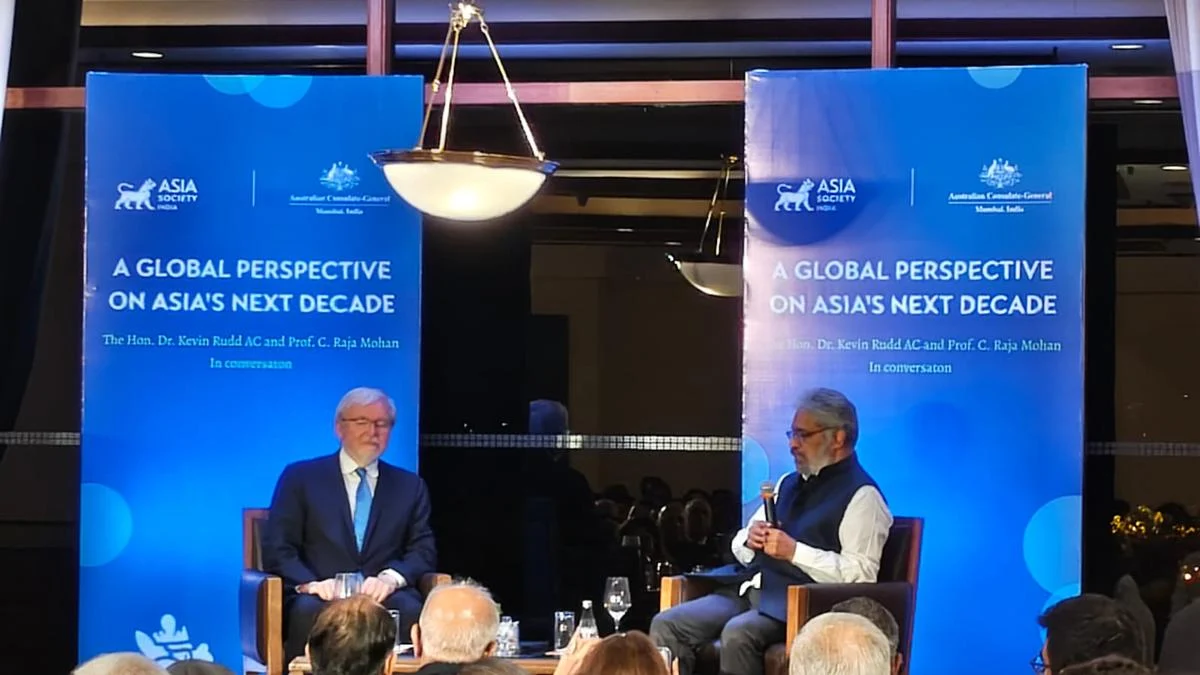
MUMBAI — In a sobering assessment of the rapidly shifting global order, former Australian Prime Minister and current President of the Asia Society, Kevin Rudd, has warned that the world may be sleepwalking toward an "AI-related security crisis" of unprecedented proportions. Speaking at a high-profile event in Mumbai on Thursday, October 8, 2026, Rudd cautioned that without immediate and rigorous diplomatic intervention, the United States and China risk an accidental escalation that could mirror the nuclear brinkmanship of the 20th century.
The event, titled "Navigating the New Geopolitics," was organized by the Asia Society India Centre in collaboration with the Australian Consulate-General. Rudd, a renowned Sinologist and diplomat, engaged in a wide-ranging conversation with foreign policy expert C. Raja Mohan, covering the intersections of artificial intelligence, Indo-Pacific security, and the fragile state of Washington-Beijing relations.
Main Facts: The Warning of "Unmanaged" Competition
The crux of Rudd’s address centered on the lack of international guardrails governing the military and strategic applications of Artificial Intelligence. He argued that the speed of technological development has far outpaced the speed of diplomatic deliberation, leaving a dangerous vacuum where a misunderstanding in the digital realm could lead to kinetic warfare.
Rudd’s primary thesis is that the current political climate—characterized by domestic polarization in the U.S. and hyper-nationalism in China—is preventing the "political center" in both capitals from establishing necessary safeguards. He invoked the specter of the 1962 Cuban Missile Crisis, suggesting that today’s leaders might only find the political will to cooperate after narrowly averting a global catastrophe.
"My fear," Rudd told the audience of diplomats, business leaders, and academics, "is that we are so paralyzed in our politics, domestically and bilaterally, that we are sentencing ourselves to a future where we’ve got to have a Cuban Missile-type crisis in order to galvanize the political center in both capitals to move to act."
The former Prime Minister emphasized that unlike the nuclear era, where the threat was visible and the actors clearly defined, AI-driven conflict could be invisible, rapid, and initiated by autonomous systems before human commanders even realize a breach has occurred.
Chronology: The Road to the 2026 AI Security Dilemma
To understand Rudd’s urgency, one must look at the trajectory of the AI race over the last three years. Since the explosion of generative AI in 2023, the technology has transitioned from a commercial novelty to a core pillar of national defense.
- 2023–2024: The initial "gold rush" where the U.S. established a lead in large language models (LLMs), while China focused on industrial application and facial recognition.
- 2025: A pivot toward "Autonomous Defense Systems." Reports emerged of AI-integrated drones and cyber-offensive tools capable of self-correcting code to bypass firewalls.
- 2026: The current state of "Strategic Friction." The U.S. has intensified export controls on H100 and subsequent generation chips, while China has leveraged its dominance in the energy sector to power massive server farms, closing the gap in "compute" capacity.
Rudd noted that this chronology has led to a "security dilemma" where every defensive advancement by one side is viewed as a provocative offensive capability by the other. The Mumbai event served as a platform to argue that the window for "Managed Strategic Competition" is closing.
Supporting Data: The AI Economy and the "Scale" Factor
Rudd provided a nuanced breakdown of the current standing of global powers in the AI race, moving beyond the binary of who is "winning." He identified three distinct pillars of power:
1. The American Edge: Innovation and Frontier Models
Washington remains the leader in "frontier AI"—the most advanced, high-reasoning models. The United States benefits from a concentrated ecosystem of venture capital, top-tier research universities, and the world’s most sophisticated semiconductor designs.
2. The Chinese Advantage: Energy and Application
Beijing, according to Rudd, holds a significant lead in "energy capacity"—the physical power required to run the massive data centers that sustain AI. Furthermore, China’s top-down governance allows for a more rapid "adoption of AI across the economy," particularly in manufacturing and logistics, creating a highly efficient, AI-integrated domestic market.
3. The Indian Opportunity: The Power of Scale
Rudd was particularly bullish on India’s role, coining the phrase: "With AI, he who scales prevails."

- Workforce: India possesses the world’s largest pool of technically skilled youth, essential for the "human-in-the-loop" requirements of AI development.
- Market: With a domestic consumer base of 1.4 billion people, India offers a unique "data set" that is invaluable for American tech companies looking to refine commercially viable applications.
- Strategic Autonomy: India’s position allows it to be a bridge, potentially setting the standard for how middle powers interact with AI-driven superpowers.
Official Responses and Strategic Perspectives
The conversation in Mumbai also touched upon how regional leaders have responded to these systemic pressures. Rudd provided a defense of the Indian government’s recent foreign policy shifts, particularly regarding China.
On India-China Relations
Following the border skirmishes in Ladakh (2020) and the tensions in Doklam (2017), the Indian government under Prime Minister Narendra Modi implemented a series of "economic deterrents," including bans on hundreds of Chinese apps and stricter scrutiny of Chinese foreign direct investment (FDI).
When asked if New Delhi had "overreacted," Rudd was firm. "It is inevitable that Prime Minister Modi reacted in the manner in which he did," he stated. He argued that these were not merely emotional responses but calculated strategic maneuvers to protect national sovereignty. He suggested that while diplomatic approaches might evolve, the underlying shift in India’s stance toward China represents a permanent realization of the risks involved in over-dependence.
On U.S. Indo-Pacific Commitment
Despite the "domestic political turbulence" currently facing the United States, Rudd dismissed the notion that Washington would retreat from the Indo-Pacific. He argued that U.S. national interests—ranging from the protection of sea lanes to the security of the semiconductor supply chain—are now so deeply entwined with Asia that a withdrawal is strategically impossible, regardless of which party holds the White House.
On the Quad’s Evolution
Rudd highlighted the "growing fabric of engagement" between the militaries of the Quad—specifically the non-American members: India, Australia, and Japan. He noted that the frequency and complexity of joint exercises among these three nations have reached historic levels, creating a resilient regional security architecture that operates alongside, but is not entirely dependent on, U.S. leadership.
Implications: A Call for a New "Digital Diplomacy"
The implications of Rudd’s warnings are profound for both policymakers and the private sector. He outlined a roadmap for what he calls "Managed Strategic Competition," which requires four immediate actions from the global community:
- Standardized Testing Protocols: Establishing international "red-teaming" standards for advanced AI models before they are deployed in sensitive infrastructure.
- Cyber-Incident Reporting: A formal mechanism where the U.S. and China (and other powers) report major cyber-breaches to a neutral or bilateral body to prevent misattribution.
- Verification Mechanisms: Developing ways to verify that AI systems are not being integrated into nuclear command-and-control structures—a "No-AI-on-the-Trigger" policy.
- Critical Mineral Cooperation: Rudd noted that the transition to an AI and green economy requires rare earth minerals. He suggested that the U.S. needs access to these minerals, while China seeks relief from American tariffs. This creates a potential "grand bargain" area where trade could stabilize security tensions.
The Corporate Risk Profile
Addressing the business leaders in the room, Rudd identified a "triple threat" for the late 2020s:
- Geopolitical Instability: The risk of sudden decoupling or sanctions.
- Emerging Technologies: The disruption of traditional business models by autonomous systems.
- Climate Change: The physical and regulatory risks of a warming planet.
He warned that while corporations are getting better at managing climate and tech risks, they remain dangerously exposed to geopolitical "black swan" events.
Conclusion
Kevin Rudd’s address in Mumbai serves as a clarion call for a new era of "preventative diplomacy." By framing the AI race not just as a commercial competition but as a potential "Cuban Missile Crisis" in the making, he has raised the stakes for the upcoming diplomatic cycles.
As the event concluded, the sentiment in the room was one of cautious urgency. The "strategic silence" between the world’s leading tech powers cannot hold indefinitely. For India, Australia, and the broader Indo-Pacific, the challenge will be to build the "fabric of engagement" that Rudd described—ensuring that when the inevitable AI crisis arrives, the world has the protocols in place to ensure it remains a footnote in history rather than a final chapter.
About the Speaker: Kevin Rudd served as the 26th Prime Minister of Australia and is currently the President and CEO of the Asia Society. He is a leading authority on Chinese politics and international relations, and the author of "The Avoidable War: The Dangers of a Catastrophic Conflict between the US and Xi Jinping’s China."