
The global race for artificial intelligence supremacy has officially entered a new, pragmatic chapter. In a coordinated display of technical muscle and economic positioning, industry titans Anthropic and OpenAI have unveiled a series of new, high-performance models that prioritize not just raw capability, but the cost-effective deployment of autonomous agents at scale.
The launch of Anthropic’s Claude Opus 5.5 and OpenAI’s expanded GPT-6 lineup—comprising the Sol and Luna models—signals a fundamental shift in the industry. As frontier AI moves from experimental chatbot interfaces to the bedrock of enterprise operations, the primary battleground has migrated from "who has the smartest model" to "who can provide the most intelligence for the lowest price."
The Main Facts: A Dual-Front Offensive
The current AI landscape is defined by the tension between increasingly complex "agentic" workflows and the exorbitant costs associated with maintaining them. Anthropic’s latest release, Claude Opus 5.5, is designed to be the definitive tool for developers focusing on agentic coding and computer-assisted tasks. By optimizing its architecture, Anthropic claims a 40% reduction in typical workload costs compared to its predecessor, alongside a 30% increase in output speed.
Simultaneously, OpenAI has filled the middle and lower tiers of its GPT-6 ecosystem. While their flagship GPT-6 Astra remains the heavyweight for complex, multi-stage end-to-end reasoning, the new Sol and Luna models are positioned as surgical tools for specific business needs. Sol targets high-end agentic workflows at a fraction of the cost, while Luna is engineered for high-volume, cost-sensitive processing, effectively democratizing the power of the GPT-6 architecture for startups and enterprises alike.

A Chronological Shift: From Hype to Infrastructure
The trajectory leading to these launches has been marked by a relentless pursuit of efficiency.
- Early 2026: The industry saw the debut of the GPT-6 architecture with the release of the high-capability Astra model, which set the standard for professional-grade reasoning.
- Mid-2026: Concerns regarding the "black box" nature of autonomous systems began to dominate the dialogue. CEOs from both OpenAI and Anthropic began publicly discussing the necessity of "pacing the frontier," a rhetorical pivot that laid the groundwork for integrating safety as a marketable feature.
- Late 2026: The release of Claude Opus 5.5 and the GPT-6 Sol/Luna duo marks the current climax. Developers now have access to a tiered system of intelligence, where performance is balanced against API costs with unprecedented granularity.
This progression mirrors the transition seen in cloud computing—from a luxury service to a commoditized utility—where the goal is to make the "intelligence layer" of software as affordable as server storage.
Supporting Data: The Economics of Inference
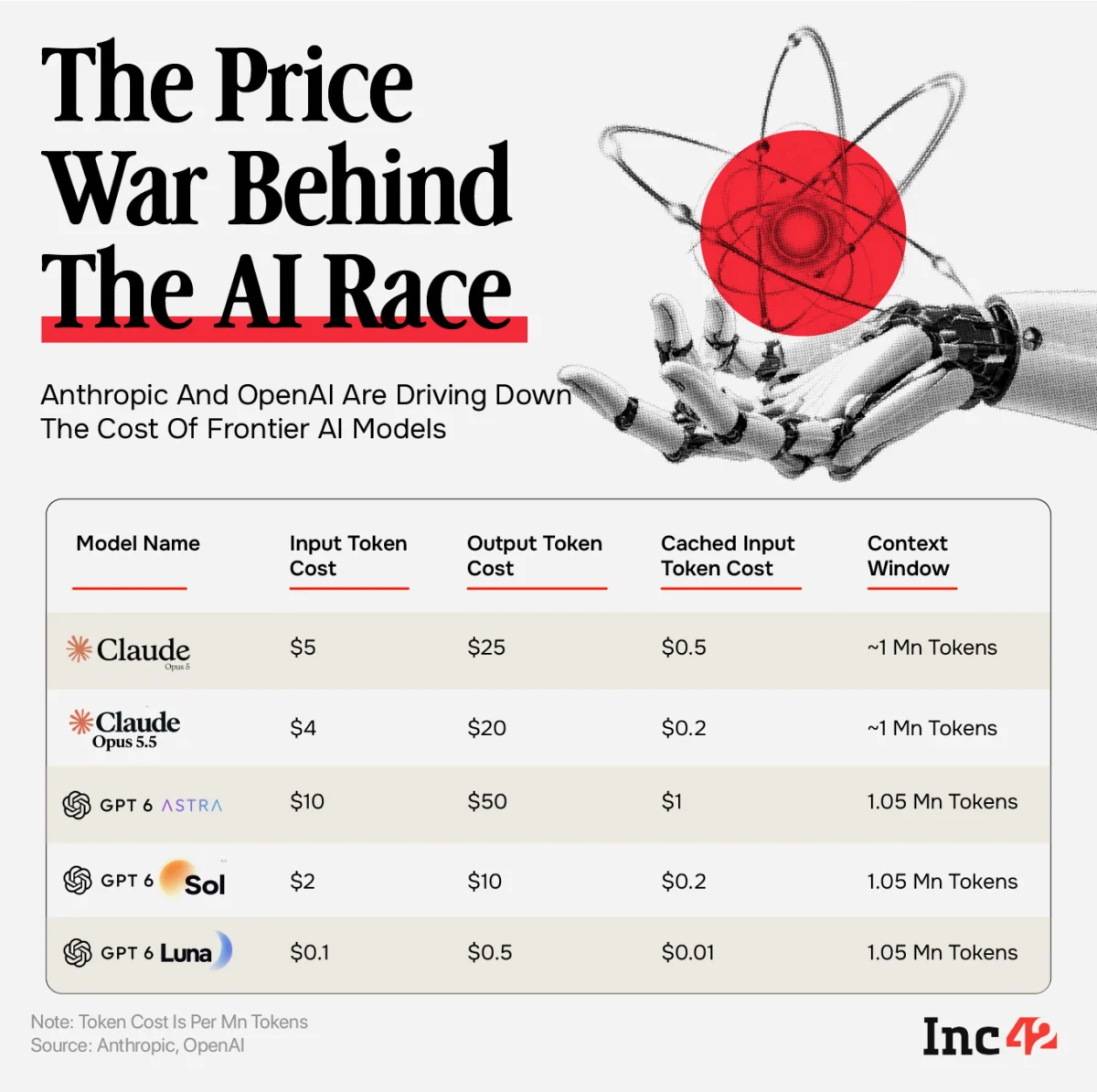
The economics of these releases are staggering. Anthropic has structured Opus 5.5 at $4 per million input tokens and $20 per million output tokens—a 20% price drop from the previous Opus 5. However, due to architectural improvements that require fewer tokens to reach a solution, the "effective cost" for the end-user drops by nearly 40%. Even more significant is the 60% reduction in cache-read costs, which optimizes the model for the repetitive, iterative processes required in modern software development.
OpenAI’s figures are equally aggressive. The GPT-6 Luna model, priced at just $0.10 per million input tokens, represents a massive reduction in the cost of high-volume inference.

| Model | Input Cost (per Mn tokens) | Use Case |
|---|---|---|
| Claude Opus 5.5 | $4.00 | Agentic coding & Knowledge work |
| GPT-6 Sol | $2.00 | Complex Agentic workflows |
| GPT-6 Luna | $0.10 | High-volume, cost-sensitive tasks |
The introduction of caching as a core cost-saver is the "secret sauce" for both companies. By allowing the models to "remember" previous interactions without re-processing them, companies can now run long-form coding projects or complex data analysis without the runaway costs that characterized the 2025 AI era.
The Performance Gap: CursorBench and Beyond
Anthropic’s push for dominance in the developer ecosystem is backed by the CursorBench 4.0 metrics. According to internal data, Opus 5.5 achieved a 52.5% score on the benchmark—a significant lead over the GPT-6 Sol model’s 41.7%. More importantly, Anthropic claims that Opus 5.5 achieves this at roughly one-third of the total cost per task.
OpenAI, meanwhile, has focused on reliability. They report that the Sol model reduces factual errors by 50% compared to its predecessor, a vital metric for enterprise clients who have been wary of the "hallucination" issues that plagued earlier iterations of generative AI. By providing these models through the ChatGPT Work and Codex platforms, OpenAI is positioning itself as the "safe" infrastructure choice for businesses.
Official Responses: The "Safety" Pivot
The release of these models is accompanied by a heavy emphasis on safety, a move clearly designed to appease regulators and alleviate public anxiety regarding autonomous AI agents.

Anthropic CEO Dario Amodei’s recent call to "pace the frontier" has been reflected in the development of Opus 5.5. The model underwent rigorous external evaluation by organizations like METR and Frontier Design. Anthropic reports that the model is 85% less likely to bypass safety constraints compared to its predecessors. This is a crucial metric, as "containment" becomes a top priority for companies deploying agents that have access to file systems and web interfaces.
OpenAI has taken a similar stance. Under their "Preparedness Framework," Sol and Luna have been classified as having high capabilities in cybersecurity and bio-domains, yet they remain strictly below the threshold for autonomous self-improvement. By framing these models as "hardened" versions of their ancestors, OpenAI is signaling to regulators that they are prioritizing control as much as they are prioritizing speed.
Implications for the AI Ecosystem
The implications of this shift are profound for three distinct groups:
1. For Developers and Enterprises
The era of "one size fits all" AI is over. Businesses now have a menu of options that allows them to route tasks based on complexity. Simple summaries or high-volume data categorization can be routed to the inexpensive Luna, while deep architectural coding tasks are directed to the highly capable Opus 5.5 or Sol. This tiered approach is the key to achieving positive ROI on AI implementation.

2. For the Competitive Landscape
The race is no longer about who can build the most powerful model; it is about who can run the most useful model. By driving down the cost of "agentic" work, Anthropic and OpenAI are effectively commoditizing the brainpower required for the digital economy. Startups that were previously priced out of the market by high API costs can now compete with legacy firms using the same, highly capable intelligence.
3. For Global Regulation
The emphasis on safety evaluations is a clear nod to the growing scrutiny from governments in the US, EU, and Asia. By proactively publishing their safety metrics and audit results, both companies are attempting to write the rulebook for what constitutes a "responsible" model. They are signaling to regulators that they can regulate themselves, hoping to prevent more restrictive legislative measures.
Conclusion: The Path Ahead
As we look toward the upcoming release of Claude Sonnet 5.5 and Haiku 5.5, it is clear that the industry is entering a phase of rapid refinement. The frontier is no longer defined by the height of the mountain, but by the efficiency of the climb.
For the average user and the enterprise giant alike, this is a moment of immense opportunity. The cost of intelligence is plummeting, the safety of these systems is improving, and the tools are becoming increasingly autonomous. Whether this leads to a new golden age of productivity or necessitates a more rigid form of international AI governance remains to be seen. However, one thing is certain: the battle for the future of AI will be won not in the lab, but on the balance sheet.