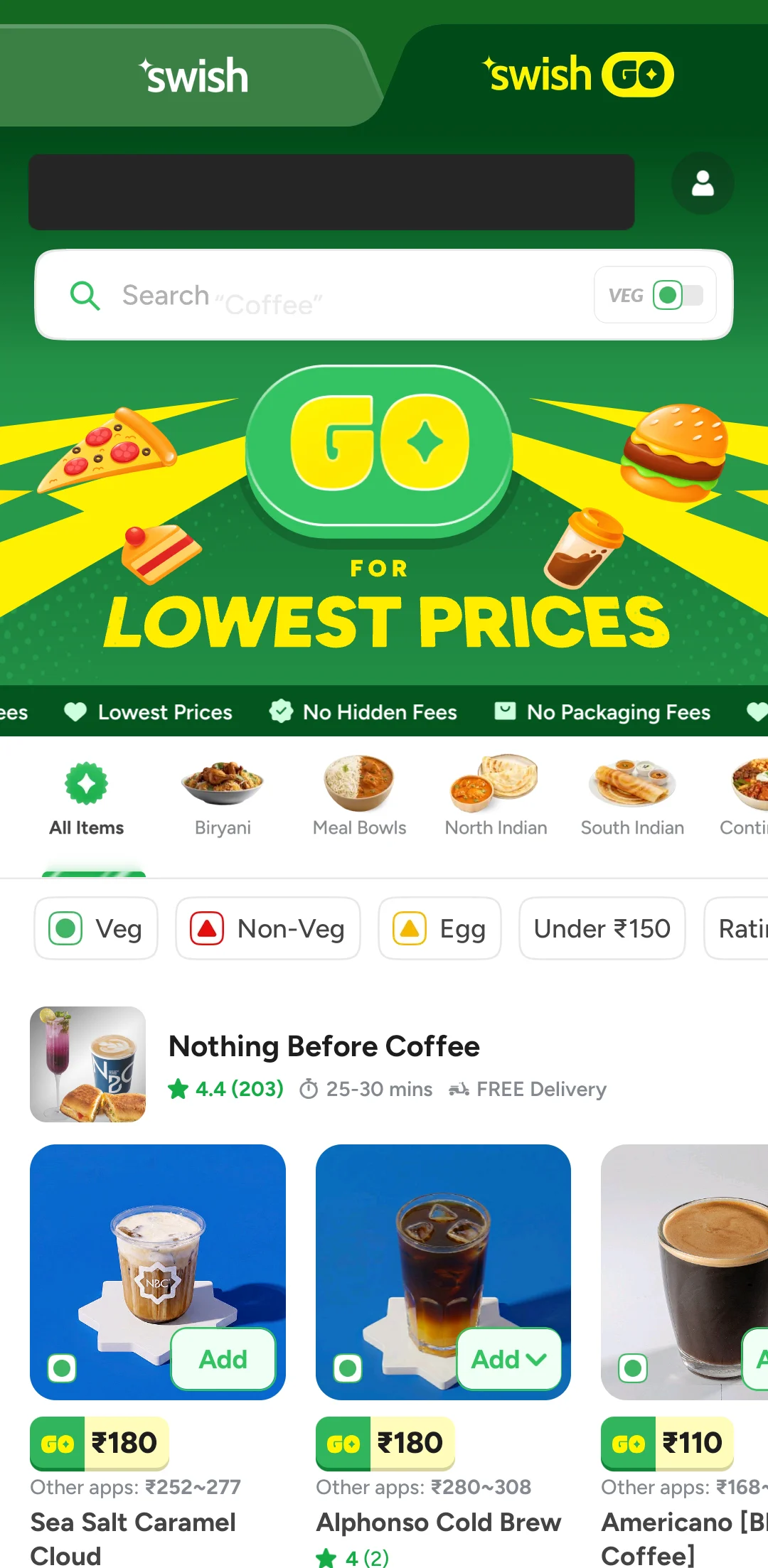
In a significant strategic departure from its origins, the rapid-delivery food startup Swish has launched a new service, Swish Go. By opening its platform to third-party restaurants and cloud kitchens, the company is moving away from its strictly "full-stack" operational model—where it previously only sold food prepared in its own, company-owned kitchens—to compete directly in the broader, hyper-competitive food delivery landscape.
This pivot marks a pivotal moment for the two-year-old startup, which has carved a niche for itself by promising ultra-fast, 15-minute food delivery. With "Swish Go," the company is shifting gears to capture a different segment of the market: consumers who prioritize affordability and variety over the lightning-fast speed of its core offering.
Main Facts: What is Swish Go?
Swish Go is currently being piloted in select pin codes across Bengaluru. Unlike the core Swish service, which operates as a vertical integration play, Swish Go functions as a marketplace. It aggregates food from established QSR (Quick Service Restaurant) brands and cloud kitchens, including Nothing Before Coffee, Mealy, and Taaka Chinese.
The core value proposition of Swish Go is its pricing structure. In an era where food delivery platforms are frequently criticized for bloated "platform fees," "packaging charges," and "surge pricing," Swish Go is advertising itself as a fee-transparent alternative. By eliminating packaging and platform fees, the startup is aggressively positioning itself as a consumer-friendly option in an inflationary market.
However, there is a trade-off. The company has made it clear that Swish Go does not adhere to the 15-minute fulfillment promise that defines its parent brand. Customers using the new feature should expect longer wait times, as the operational logistics for third-party deliveries differ significantly from the proprietary kitchen model.
Chronology: From Vertical Integration to Marketplace
The Early Days (2024)
Founded in 2024 by Aniket Shah, Ujjwal Sukheja, and Saran S., Swish entered the market with a high-conviction bet on the full-stack model. By owning the entire supply chain—from the ingredients in the pantry to the rider delivering the final box—Swish sought to bypass the inefficiencies that plague traditional food delivery aggregators.
Scaling the Footprint
The startup rapidly scaled its operations, expanding to nearly 50 pin codes across major Indian metros, including Bengaluru, Gurugram, Noida, Delhi, and Ghaziabad. This growth was fueled by substantial investor confidence, with the company raising $78 million in total funding from marquee investors such as Accel, Bain Capital Ventures, Hara Global, and Alteria Capital.
The Recent Pivot (Late 2026)
Following a successful $24 million funding round led by Bertelsmann India Investments, the company began evaluating its growth levers. Recognizing the limitations of scaling physical kitchen infrastructure to match the reach of legacy platforms, the leadership team conceptualized Swish Go. The launch in late 2026 signals a recognition that while full-stack models offer quality control, a marketplace model offers the scale necessary for long-term viability.
Supporting Data: The Economics of Quick Delivery
The landscape of quick-commerce food delivery is littered with the remnants of failed experiments. Swish’s pivot occurs against a backdrop of intense market consolidation and economic skepticism.
The "Death" of 15-Minute Delivery
The industry has seen several high-profile failures in the quest for "instant" food.

- Swiggy SNACC: Earlier this year, food delivery giant Swiggy shuttered its dedicated 15-minute delivery app, SNACC, citing concerns over unit economics.
- Zing: Delhi-NCR based startup Zing also ceased operations, admitting that it had significantly overestimated the consumer appetite for ultra-fast delivery, particularly when weighed against the high cost of maintaining such a tight logistical loop.
Financial Backing
Swish’s current war chest, totaling $78 million, provides a buffer that many of its predecessors lacked. However, the move into the marketplace model requires a different set of financial metrics. Unlike the kitchen-first model, which relies on gross margins from food production, the marketplace model relies on take rates, delivery fees, and operational efficiency across a vast network of third-party vendors.
Strategic Implications: A Three-Way War for Affordability
Swish Go does not exist in a vacuum. It is a direct response to the "affordability war" currently unfolding in the Indian food delivery sector.
The Competitors: Toing and Ownly
Swish is entering a space occupied by two major challengers:
- Rapido’s ‘Ownly’: Rapido, the mobility unicorn, introduced Ownly to capitalize on the growing resentment among restaurant owners regarding the high commission structures of Swiggy and Zomato. By charging zero commissions, Ownly seeks to lower prices for consumers while keeping restaurants happy.
- Swiggy’s ‘Toing’: In response to the market shift, Swiggy launched Toing. This sub-service focuses on "affordability without deep discounting." Toing optimizes costs by batching orders and restricting delivery radii, ensuring that the platform can provide service at lower price points without eroding its EBITDA targets.
The Impact on Restaurant Partners
The restaurant industry has long been the primary stakeholder in the delivery ecosystem. Swish Go’s promise of no packaging or platform fees creates a strong incentive for mid-sized cloud kitchens to experiment with the platform. If Swish can maintain these transparent pricing structures, it may successfully siphon off volume from dominant players who are currently struggling with merchant churn due to high commission rates.
Official Responses and Industry Outlook
Inc42 reached out to the founders of Swish for comment regarding the long-term vision of the Go feature. While the company has yet to release a formal statement, industry analysts suggest that this move is a "hedging strategy."
"By operating both a full-stack premium model and a marketplace value model, Swish is attempting to cover the entire spectrum of the urban diner’s needs," says one industry observer. "If the 15-minute model is for the time-strapped office worker, Swish Go is for the family looking for an affordable, variety-rich meal. It’s a classic platform expansion play."
However, the challenge remains: Operational complexity. Managing a fleet for two distinct delivery speeds—one hyper-fast and one standard—requires sophisticated algorithmic management. If the user experience on Swish Go is not seamless, it risks damaging the brand equity built by its core, high-speed service.
Conclusion: The Road Ahead
Swish is currently at a crossroads. Its transition from a vertically integrated "kitchen-to-door" service to a hybrid platform is a testament to the volatility of the Indian quick-commerce market. The startup has proven that it can build a high-quality, fast-delivery brand, but the market is now demanding a balance between speed and cost-efficiency.
As Swish Go expands to more pin codes, the company’s ability to manage its take rates, satisfy third-party restaurant partners, and maintain its technological edge will determine if it can stand toe-to-toe with giants like Swiggy and Zomato. The company is no longer just selling food; it is now selling a delivery network. Whether this pivot leads to sustainable profitability or adds to the list of failed experiments remains to be seen.
For now, the consumers of Bengaluru are the primary beneficiaries of this competition, enjoying a period of reduced fees and increased optionality as these startups fight for dominance in one of the world’s most dynamic food-tech ecosystems.