In the modern corporate ecosystem, financial precision is the bedrock of operational stability. A single missed payment can trigger a domino effect, damaging vendor relationships and eroding cash flow, while a minor entry error in a ledger can compromise the integrity of high-level financial reporting. Consequently, the role of a Finance Executive has evolved from a back-office function to a strategic pillar that ensures a business remains accurate, compliant, and fiscally agile.
For employers, the challenge lies in sourcing talent that can navigate this complexity. This starts with a meticulously crafted job description (JD). A well-defined JD acts as both a filter for candidates and a roadmap for the role, ensuring that the expectations set on day one align with the actual financial operations of the organization.
The Strategic Importance of a Precise Job Description
A finance executive is responsible for the lifeblood of an organization: its money. Their portfolio typically encompasses accounting, bank reconciliations, accounts payable (AP) and receivable (AR), Management Information System (MIS) reporting, and rigorous regulatory compliance. When a job description is vague, it invites unqualified applicants and misaligned expectations.
By defining the parameters of the role—including the specific tax frameworks (like GST and TDS), ERP proficiencies, and Excel competencies—employers can attract candidates who possess the technical acumen required for the modern digital workspace.
Key Sections: The Anatomy of an Effective JD
To build a high-performing finance team, your job description must be granular. Avoid generic platitudes; instead, focus on the specific mechanical requirements of the role.

1. Company Context and Mission
Candidates are not just looking for a salary; they are looking for a culture. Introduce your company’s industry, its scale, and the specific role the finance team plays in supporting the broader business objectives. If your firm is a high-growth startup, emphasize agility; if it is a legacy financial firm, emphasize stability and rigorous compliance.
2. The Job Summary: Beyond the Basics
Avoid using a one-size-fits-all summary. Clearly define the "why" of the role. Does this executive report to the Finance Manager or the CFO? What are the primary KPIs (Key Performance Indicators) for this position? Providing this context allows the applicant to visualize their daily workflow.
3. Roles and Responsibilities: The Daily Grind
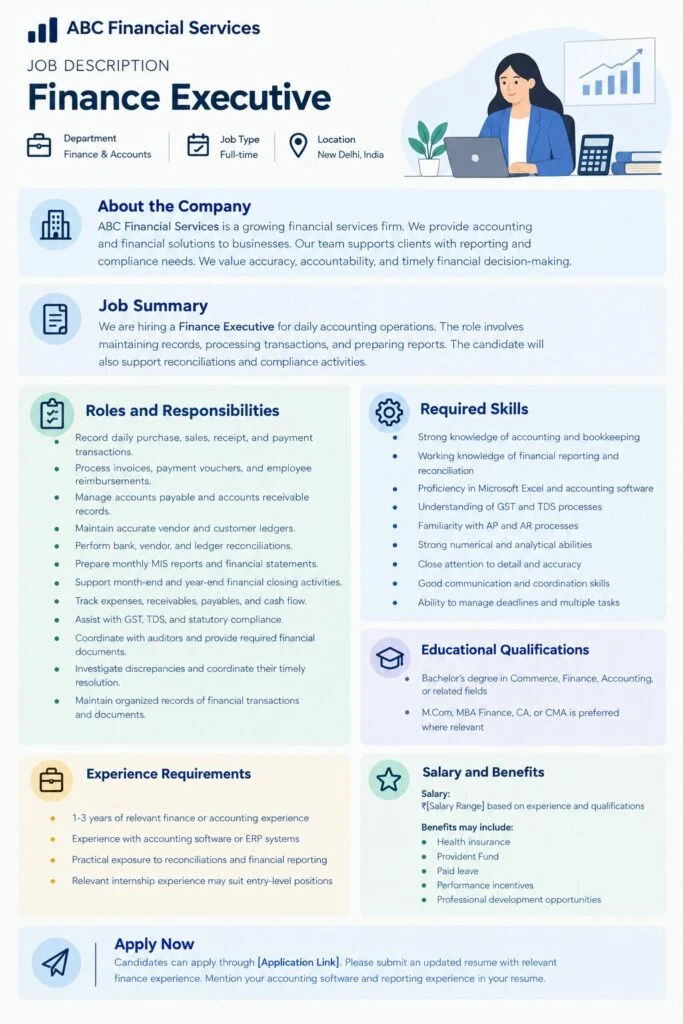
This is the most critical section. It should detail the specific tasks that occupy the employee’s time. Examples include:
- Transaction Management: Recording daily purchases, sales, and payment vouchers.
- Ledger Maintenance: Ensuring accuracy in vendor and customer accounts.
- Compliance: Assisting in GST/TDS filings and liaising with external auditors.
- Reporting: Preparing monthly MIS reports to support leadership in decision-making.
4. Technical Skills and Software Proficiency
In an era of digital accounting, technical skills are non-negotiable. Specify the software your company utilizes—whether it is Tally, SAP, Oracle, or proprietary cloud-based ERPs. Mentioning proficiency in Advanced Excel (Pivot tables, VLOOKUP, macros) is essential, as this remains the universal language of finance.
Chronology of the Hiring Process: A Strategic Timeline
Hiring a finance executive should not be an ad-hoc process. To ensure quality, follow a structured timeline:

- Phase One: Requirement Definition (Days 1–3): Map out the current pain points in your finance department. Does the team struggle with reconciliations? Is the reporting cycle too slow? Identify these gaps to shape the JD.
- Phase Two: Sourcing and Advertisement (Days 4–14): Deploy the JD across professional platforms. Ensure the post highlights the "what’s in it for them" aspect, such as professional development or mentorship.
- Phase Three: Skill-Based Screening (Days 15–20): Move beyond resume screening. Use practical assessments, such as a mock bank reconciliation or an Excel data analysis task.
- Phase Four: Interviewing (Days 21–25): Focus on behavioral and technical interviews. Assess how the candidate handles high-pressure situations, such as audit deadlines or fiscal year-end closures.
- Phase Five: Onboarding (Day 30+): Ensure the new hire is integrated into the financial systems and introduced to the relevant stakeholders early to maintain continuity.
Supporting Data: Why Specialized Roles Matter
According to industry trends, finance executives with dual expertise—blending traditional accounting with modern ERP software skills—are 35% more likely to be retained long-term. Furthermore, businesses that provide clear, transparent salary ranges in their job postings see a 40% increase in qualified applicant volume.
The requirement for specialized knowledge, such as GST and TDS, is no longer a "nice-to-have" but a mandatory operational requirement in most jurisdictions. Ignoring these specifics in a JD leads to higher turnover, as new hires quickly realize they lack the necessary technical background to meet the firm’s compliance needs.
Official Perspectives: What Employers and Recruiters Say
"The biggest mistake employers make is being too generic," notes a senior recruitment consultant. "A Finance Executive in a retail firm has vastly different daily tasks than one in a manufacturing plant. The former deals with high-volume, low-value transactions, while the latter deals with inventory valuation and complex COGS (Cost of Goods Sold) calculations. The JD must reflect these nuances."
Furthermore, recruiters emphasize that soft skills—specifically "attention to detail" and "integrity"—should be highlighted as essential traits. In finance, accuracy is not just a skill; it is a professional obligation.
Implications of a Well-Executed Hire
A successful hire, backed by a precise job description, has profound implications for your business:

- Reduced Financial Leakage: A competent executive catches discrepancies early, saving the company significant capital.
- Improved Audit Readiness: With proper documentation and regular reconciliations, year-end audits become a smooth, non-disruptive process.
- Strategic Decision Support: When the MIS reporting is accurate and timely, the leadership team can make informed decisions based on real-time data rather than lagging indicators.
Sample Job Description Template
Role: Finance Executive
Location: [City, State]
Experience: 1–5 Years
About the Role:
[Insert company description here.]
Key Responsibilities:
- Manage the full-cycle accounts payable and receivable process.
- Execute daily bank and ledger reconciliations.
- Prepare monthly financial statements and management reports.
- Coordinate with external auditors and regulatory bodies for tax filings.
Required Skills:
- Bachelor’s degree in Commerce/Finance.
- Expertise in ERP software and Microsoft Excel.
- Deep understanding of GST, TDS, and statutory compliance.
- Analytical mindset with a focus on data accuracy.
Benefits:

- Competitive salary based on experience.
- Comprehensive health insurance and retirement benefits.
- Opportunities for professional certifications (CPA/CMA sponsorship).
Conclusion
The Finance Executive is the guardian of a company’s financial health. By investing time in drafting a comprehensive, transparent, and accurate job description, you move beyond the "hiring by chance" model and into a "hiring by design" strategy. Whether you are a startup or an established enterprise, the principles remain the same: define the needs, assess the skills, and communicate the value.
When you align the right talent with the right set of expectations, you aren’t just filling a vacancy; you are fortifying the financial backbone of your entire organization. Use the tools provided—from AI-powered hiring platforms to structured assessment tasks—to ensure that your next hire is a catalyst for long-term growth and stability.