
By Editorial Staff
October 10, 2026
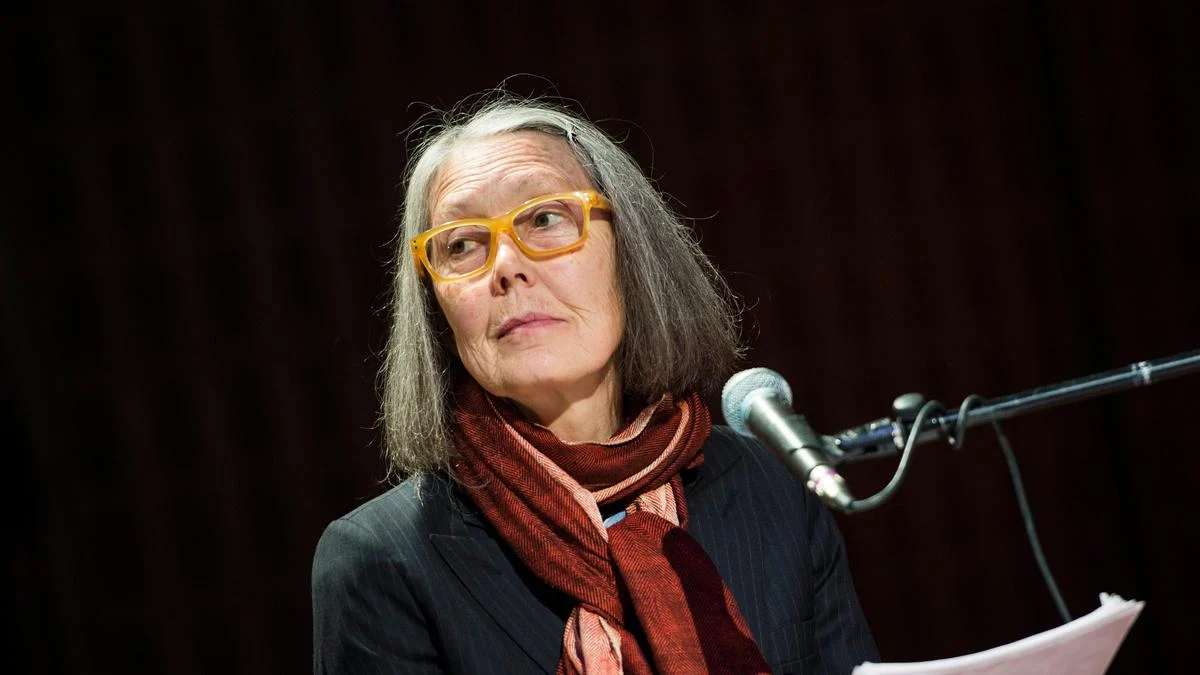
In an era increasingly dominated by the rapid, often sterile generation of artificial intelligence, the Swedish Academy has made a profound statement about the enduring value of human consciousness. Anne Carson, the 76-year-old Canadian poet, essayist, translator, and classicist, has been awarded the 2026 Nobel Prize in Literature. The decision is being hailed by critics worldwide not merely as an acknowledgment of a singular career, but as a victory for the kind of literary experimentation that refuses to be categorized.
The Academy’s citation lauded Carson for her "bold and inventive oeuvre that, in playful dialogue with the classical tradition, has created new forms for contemporary literature." In doing so, the Nobel Committee has validated a writer whose work exists in the interstitial spaces between disciplines—where poetry bleeds into prose, scholarship into confession, and the ancient world into the hyper-modern.
The Weight of Expectation: A Rare Win for a Favorite
Every autumn, the literary world engages in a ritual of speculation. The Nobel Prize in Literature, governed by the Swedish Academy’s famously opaque processes—which keep nomination lists sealed for 50 years—is notoriously difficult to predict. While the Academy is known for springing surprises, this year they opted for a bookmaker’s favorite, a move that signals a rare alignment between critical acclaim and popular prediction.
Carson’s victory is also a continuation of the Academy’s decade-long effort to correct historical gender imbalances. As the 19th woman to receive the prize among 123 laureates, her selection highlights a slow but steady shift in the institution’s canon-building priorities. For Carson, a writer who has spent decades dismantling the "great man" theories of history, the recognition feels fittingly subversive.
A Life of Intellectual Daring: Chronology of an Oeuvre
To understand the significance of this prize, one must look at the trajectory of a career defined by its refusal to sit still. Born in Toronto in 1950, Carson’s academic background in ancient Greek provided the scaffolding for a body of work that is as rigorous as it is emotionally devastating.
The Foundational Years (1986–1998)
Carson burst onto the literary scene with Eros the Bittersweet (1986). A reworked version of her PhD thesis, the book was an early indicator of her methodology: it did not merely analyze Sappho; it performed the act of longing. By examining the Greek concept of lack, Carson established the themes that would define her life’s work: desire, distance, and the inherent failure of language to fully capture the human experience.
This was followed by Short Talks (1992), a collection that showcased her mastery of the lyric fragment. However, it was Autobiography of Red (1998) that cemented her reputation as a visionary. By reimagining the ancient Greek myth of Geryon and Heracles as a contemporary queer coming-of-age story, Carson proved that antiquity was not a dusty relic, but a living, breathing landscape capable of hosting modern trauma and joy.
The Middle Period and the T.S. Eliot Breakthrough (2001–2010)
In 2001, Carson published The Beauty of the Husband, a semi-autobiographical narrative poem exploring the slow, agonizing disintegration of a marriage. It was a masterclass in juxtaposition: she threaded the brutal intimacy of her personal experience with the elegant, rigid structure of the tango and the Romantic longing of John Keats. When she became the first woman to win the T.S. Eliot Prize for this work, the literary establishment finally recognized that Carson was operating in a register few others could access.
The Experimental Avant-Garde (2010–Present)
Her later works have consistently pushed the physical and conceptual boundaries of the book. Nox (2010) is perhaps the most radical example—a heart-wrenching elegy for her brother, presented as an accordion-fold book housed in a box filled with photographs, scraps of letters, and dictionary definitions. It challenged the very definition of what a book is, forcing the reader to engage with the text as a physical artifact. Red Doc (2013) continued the Geryon narrative, while Float (2016)—a collection of 22 chapbooks in an acetate case—offered a nonlinear reading experience that perfectly mirrored the instability of the modern condition.
The Anatomy of a Genius: Supporting Data and Methodology
Carson’s work is characterized by what critics call "strange juxtapositions." She is a translator who treats ancient texts not as sacred artifacts, but as raw material to be interrogated. Her translation of Aeschylus’s Agamemnon or Sophocles’ Antigone is never a simple act of linguistic transfer; it is a creative act of resurrection.
Her influence extends beyond the printed page. Carson has frequently collaborated with theatre directors, choreographers, and visual artists, viewing performance as an extension of the essay. This interdisciplinary approach is essential to understanding her Nobel win. The Academy is not merely rewarding a "poet" or a "classicist"; they are rewarding a polymath who has redefined the capacity of the human imagination.
Key Characteristics of the Carsonian Style:
- The Fragmented Narrative: An avoidance of linear progression in favor of associative leaps.
- Classical Integration: Using the ancient world as a mirror for modern, often queer or personal, experience.
- Physicality: Treating the book as an object, an elegy, or a site of artistic performance.
- Linguistic Precision: A paradoxical blend of academic rigor and raw, unvarnished emotional honesty.
Official Responses and Global Reception
The response from the literary community has been one of near-unanimous celebration. "Anne Carson is the writer we need for this specific moment in history," noted one prominent critic at the announcement in Stockholm. "She doesn’t offer us the comfort of neat conclusions. She offers us the honesty of the fragment."
The Nobel Committee, in their official statement, emphasized that Carson’s work "belongs in no category in particular, and everywhere at once." This sentiment has been echoed by literary societies across the globe. Unlike many laureates whose work is bound to a specific national identity or political movement, Carson’s writing is universal in its concern with the mechanics of desire and the inevitability of loss.
Implications: A Stand Against "AI Slop"
Perhaps the most striking subtext of this year’s award is the timing. We live in a period where Large Language Models are churning out vast quantities of "content"—a phenomenon often derided by the creative class as "AI slop." In this context, the Nobel Prize for Anne Carson serves as a powerful, if unspoken, manifesto.
Carson’s work is the antithesis of the algorithm. It is difficult, deeply personal, physically idiosyncratic, and rooted in a lifetime of specialized human knowledge. Her writing never simplifies the complexities of the human condition; it refuses to provide the "neat conclusions" that an AI might offer to satisfy a prompt. By choosing a writer who dismantles boundaries, the Swedish Academy has reminded us that literature is not a product to be generated, but a high-stakes, deeply human act of resistance.
Conclusion: The Limitless Possibilities
As the world turns its attention to Anne Carson’s body of work, the implications for the future of letters are clear. We are entering an era where the definition of "literature" must expand to include the experimental, the interdisciplinary, and the unconventional.
Carson has spent her career proving that the ancient is never truly gone, that our contemporary sorrows are echoes of past ones, and that the page is a place where anything can happen. In a digital age that threatens to flatten our experiences, Anne Carson’s Nobel Prize is a beacon. She reminds us that the human imagination is not a database, but a wild, untamable space that continues to hold the only truths worth seeking.
Whether she is translating the despair of a Greek tragedy or documenting the tango of a failed marriage, Carson remains a singular force—a reminder that in the face of uncertainty, the most radical thing one can do is to write, and to write with everything one has.