If you have spent any time in the "Customize" settings of your Claude interface, you have likely encountered a trio of terms that often appear together but perform vastly different functions: Skills, MCP (Model Context Protocol) connectors, and Plugins. In the rapidly evolving landscape of AI-driven productivity, these terms are frequently used interchangeably, leading to confusion for power users and IT administrators alike.
However, distinguishing between them is not merely a semantic exercise; it is the key to unlocking true operational efficiency. By understanding how these three components interact, teams can transition from using AI as a basic chatbot to utilizing it as a sophisticated, integrated engine for business logic.
The Core Distinction: Procedure, Access, and Distribution
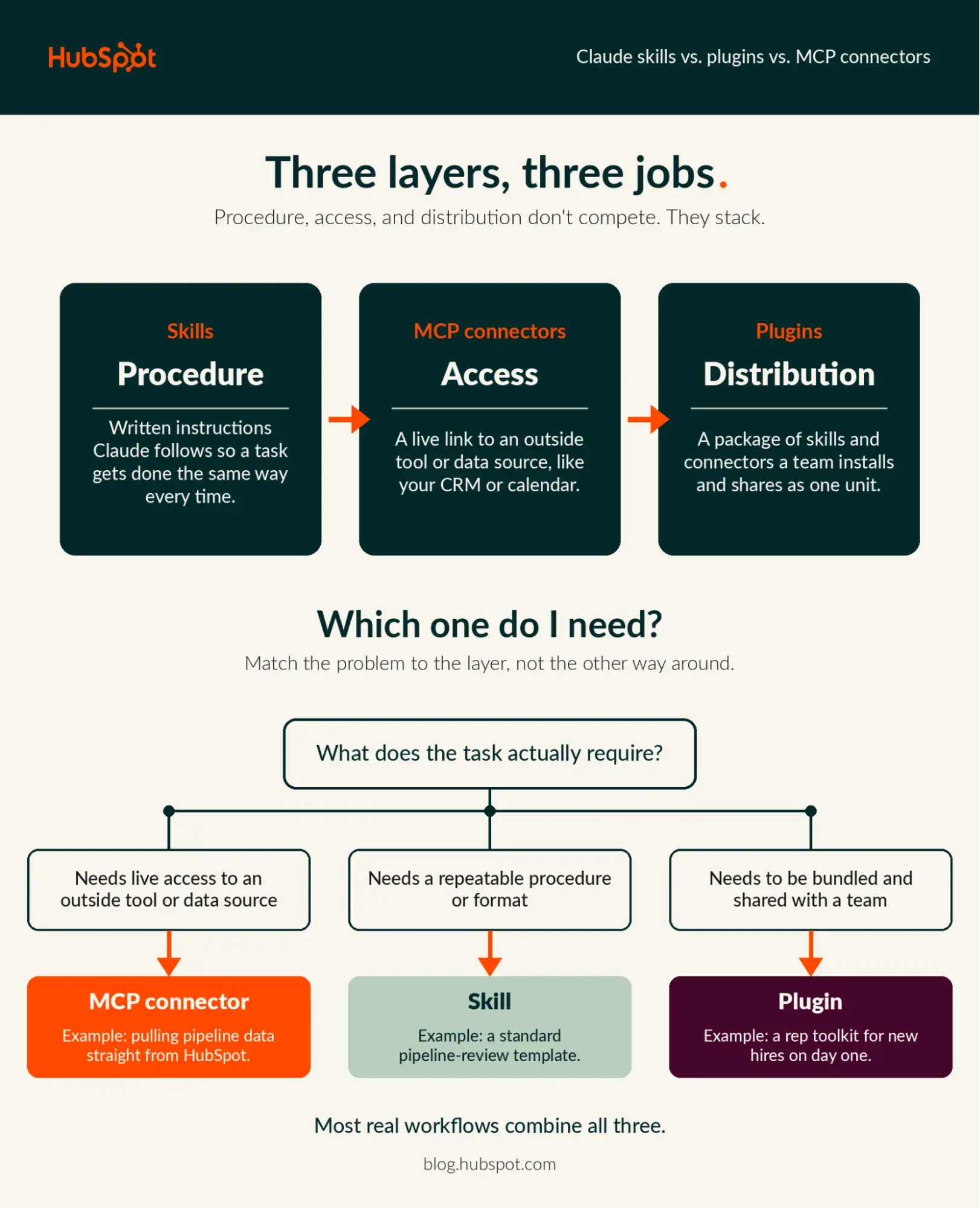
To simplify the Claude ecosystem, it is best to view these components through the lens of a three-tier architecture: Access, Procedure, and Distribution.
1. MCP Connectors: The "Access" Layer
An MCP connector serves as the bridge between Claude and the external world. Through the Model Context Protocol (MCP), a standardized interface, Claude can securely "reach out" to your existing data repositories—whether that is a CRM like HubSpot, a project management tool, or a cloud storage drive. When you enable a connector, you are essentially granting Claude the "eyes" to read your data and the "hands" to take authorized actions within those external services. Critically, these connectors operate within your existing security and permission frameworks, ensuring that Claude never accesses data that a human user wouldn’t be allowed to see.
2. Skills: The "Procedure" Layer
While a connector provides the "where" and "what," a Skill provides the "how." A Skill is a set of defined instructions, logic, and reference materials that guide Claude’s reasoning. If a connector allows Claude to see a sales pipeline, a Skill tells Claude how to analyze that pipeline, which metrics matter most to your organization, and what the final output should look like. Skills are the embodiment of your company’s "best practices," ensuring consistency across the team regardless of who is prompting the AI.
3. Plugins: The "Distribution" Layer
Plugins act as the delivery vehicle. If you have developed a robust Skill and paired it with a necessary MCP connector, a Plugin allows you to bundle those assets into a single, cohesive package. This is essential for scaling AI workflows across an organization. Instead of forcing every team member to manually configure connections and upload instruction sets, an administrator can simply deploy a single Plugin, ensuring the entire team is operating from the same source of truth.
Chronology of Integration: A Practical Workflow
To understand how these elements function in the real world, consider the lifecycle of a typical enterprise workflow—for example, a weekly pipeline review for a sales team.

Phase 1: The Foundation (The Connector)
Initially, a sales manager may simply connect their CRM to Claude via an MCP connector. At this stage, Claude can answer simple queries like, "What is the status of the Acme Corp deal?" It is useful, but the output varies based on the AI’s default behavior, which may not align with company-specific reporting requirements.
Phase 2: Defining Excellence (The Skill)
The manager realizes the team needs consistent reporting. They draft a "Pipeline Review Skill," which provides Claude with specific rules: "Flag deals that have been in the same stage for over 14 days," and "Format all summaries as a bulleted list with a ‘Next Steps’ section at the end." Now, when Claude pulls data through the connector, it applies this specific logic to the output.
Phase 3: Scaling the Impact (The Plugin)
Finally, the manager realizes the entire department needs this workflow. Instead of training every rep on how to set up the connector and upload the Skill instructions, they bundle the two into a single Plugin. This Plugin is then pushed to the team’s Claude environment, turning a complex, manual configuration into a one-click deployment.
Supporting Data: Why Integration Matters
The necessity for these layers is backed by growing enterprise trends. According to recent developer logs from platforms like HubSpot, over 50% of modern businesses are currently utilizing multiple Large Language Models (LLMs) to manage their workflows. This fragmentation creates a "data silo" problem, where context is lost as users move between tools.
The three-layer model effectively solves this by decoupling the context (data access) from the logic (the Skill). Because the MCP connector is a standardized protocol, a single data source can be accessed by various agents or interfaces, ensuring that your CRM context remains consistent, whether you are using a custom internal tool or a standard commercial AI interface.
Governance and Security: Official Perspectives
Anthropic, the developer of Claude, has implemented rigorous guardrails for these components, particularly as they move into enterprise environments.
Security Protocols
When utilizing MCP connectors, users retain granular control. Administrators can set permissions to "Always Allow," "Needs Approval," or "Blocked" for specific actions. This means that even if a connector has access to a CRM, you can restrict it from deleting records while allowing it to update deal stages.

Validation and Trust
Plugins undergo a multi-stage validation process. Before a plugin is listed on a public directory, it undergoes automated security scanning and a manual human review. For enterprise users, this provides a "trust but verify" framework. Organizations can pilot plugins with a small cohort of "power users" before deploying them to the entire company, ensuring that the logic within the Skill does not produce unintended outcomes.
Auditability
For highly regulated industries, Enterprise plans provide comprehensive audit logs. Organization owners can track every action taken by an AI, export logs via an API, and integrate them into existing SIEM (Security Information and Event Management) tools. This turns the "black box" of AI into an auditable, transparent business process.
Implications for Future Workflows
The move toward modular AI components—separating access, procedure, and distribution—signals a shift in how software will be built and managed.
- The End of "One-Size-Fits-All" AI: Companies will move away from generic AI prompts toward highly tailored, proprietary "Skill libraries." These libraries will become intellectual property, representing the refined knowledge and operational preferences of the company.
- Reduced Barrier to Entry: Because connectors and plugins can be deployed by administrators without needing deep engineering expertise, the "AI-enablement" of a department will transition from a six-month IT project to a series of configuration steps.
- The Rise of "Agentic" Collaboration: As these layers mature, we will see the emergence of "sub-agents"—specialized AI units that can trigger other Plugins. For instance, a Marketing Plugin might trigger a Sales Plugin when a lead hits a certain "hot" score, creating a seamless, cross-departmental automated flow.
Conclusion: Start Small, Scale Smart
The most common mistake organizations make is attempting to build an overly complex, "all-encompassing" AI infrastructure from day one. The professional approach is to identify a single, high-friction, repetitive task—such as the aforementioned pipeline review or a customer support ticket summary—and apply the layers sequentially.
Pro Tip: Always begin by identifying the "Access" requirement. If Claude cannot see the data, no amount of sophisticated "Procedure" (Skill) will produce a valuable result. Once the connector is stable, develop the Skill. Only when you have a proven, repeatable workflow that provides value to more than one person should you consider packaging it into a Plugin for wider distribution.
By viewing Skills, MCP connectors, and Plugins not as competing technologies, but as a stack of building blocks, teams can transform their AI strategy from a reactive experiment into a proactive, scalable, and secure engine for organizational growth. The future of work is not about who has the "best" AI model; it is about who has the most effective, well-connected, and well-governed integration of their own proprietary processes with the power of machine intelligence.