
The allure of guaranteed returns is powerful, especially when it promises to double your investment and secure your post-retirement years. Many salaried individuals in their forties find themselves drawn to financial products that offer such seemingly straightforward solutions to a looming concern: how to maintain their lifestyle when their primary income stream dries up. A common proposition involves an annual investment for a set period, followed by a guaranteed payout for an extended duration, effectively doubling the total capital deployed. While this proposition sounds attractive, a closer examination reveals a complex interplay of benefits, drawbacks, and strategic considerations that warrant a deeper understanding.
This article delves into these structured insurance plans, often marketed as retirement-focused products, dissecting their appeal, scrutinizing their financial viability, and comparing them with alternative investment avenues. We will explore the promises made, the underlying mechanics, and the crucial factors that determine their true value, moving beyond the initial "click-bait" appeal to offer a comprehensive, data-driven perspective for informed financial decision-making.
The Allure of Certainty: What Makes These Plans Appealing?
At their core, these retirement-focused insurance products offer a compelling proposition rooted in simplicity and predictability. For individuals grappling with the uncertainty of future market performance, the guarantee of a specific return holds significant weight.
Key Advantages:
- Simplicity and Transparency: A significant draw is the inherent simplicity of these plans. They often eschew complex financial jargon, presenting a clear "you pay this, you get that" structure. This transparency allows potential investors to grasp the core offering without needing specialized financial knowledge.
- Guaranteed Returns: In a world where market volatility can cause significant anxiety, the promise of guaranteed returns is a powerful anchor. Investors are assured of a specific payout, irrespective of market fluctuations. This certainty can be particularly comforting when planning for long-term financial goals like retirement.
- Predictable Payouts: Knowing precisely how much you will receive and for how long provides a tangible sense of financial security. This predictability allows for more effective budgeting and planning for retirement expenses.
- Locking in Interest Rates: For those concerned about future interest rate declines, these plans offer a way to lock in a predetermined rate for a significant period. This can be a strategic advantage compared to leaving funds in uncertain bank fixed deposits for the long term.
- Integrated Life Insurance Cover: Many of these plans bundle a component of life insurance. This dual benefit offers a degree of financial protection for dependents in the event of the policyholder’s untimely demise, adding another layer of security.
- Clear Understanding of Outcomes: Despite potential complexities in nomenclature like "guaranteed additions," the fundamental structure of these plans allows for the calculation of expected payouts. This clarity is crucial for investors to perform their own analysis and understand the long-term implications of their investment.
The author of the original content highlights that, even with additional features, the core mechanics of these plans allow for a reasonably accurate estimation of future returns. This ability to project future income streams is a cornerstone of effective retirement planning, and these products, at face value, facilitate this process.
Unveiling the Nuances: Where the Problems Lie
While the allure of guaranteed income is undeniable, a closer examination reveals potential pitfalls that can significantly impact the perceived value of these products. The primary concern often lies in the overestimation of their benefits, particularly when focusing solely on headline figures without a deeper financial analysis.

Key Challenges and Considerations:
- The Illusion of Doubling Your Money: The common narrative of "pay Rs 1 lakh annually for 15 years, get Rs 2 lakh annually for 15 years" can be misleading. While technically true in terms of gross payout versus gross investment, it fails to account for the time value of money and the overall net return on investment.
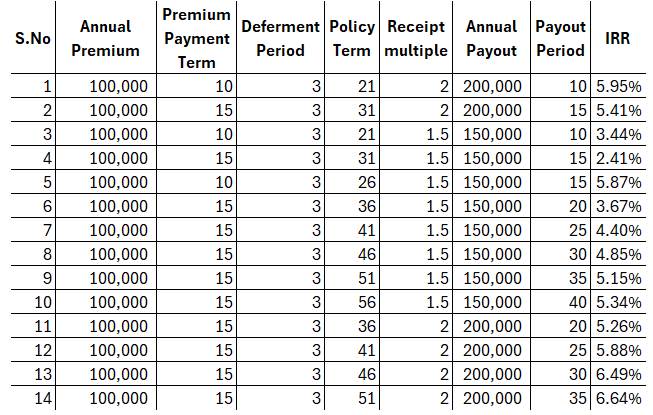
- The Importance of Net Returns (IRR): To truly assess the financial viability of these products, calculating the Internal Rate of Return (IRR) is essential. This metric accounts for the timing of cash flows – both the premiums paid and the payouts received. Spreadsheet software like Microsoft Excel can be invaluable for this calculation.
- Impact of Deferment and Premium Payment Periods: The IRR is highly sensitive to the deferment period (the gap between the last premium payment and the first payout) and the premium payment term. Longer deferment and premium payment periods, while seemingly allowing the insurer more time to manage funds, can significantly reduce the net returns for the investor. This is a deliberate strategy employed by insurers to optimize their profitability.
- Limited Impact of Payout Period on IRR: Interestingly, increasing the payout period, while extending the duration of income, often has a less pronounced effect on the IRR compared to changes in the deferment or premium payment terms.
- Liquidity and Exit Barriers: A significant drawback of many traditional insurance plans, including these structured products, is their illiquidity. Exiting such a plan prematurely typically involves substantial penalties, making it difficult for investors to adapt their strategy if their circumstances or financial needs change. This lack of flexibility can be a major deterrent for those who prefer more agile investment approaches.
- The "Magic" of the Deferment Period: Insurers often strategically utilize the deferment period to their advantage. A stated "2-year deferment" might, in reality, translate to a 3-year gap between the last premium payment and the first payout, due to how the "year" is calculated (end of the year versus start of the year). This subtle difference, amplified over the policy term, significantly impacts the overall return by leveraging the time value of money in the insurer’s favor.
The author’s analysis, supported by illustrative tables, clearly demonstrates how extending the deferment period can dramatically diminish net returns. This underscores the critical need for investors to look beyond the superficial attraction and perform a thorough financial analysis to understand the true value proposition.
Strategic Decision-Making: Should You Invest?
The decision to invest in these structured retirement plans is not a simple yes or no. It hinges on an individual’s financial goals, risk appetite, and overall retirement strategy.
Factors to Consider:
- Not a Sole Retirement Solution: These products are best viewed as a component of a diversified retirement portfolio, not its entirety. They can be particularly effective for securing income for essential, basic expenses during retirement, providing a sense of comfort and stability.
- Peace of Mind vs. Optimal Returns: For some, the psychological benefit of guaranteed income, even if at a sub-optimal return, might outweigh the pursuit of maximum financial gains. If these plans provide peace of mind and help cover a portion of retirement expenses, they can still be a valuable addition.
- Inflation Adjustment: It is crucial to account for inflation when projecting retirement expenses. The fixed payouts from these plans may not keep pace with rising costs over time, necessitating other investment strategies to supplement them.
- Understanding the "Why": Before investing, a clear understanding of how such a product fits into your overall financial plan is paramount. If the value proposition remains unclear, it’s a sign that further investigation or a different approach is needed.
- Due Diligence: Thoroughly understanding the product terms and conditions is non-negotiable. This includes scrutinizing the exact calculation of the deferment period, the exit clauses, and any associated charges.
The author’s personal stance of not owning such products currently, but acknowledging their potential for providing peace of mind, reflects a balanced perspective. The emphasis is on informed decision-making, where investors understand precisely what they are acquiring and how it aligns with their broader financial objectives.
Annuity Plans vs. Structured Insurance Products: A Key Distinction
It is important to differentiate these structured insurance products from traditional annuity plans, as they serve distinct purposes and carry different implications.
Annuity Plans:
- Longevity Risk Transfer: The primary characteristic of an annuity plan is that the insurance company assumes the "longevity risk." This means the insurer guarantees income for life, regardless of how long the annuitant lives.
- Taxability of Income: Income generated from annuity plans is generally taxable at the individual’s marginal income tax rate. This is because they do not typically meet the criteria for tax-exempt life insurance proceeds.
Structured Insurance Products (as discussed):
- Limited Payout Period: Unlike annuities, these plans offer payouts for a fixed, predetermined period, not for life. The insurance company does not assume the longevity risk.
- Tax Benefits: A significant advantage of these plans is their potential for tax exemption on payouts, provided certain conditions are met. These typically include a cumulative annual premium limit (e.g., Rs 5 lakh for traditional non-linked plans) and a life cover of at least 10 times the annual premium. This tax efficiency can make them more attractive from a net return perspective.
- Reason for Tax Benefits: The tax exemption stems from their classification as life insurance products. The proceeds from life insurance policies are generally tax-exempt if the death benefit (Sum Assured) is at least 10 times the annual premium. Annuity plans often lack this substantial death benefit component, leading to taxable income.
The author notes that while annuity plans offer lifelong income security, the tax implications can be a significant drawback. Conversely, these structured insurance products, while offering a finite payout period, can provide a tax-efficient income stream, making them a compelling option for specific retirement planning needs, provided the investor understands the limitations and performs the necessary financial analysis.
Conclusion: Informed Choices for a Secure Future
The promise of guaranteed income during retirement is a powerful siren song for many. Structured insurance products, with their straightforward appeal and guaranteed payouts, can appear to be the perfect solution. However, a deeper dive reveals that the true value lies not just in the headline figures, but in a thorough understanding of the underlying financial mechanics.
By calculating net returns, scrutinizing deferment periods, and recognizing the limitations of liquidity, investors can move beyond the initial allure and make truly informed decisions. While these products may not always offer the highest financial returns, they can play a valuable role in a diversified retirement portfolio by providing a sense of security and covering essential expenses. The key lies in approaching them with a discerning eye, understanding their place within a broader financial plan, and prioritizing peace of mind achieved through informed choices. Ultimately, the goal is not to find a perfect product, but to find the right product that aligns with individual needs, risk tolerance, and long-term financial aspirations.