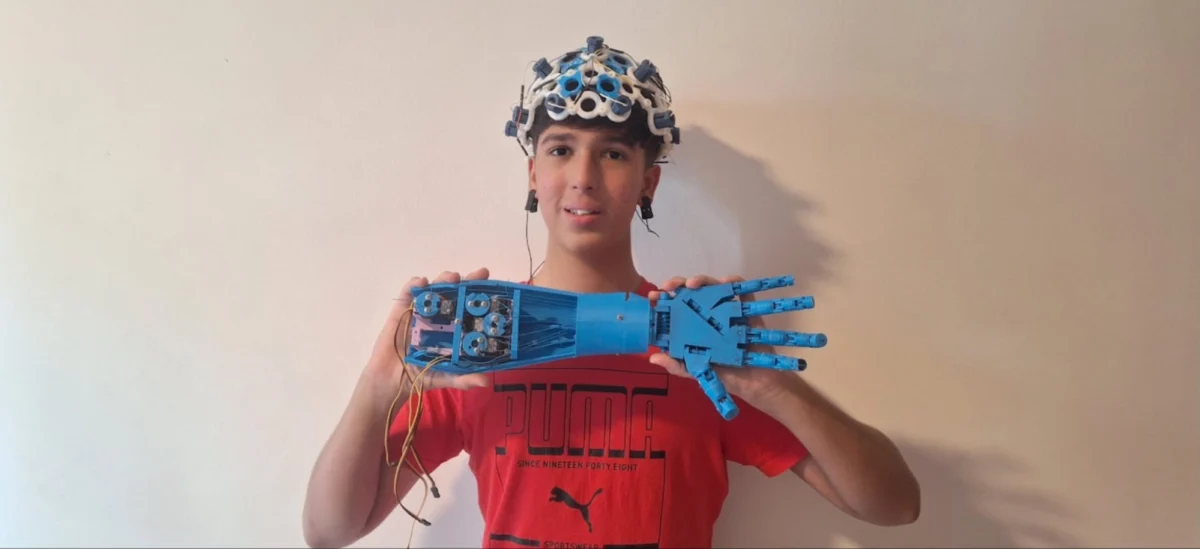
When Aarav Sharma first captured the attention of the maker community in July, he was a 14-year-old innovator showcasing a functional, 3D-printed, brain-controlled robotic arm. It was an impressive feat of engineering that suggested a maturity well beyond his years. However, for Sharma, that project was merely the foundation. In the months since, he has pivoted from physical robotics to the more abstract, yet profound, challenge of human-computer communication.
Supported by a sponsorship from OpenBCI, Sharma has spent his recent months developing a sophisticated six-command Steady State Visually Evoked Potential (SSVEP) system. This project marks a significant leap forward in accessibility technology, demonstrating how high-level machine learning and consumer-grade EEG hardware can be synthesized to provide a voice for those who cannot speak.
The Mechanics of Thought: Understanding SSVEP
At the core of Sharma’s latest endeavor is the principle of SSVEP. To the uninitiated, the term sounds like science fiction, but the reality is grounded in the rhythmic nature of human neurology.
“SSVEP is a type of brain-computer interface where different targets flash at different frequencies,” Sharma explains. “When the user focuses on one target, the EEG headset detects the matching response in the brain and converts it into a command.”
Essentially, the human brain acts as an amplifier for these visual signals. When a user stares at a flickering light source on a screen, the visual cortex exhibits an increase in electrical activity at the exact frequency of that flicker. By isolating these specific frequency spikes using an EEG headset, Sharma’s system can determine exactly which "button" on a digital interface the user is looking at, without them having to move a muscle.
Chronology of Development: From Robotics to Communication
The trajectory of Sharma’s work reveals a clear evolution of thought. His initial project—the robotic arm—was focused on physical agency: the ability to reach, grasp, and move. While vital for physical autonomy, the limitation of such a device is its lack of communicative depth.
Following the successful deployment of the arm, Sharma turned his attention to the "Neurova" project. The transition was marked by a shift in focus from motor output to linguistic output. By late summer, he had successfully integrated an OpenAI language model into his pipeline. This integration was the "force multiplier" his project needed; rather than forcing a user to spell out every character—a slow and exhausting process—the language model predicts the user’s intent, allowing them to compose full, grammatically correct sentences in under five seconds.

This rapid acceleration in output capability is a turning point for BCI technology. Historically, BCIs have been notoriously slow, often requiring significant cognitive fatigue from the user. By offloading the linguistic heavy lifting to AI, Sharma has effectively lowered the "cost" of communication.
Supporting Data and Technical Rigor
Sharma’s approach is not merely iterative; it is deeply analytical. He approaches his BCI development with the rigor of a research scientist, moving beyond "making it work" to "optimizing the signal-to-noise ratio."
“For offline EEG data collection, the user completes around 60 trials where the system tells them which of the six flashing targets to focus on,” Sharma notes. This controlled environment allows him to map the unique neurological signatures of his users. He employs Time-Frequency Representation (TFR) graphs to visualize how the brain reacts to different stimuli and utilizes confusion matrices to identify where the software struggles to distinguish between targets.
By fine-tuning these parameters, Sharma is working to solve the "fatigue factor" that plagues many BCI systems. His data shows that as the software learns the specific patterns of a user’s brain, the accuracy remains high while the required duration of focus decreases. This creates a feedback loop where the system becomes more intuitive the more it is used.
The Path Toward Ubiquity: AR and Beyond
The current iteration of Sharma’s interface lives on a computer screen, but his vision extends to the world of augmented reality (AR). He is currently drafting plans to migrate his UI into AR glasses, a move that would transform the BCI from a desktop-bound peripheral into a wearable, real-world communication tool.
The implications for this are vast. For individuals with conditions like ALS (Amyotrophic Lateral Sclerosis), locked-in syndrome, or severe physical disabilities, the ability to control a wearable device via ocular focus could be life-changing. AR glasses would allow a user to navigate a room, interact with smart home devices, and converse with others in real-time, all while maintaining eye contact—a level of social integration that traditional head-mounted displays have struggled to facilitate.
Implications for the Future of Accessibility
The work of a young maker like Aarav Sharma highlights a critical shift in the technology landscape: the democratization of neuroscience.

1. Lowering the Barrier to Entry
Historically, high-end BCI technology was the exclusive domain of research universities and multi-million dollar corporations. Through his collaboration with OpenBCI and his reliance on open-source AI models, Sharma is demonstrating that the barrier to entry for complex neuro-tech is dropping rapidly. This allows for rapid iteration and community-led improvements that traditional, siloed corporate research often overlooks.
2. The Fusion of AI and Neuroscience
Perhaps the most significant implication of Sharma’s project is the synergy between large language models (LLMs) and BCIs. By using AI to "guess" the user’s intent, the system can interpret partial data from the brain and translate it into coherent, complex thought. This effectively hides the latency and error rates of the hardware, making the experience feel fluid rather than robotic.
3. Ethical and Practical Considerations
As with any BCI, the question of privacy and data security looms large. When a device is recording the electrical impulses of the brain, the potential for data misuse is significant. Sharma’s focus on "offline" processing and user-side control is a step in the right direction, ensuring that the user’s "thought data" remains under their own sovereignty rather than being uploaded to a third-party cloud.
Conclusion: A New Generation of Makers
Aarav Sharma’s journey is a testament to the power of curiosity and the efficacy of modern maker tools. He is not just building a product; he is building a framework for human expression that bypasses the limitations of the physical body.
While there is still much work to be done—particularly in reducing the hardware footprint of EEG sensors and increasing the reliability of signal detection in non-laboratory environments—the progress made over the last six months is staggering. As he moves toward the implementation of AR-integrated communication systems, the maker community watches with anticipation.
For those interested in following the technical progress or contributing to the development, Sharma provides regular updates on his progress via his personal research site, aaravinnovate.com/bci-neurova. In a world that is increasingly reliant on digital interfaces, Aarav Sharma is proving that the most important interface of all is the one between the human mind and the digital future.
As Sharma continues his work, one thing is certain: he is no longer just a young student experimenting with robots. He has established himself as a serious contributor to the field of neuro-engineering, providing a glimpse into a future where our thoughts, amplified by AI, might finally have a voice that the world can clearly understand.