
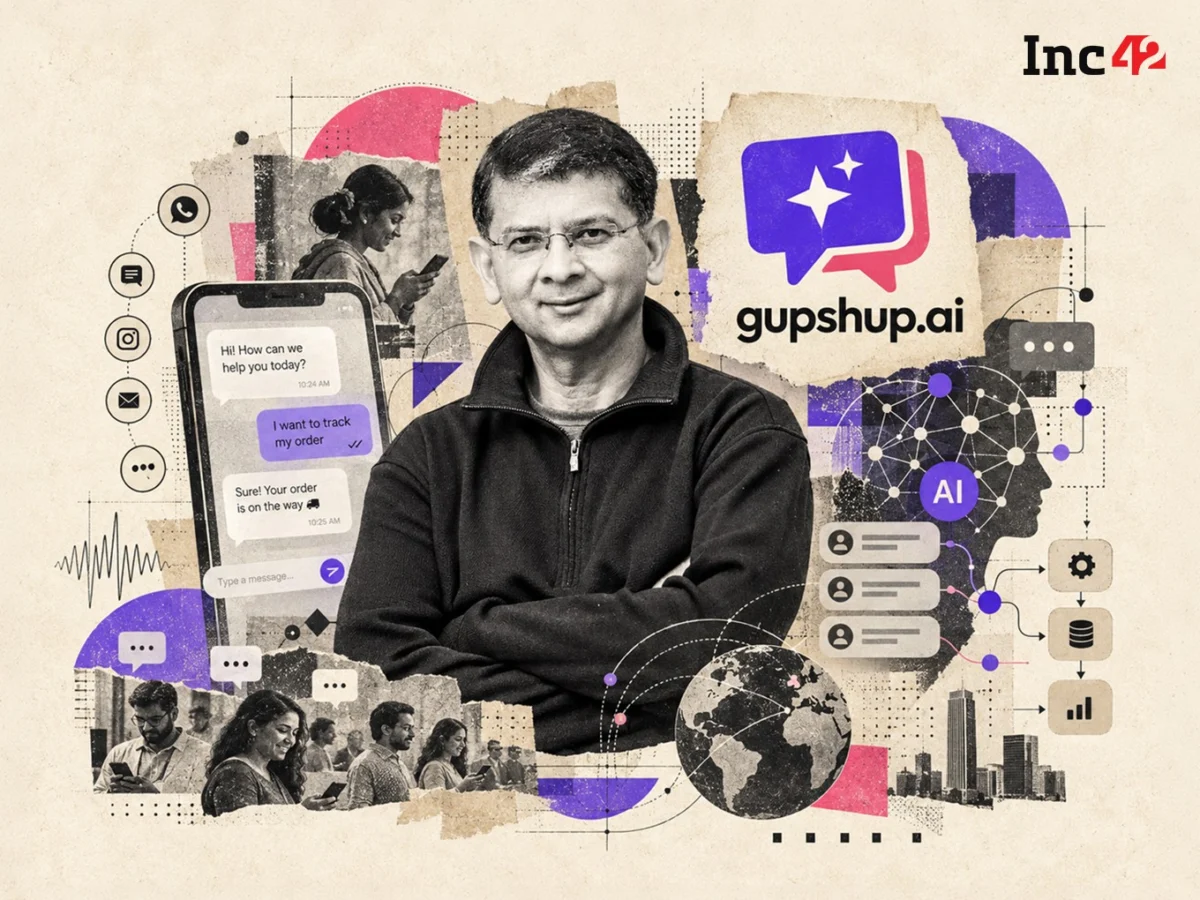
For nearly two decades, Gupshup has served as the silent plumbing of the digital economy. What began in 2004 as a humble SMS-based social network has matured into a global enterprise messaging powerhouse, facilitating the way businesses communicate with their customers. However, in the rapidly shifting landscape of 2026, Gupshup is undergoing a profound transformation. The company is no longer content with being a mere messaging infrastructure provider; it is aggressively pivoting to become the central nervous system for Conversational AI.
This transition—from simple text-based APIs to a sophisticated layer of AI agents, voice intelligence, and cross-platform orchestration—represents the most critical juncture in the company’s history. As it faces cooling private market valuations and an increasingly competitive landscape dominated by tech giants like Meta, Gupshup’s survival and future growth depend on whether it can successfully "AI-ify" its vast, long-standing enterprise customer base.
The Core Transformation: Messaging as the Foundation
Gupshup’s evolution mirrors the broader trajectory of digital communication. The company’s journey from SMS to WhatsApp, and now to Rich Communication Services (RCS) and AI, is a testament to its ability to adapt to changing user behaviors. Yet, the current shift toward AI is fundamentally different. It is not just about adopting a new channel; it is about changing the value proposition of the platform.
CEO and co-founder Beerud Sheth views the company’s history as a strategic asset. "We’ve been doing this business for 15–20 years," Sheth notes. By leveraging the transaction volumes and infrastructure built over two decades, Gupshup is positioning its existing relationships as a formidable "competitive moat." While AI-native startups struggle to acquire customers, Gupshup already commands a network of over 50,000 businesses across 130 countries, processing more than 120 billion messages annually.

The financial data highlights this transition: for FY26, the company is reporting approximately $350 million in revenue, with a significant 25% of that now derived from AI-related offerings. This is a marked shift from its legacy business, indicating that while the volume of traditional messaging remains high, the growth engine is increasingly fueled by intelligence-led services.
Chronology of a Tech Pivot
- 2004–2010: The "SMS Gupshup" era. The company launches as a consumer-facing social networking platform for group messaging, later pivoting to enterprise services as SMS costs and regulatory environments fluctuated.
- 2011–2020: The enterprise messaging expansion. Gupshup cements itself as a leader in API-based communication, riding the massive wave of WhatsApp business adoption and global mobile penetration.
- 2022: A strategic bet on voice. The acquisition of Knowlarity for $100 million provides Gupshup with a robust voice stack, currently handling over 500 million calls per month.
- 2025 (February): Official entry into the Conversational AI segment.
- 2025–2026: Massive product rollout, including the "Super Agent" orchestration layer and on-device "Superclaw" solutions.
- 2026 (March): Appointment of CFO Ravi Dugar, signaling a renewed focus on corporate restructuring and the potential for a public listing in India.
The Strategy: Orchestration Over Commoditization
Gupshup’s current product stack is a deliberate move to avoid the "commodity trap." As messaging prices for SMS and WhatsApp fluctuate, Gupshup is moving up the value chain.
The Voice AI Platform
Gupshup’s voice AI is not a standalone product but a self-serve platform for deploying agents that handle inbound support, lead qualification, and operational tasks like payment reminders. By pricing these services at $0.035 per minute—significantly lower than the $0.05 to $1.00 industry average—Gupshup is using aggressive pricing to capture market share. The company’s "model-agnostic" approach allows it to integrate with leaders like Deepgram, ElevenLabs, and Cartesia, while also experimenting with Indian-specific and open-weight models.
Super Agent and Orchestration
In April 2026, the launch of "Super Agent" marked a strategic shift toward becoming a central "command center" for enterprises. Modern businesses struggle with a fragmented tech stack—CRMs, messaging platforms, payment gateways, and analytics tools rarely speak the same language. Super Agent acts as an orchestration layer, allowing enterprises to manage these workflows through natural language instructions.

This model-agnostic philosophy is central to Sheth’s vision. He argues that enterprises do not want to be locked into a single AI model. By providing the plumbing that connects various LLMs (Large Language Models) to enterprise data, Gupshup becomes the essential middleman, regardless of whether a client chooses to use OpenAI, Anthropic, or Meta’s proprietary tools.
Financial Realities and Market Pressures
Despite the optimistic narrative, the path forward is paved with financial challenges. The company’s valuation has faced scrutiny, particularly following a markdown by Fidelity Investments earlier this year, which brought its valuation significantly below the peak of $1.4 billion seen in 2021.
Furthermore, the company’s India-specific financial performance showed a decline in revenue from ₹2,051 Cr to ₹1,943 Cr in FY25, accompanied by a drop in net profit. While Sheth maintains that the global business is profitable and growing, these numbers underscore the difficulty of migrating a legacy revenue stream to a high-growth AI model without incurring friction. The workforce reduction of over 100 employees in late 2025 was a painful but necessary step to streamline operations and focus capital on R&D for AI, rather than maintaining the overhead of a traditional messaging firm.
The Competitive Landscape: The "Meta Problem"
Perhaps the greatest challenge to Gupshup’s strategy is the shifting nature of the platforms they rely on. As a Meta Business Solution Provider (BSP), Gupshup has historically thrived on WhatsApp’s growth. However, the launch of "Meta Business Agent" presents a direct conflict of interest. When the platform owner (Meta) builds its own native AI agent capabilities, the role of third-party orchestrators like Gupshup risks being squeezed.

Sheth, however, remains confident. He posits that the "Meta Business Agent" is just one of many tools an enterprise needs. "Enterprises don’t want to be locked into a single model," he asserts. Gupshup’s bet is that while Meta provides the channel, Gupshup provides the intelligence and integration that spans across channels—including voice, web, and internal enterprise systems.
Additionally, the emergence of RCS (Rich Communication Services) as a dominant standard, accelerated by Apple and Reliance Jio, is a double-edged sword. While it expands the market for high-quality messaging, it also invites more competition into the infrastructure space, reinforcing why Gupshup must succeed in its pivot to AI-driven, high-value orchestration.
Implications: The Road to the Public Market
The appointment of Ravi Dugar as CFO is the clearest signal yet that Gupshup is preparing for a public market debut. With a 12–24 month window for a potential IPO, the company is actively working to resolve the "reverse flipping" challenge—the structural process of moving its domicile back to India to appeal to local investors.
For potential investors, the narrative is no longer about how many messages the company sends, but about the quality of those interactions. The key metrics of the next two years will be:

- Revenue per Customer: Can the shift to AI raise the average spend per enterprise client?
- Retention: Does the "Super Agent" platform create stickiness that prevents churn to native solutions?
- Margin Expansion: Can the company leverage its existing infrastructure to lower the cost of AI inference, thereby maintaining profitability?
Gupshup is at a crossroads. It has successfully navigated the shift from SMS to mobile apps, and from apps to chatbots. Now, it must prove that its long history as an incumbent is a launchpad for innovation rather than a weight of legacy. As the market for Conversational AI is projected to reach nearly $3.7 billion by 2033, the company is positioned in the right place—but it must now prove that its role as the "orchestrator" is essential enough to survive the rise of the AI-native giants.
Ultimately, Gupshup is betting that in a world of infinite AI models and fragmented communication channels, someone will always need to be the glue that holds it all together. Whether that glue is worth a billion-dollar valuation will be the definitive question of their upcoming IPO.