For over a decade, Inc42 has served as a front-row observer to the meteoric rise of the Indian tech startup ecosystem. We have watched it evolve from an energetic, experimental "kid" into a sophisticated, disciplined "adult." Today, the most compelling evidence of this maturation is not found in pitch decks or private funding rounds, but on the ticker tapes of the National Stock Exchange (NSE) and the Bombay Stock Exchange (BSE).
The Indian startup "IPO wave" has officially graduated from a sporadic trend into a systemic movement. For new-age tech companies, an Initial Public Offering (IPO) has transitioned from a distant ambition to a critical rite of passage. It serves as the ultimate validation of operational viability, a beacon of transparency for retail and institutional investors, and, crucially, a mechanism for unlocking long-term wealth for founders and early backers alike.
The State of Play: A Record-Breaking Momentum
The numbers paint an unambiguous picture of this shift. As of mid-2026, the cumulative market capitalization of India’s listed new-age tech companies has surged to over $143 billion. This figure is not merely a statistical milestone; it represents the institutionalization of the startup dream.
The pace of these listings has accelerated exponentially. While 2024 saw 13 startups make their market debut, 2025 shattered that record with 18 companies crossing the threshold. This momentum has carried into 2026, with major players like Kissht, Aye Finance, Fractal Analytics, Amagi, Shadowfax, and SEDEMAC already ringing the opening bell.

Currently, the pipeline remains robust. Nearly 15 high-profile startups, including giants like Zepto, Shiprocket, and OYO, are in various stages of their IPO journey, signaling that the "Dalal Street Startup Ride" is far from reaching its peak.
Chronology of a Transformation: From Growth-At-All-Costs to Profitability
To understand the current IPO fervor, one must look at the ideological shift that occurred between 2022 and 2025.
During the "golden era" of 2020-2022, the Indian startup ecosystem was defined by a "growth-at-all-costs" mantra. Market share, user acquisition, and top-line revenue growth were the only metrics that mattered. Profitability was often viewed as a secondary concern, a problem to be solved "later."
The arrival of the "funding winter" in 2022 served as a brutal, necessary reality check. As capital became expensive and investors turned conservative, the narrative pivoted overnight. The pressure shifted from burning cash to burning a path to the bottom line. This transition was not just defensive; it was strategic. Companies realized that the public markets, unlike venture capital, have zero patience for perpetual loss-making entities.

The Profitability Benchmark
Today, data indicates that approximately 64% of listed new-age tech companies—a total of 41 firms—are operating in the black.
Industry veterans continue to set the bar. Info Edge, which debuted in 2006, remains a titan of profitability, reporting a net profit of ₹962 Cr in FY25. They are followed by stalwarts like Justdial (₹584 Cr) and IndiaMART (₹551 Cr). While these older companies laid the groundwork, the newer cohort is increasingly mirroring this discipline. Recent entrants like Lenskart have successfully orchestrated significant turnarounds, moving from a loss of ₹10 Cr in FY24 to a profit of ₹297 Cr in FY25.
However, the road remains volatile. The case of Urban Company illustrates the inherent challenges of sustaining profitability; after reporting a profit of ₹240 Cr in FY25, the firm slipped back into a loss of ₹234.8 Cr in FY26, despite a 36% year-on-year revenue increase. This highlights a critical reality: for listed startups, the struggle for efficiency is not a one-time event, but a perpetual cycle.
Sectoral Dominance and Regional Hubs
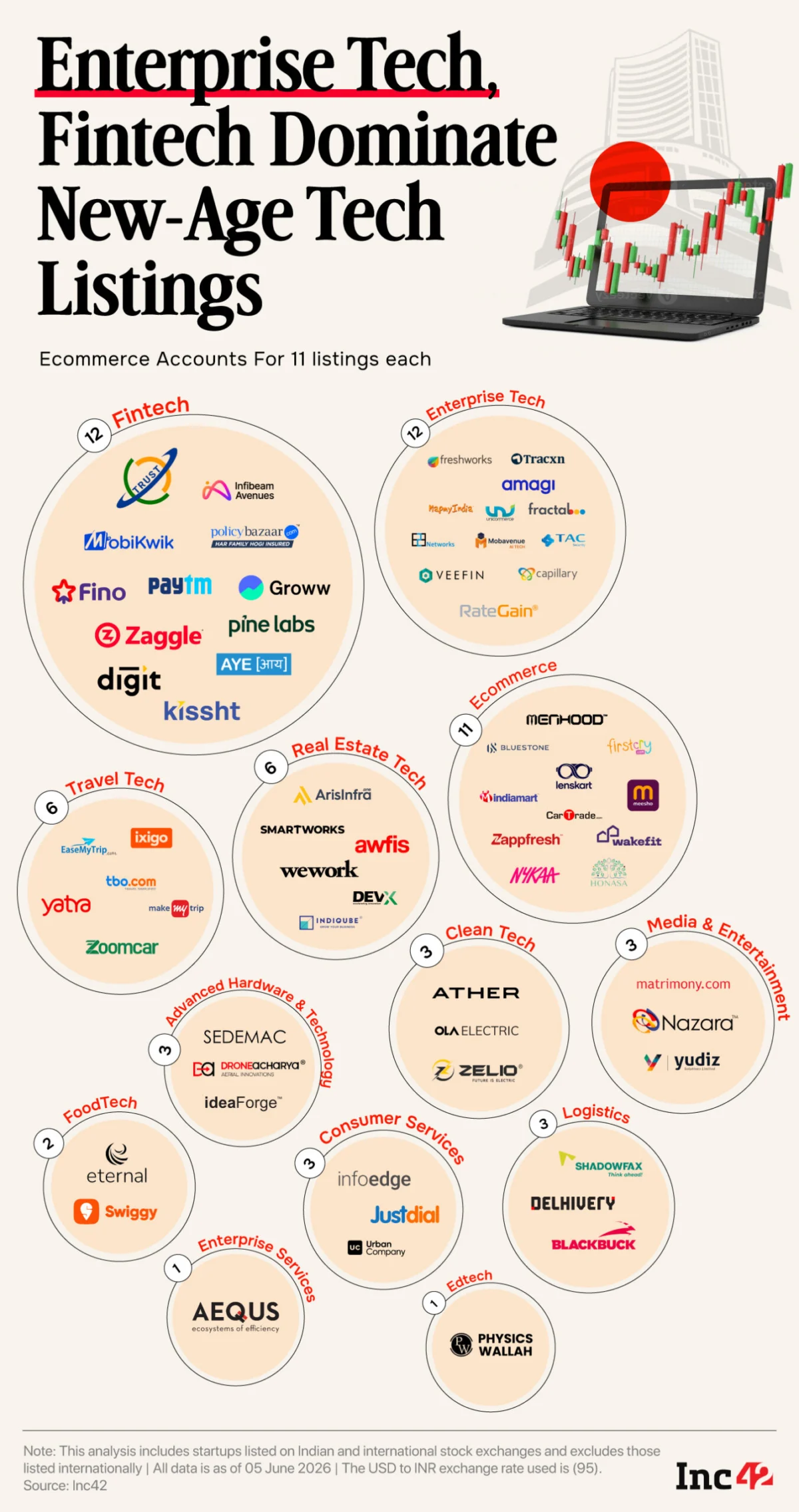
The sectors leading the charge on the bourses are a direct reflection of India’s digital consumption patterns. Fintech, Ecommerce, and Enterprise Tech account for the lion’s share of listings.
- Fintech & Enterprise Tech: These sectors currently lead with 12 listings each, driven by the massive digitization of India’s financial services and the increasing global demand for Indian SaaS solutions.
- Ecommerce: With 11 listings, the sector remains a core pillar of the public market, with giants like Meesho and FirstCry anchoring the category.
The Rise of the Delhi NCR Powerhouse
Geographically, the map of India’s startup IPOs reveals a clear leader. While Bengaluru is often called the "Startup Capital," the Delhi NCR region (including Gurugram and Noida) has effectively outpaced it in terms of public market presence.
Delhi NCR is currently home to 25 listed new-age tech companies, collectively contributing a staggering $78.9 billion to the overall $143 billion market cap of the listed cohort. Gurugram, specifically, has become the headquarters for major players like Delhivery, Lenskart, and Eternal. Meanwhile, Noida’s emergence as a tech hub is solidified by the presence of Paytm and IndiQube. Bengaluru holds the second spot with 17 listings, followed by Mumbai with 11.
Implications for the Ecosystem
The maturation of these companies into public entities has profound implications for the broader Indian economy:
- Investor Liquidity and Trust: The success of these IPOs provides an exit route for early-stage venture capitalists and angel investors, freeing up capital to be reinvested into the next generation of "zero-to-one" startups.
- Governance Standards: Transitioning from a private company to a publicly traded entity mandates higher standards of corporate governance, financial auditing, and transparency. This "cleaning up" process is essential for the long-term health of the Indian startup culture.
- Employee Wealth Creation: Public listings allow for the exercise of ESOPs (Employee Stock Ownership Plans) on a massive scale, creating a new class of wealthy employees who are likely to become the next generation of angel investors and startup founders.
- Market Discipline: Public markets act as a stern taskmaster. Unlike private investors who may be swayed by vision, public market investors demand predictable earnings, sustainable margins, and clear capital allocation strategies.
Looking Ahead: The Next Wave
As Inc42 continues to track these developments through our Indian Listed New-Age Tech Company Tracker, the outlook remains bullish. The infrastructure for public listing in India is more robust than ever, supported by a SEBI that is increasingly accommodating to new-age business models and a retail investor base that is more tech-savvy than at any point in history.

The challenge for the next wave of startups—such as the highly anticipated debuts of PhonePe and OYO—will be to demonstrate that they can balance the aggressive scale required by their business models with the fiscal prudence demanded by the bourses.
The "kid" is now an adult. The next phase for the Indian startup ecosystem will not be defined by how fast these companies can grow, but by how sustainably they can lead. As these companies continue to navigate the currents of Dalal Street, they aren’t just building products; they are building the future of the Indian financial landscape.
Data Source: Inc42 Analysis and Public Market Data. Financials are based on the latest available reporting periods. For a deeper dive into specific company performance, share price volatility, and financial health, access the comprehensive Indian Listed New-Age Tech Company Tracker.