
For the majority of professional writers, the allure of the craft lies in its inherent isolation. It is a pursuit characterized by the quiet hum of a laptop in a dimly lit room, the meditative rhythm of keys clacking, and the deliberate shaping of thoughts in solitude. Most authors are, by temperament, introverts—people who would prefer to communicate through the curated permanence of the written word rather than the unpredictable, high-stakes arena of public discourse.
Yet, as bestselling author Ryan Holiday notes, a peculiar irony defines the career of a successful writer: the more effectively one captures the public imagination through writing, the more one is inevitably pulled from the sanctuary of the study and thrust onto the stage.
The Paradox of the Public Intellectual
The transition from a “writer in the room” to a “speaker on the stage” is rarely a natural progression. For many, it feels like a fundamental betrayal of the reason they began writing in the first place. Holiday recounts his own early resistance to the lecture circuit, noting that his first invitation to speak at an international marketing conference felt like the very thing he had spent his life attempting to circumvent.
However, this resistance often gives way to a deeper realization. Public speaking is not merely a promotional necessity; it is a vital, ancient method of human connection. When an author stands before a live audience, they are providing something that the printed page cannot: the nuances of delivery, the emphasis of tone, and the immediate, human vulnerability of the “horse’s mouth.”
Historical Context: The Evolution of Communication
This human hunger for direct engagement has historical precedence. For over a century, the U.S. President’s "State of the Union" was delivered not as a speech, but as a formal written report sent to Congress—the "President’s Annual Message." Eventually, the government recognized that a document lacks the gravity of a human performance. People needed to see the leader, hear their cadence, and witness the stress placed on specific words to fully grasp the intent behind the policy. This transition from text to speech mirrors the path that many contemporary thinkers must navigate.

The Inescapability of Performance
Public speaking is not confined to the literary world; it is an inescapable component of professional life in the 21st century. Whether it is an entrepreneur pitching to venture capitalists, a coach rallying a team, a professor delivering a lecture, or even a friend delivering a wedding toast, the ability to command a room is a universal skill.
Despite its necessity, fear of public speaking remains a top-tier human phobia. As comedian Jerry Seinfeld famously quipped, people rank public speaking as worse than death, implying that at a funeral, the average person would prefer to be the one in the casket rather than the one delivering the eulogy.
The Stoic Perspective: Conquering the Tremor
To understand how to move past this paralyzing fear, one must look to history. In Courage Is Calling, Ryan Holiday examines the life of Crassus, one of ancient Rome’s most formidable orators. To the thousands who gathered to hear his prosecutions of the corrupt, Crassus appeared unshakable. Yet, in his private journals, he confessed that before every speech, he felt a "tremor through my whole thoughts and limbs."
Even the masters experience the visceral, physiological reaction to performance anxiety. Crassus’s early career was marked by such debilitating fear that a compassionate judge once adjourned a hearing simply because the young orator was "incapacitated" by terror. Crassus did not overcome this through a "trick" or a shortcut; he conquered it through the relentless, repetitive act of showing up. He made the pitch, he stood on the stage, and he gave the speech—again and again—until his competence began to outweigh his anxiety.
Stoicism: A Philosophy of the "Porch"
There is a profound irony in the modern perception of Stoicism. Because the foundational texts of the school—Marcus Aurelius’s Meditations and Seneca’s Letters—have survived for millennia in written form, we often mistake Stoicism for a "writer’s philosophy."

In reality, Stoicism was birthed as a conversational, spoken tradition. It began at the Stoa Poikile, or "Painted Porch," in Athens, where Zeno of Citium engaged in real-time debates with whoever walked by. The philosophy was not meant to be analyzed in a library; it was meant to be stress-tested in conversation.
The greatest Stoics were, in the words of playwright David Mamet, "porch guys."
- Cato the Younger: Known for his philosophical debates during his daily walks through Rome, he preferred living dialogue to written treatises.
- Epictetus: A man who famously wrote nothing down. His Discourses were recorded by his student Arrian, who captured the essence of a teacher who preferred the "back and forth" of human connection over the static nature of a manuscript.
Implications for Modern Professional Growth
For those attempting to master the art of public communication, the lesson from the Stoics is clear: there is no path through the fear other than direct, consistent confrontation.
The Methodology of Mastery
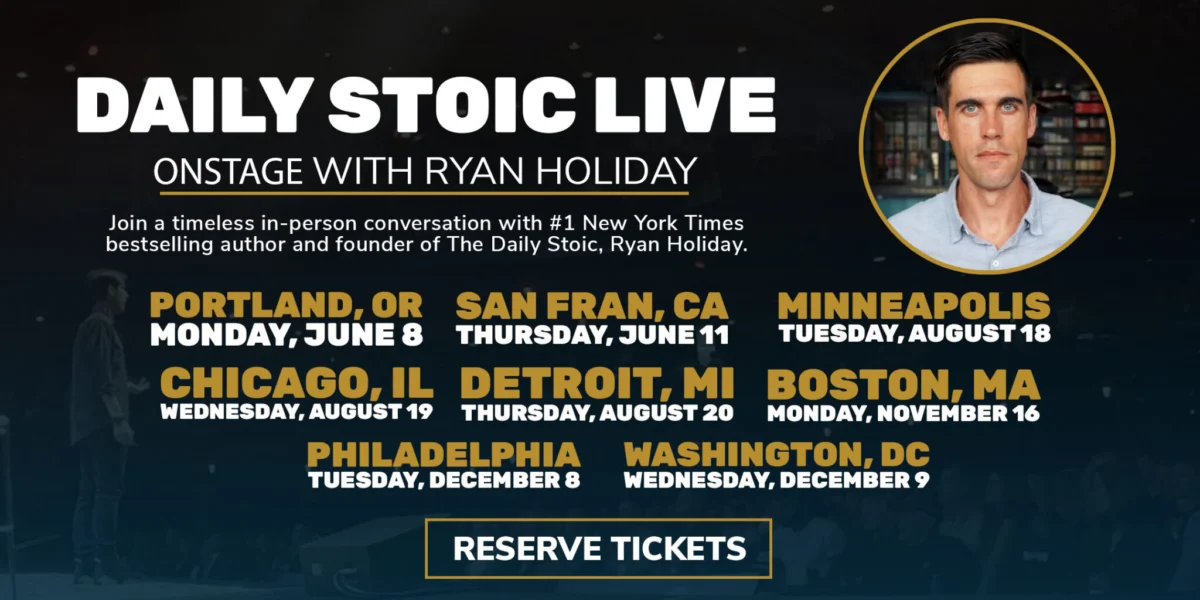
Ryan Holiday’s approach to his upcoming Daily Stoic Live tour serves as a modern blueprint for this philosophy. Rather than creating a static, polished presentation that he can deliver on autopilot—which would be the path of least resistance—he intentionally introduces variables. He adds new content, cuts segments, and adjusts his delivery nightly.
This is a deliberate "high-wire act." By making the process harder, he forces a higher level of presence and adaptation. This mirrors the Stoic practice of premeditatio malorum (the premeditation of evils), where one anticipates and embraces difficulty as a means of building resilience. Confidence, he argues, is not a feeling that precedes action; it is a byproduct of competence, and competence is the result of repetition.

The Future of Engagement
As we look at the trajectory of the modern creator, it becomes evident that the divide between the "writer" and the "speaker" is narrowing. The most influential voices of the future will be those who can leverage the depth of written research and combine it with the visceral, authentic power of the live stage.
Whether it is the upcoming tour across the United States, Australia, and New Zealand, or the daily practice of an individual speaking to a small team, the requirement remains the same: one must be willing to step out of the quiet room.
The fear never entirely disappears—it simply becomes a companion rather than an obstacle. By embracing the discomfort of the stage, we not only become better speakers but more effective conduits for the ideas we hope to share. As the tradition of the "Painted Porch" suggests, the most meaningful work is not just written; it is spoken, heard, and refined in the presence of others.
About the Author:
Ryan Holiday is a globally recognized author and media strategist. His works, including "The Obstacle Is The Way" and "Ego Is The Enemy," have sold millions of copies and have been translated into dozens of languages. As the founder of Brass Check, he has advised major corporations and cultural leaders. He resides in Austin, Texas, where he continues to explore the intersection of ancient philosophy and modern life.