In the rapidly evolving landscape of artificial intelligence, Reinforcement Learning (RL) has emerged as a cornerstone technology, moving beyond the confines of research labs and into the hands of hobbyists and engineers. At its core, RL represents a shift from explicit programming to learning through interaction. By training an "agent" to navigate environments through trial and error, developers are now creating robots capable of mastering complex physical tasks—like self-balancing—that were once the exclusive domain of sophisticated classical control theory.
This article explores the mechanics of this transformation, examining how a simple two-wheeled balance bot serves as the perfect gateway into the high-stakes world of deep reinforcement learning.

The Evolution of Learning: From Games to Hardware
The history of Reinforcement Learning is a narrative of escalating complexity. The field traces its roots back to the 1950s, drawing inspiration from behavioral psychology—specifically B.F. Skinner’s operant conditioning and Thorndike’s "law of effect." Early pioneers like Richard Bellman and Arthur Samuel laid the mathematical foundations for dynamic programming and self-learning systems, such as Samuel’s famous checkers-playing program.
For decades, RL remained a niche interest because the computational power required to model the "real world" was simply unavailable. The 1990s saw a glimmer of potential with Gerald Tesauro’s TD-Gammon, which utilized neural networks to reach a near-world-champion level in backgammon. However, the true inflection point arrived in the early 2010s. The deep learning revolution enabled agents to process high-dimensional inputs—like raw pixel data—leading to DeepMind’s DQN, which conquered dozens of Atari games.

By 2016, the world witnessed the power of RL when AlphaGo defeated legendary Go player Lee Sedol. This success was not merely a gaming triumph; it proved that machines could develop intuitive "strategies" that human experts had not yet codified. Today, this technology powers the fine-tuning of Large Language Models (LLMs) like ChatGPT and is increasingly vital in robotics, as evidenced by Boston Dynamics’ integration of RL into their Spot platform and Disney’s development of expressive, lifelike BDX droids.
The Mechanics of the Training Loop
Reinforcement Learning operates on a relatively intuitive loop: an agent observes an environment, takes an action, and receives a reward.

The Core Components:
- The Agent: The brain of the operation, consisting of a policy (the decision-making code) and, in advanced systems, a value estimator.
- The Environment: Everything external to the agent—the physics engine, sensor data, motors, and the physical chassis.
- The Observation: The data packet the agent receives (e.g., IMU data, encoder readings, or pixel information).
- The Reward: A numerical signal that reinforces positive behaviors.
In the case of a two-wheeled balancing robot, the reward function is the most critical design element. It must be carefully crafted to avoid "reward hacking"—a scenario where the agent maximizes its score by performing unintended actions, such as spinning in circles or rolling away to avoid falling. By balancing an "alive bonus" against penalties for excessive speed, pitch, and yaw, developers guide the agent toward stability without manually programming every movement.
Proximal Policy Optimization (PPO)
While there are dozens of algorithms, Proximal Policy Optimization (PPO), introduced by OpenAI in 2017, has become the industry standard for robotics. PPO is an "actor-critic" method. The critic network evaluates the current state, estimating future rewards, while the actor network determines the best action to take.

The brilliance of PPO lies in its "clipping" mechanism. Because actor-critic methods can be volatile, PPO imposes a "speed limit" on how much the policy can change in a single update. This stability ensures that the agent learns in safe, consistent increments, preventing the chaotic performance swings that often plague other algorithms.
Chronology of Implementation: A Three-Phase Approach
Training a robot for the real world requires a structured approach. Using a tool like Google Colab and the MuJoCo physics simulator, developers can move through distinct phases to ensure the agent is robust enough for physical hardware.

Phase 1: The Foundation of Balance
The initial phase focuses solely on upright stability. The agent is trained in a vacuum of ideal physics, learning to compensate for the robot’s natural tendency to fall. Using TensorBoard, developers can monitor the episodic_return—a graph of the agent’s success. As the curve trends upward toward the maximum possible reward, it indicates that the robot has mastered the basic physics of standing still.
Phase 2: Domain Randomization for Controls
Once the robot can balance in a perfect simulation, it must be prepared for the "Sim-to-Real" gap. The real world is messy: batteries drain, sensors exhibit noise, and motor response times vary. In this phase, we introduce Domain Randomization (DR). By injecting random noise into the control signals, sensor readings, and motor torques, we force the agent to become resilient to uncertainty. If the agent can balance while its internal "perception" of reality is being constantly tweaked, it will likely handle the real world with ease.

Phase 3: Physical World Simulation
In the final training phase, the environment becomes even more hostile. We introduce physical variations: uneven ground, changes in wheel friction, and external "nudges." By the end of this stage, the agent isn’t just a perfect balancer in a sterile box—it is a robust controller capable of navigating the unpredictable nature of the physical environment.
The Deployment Process: From Bits to Boards
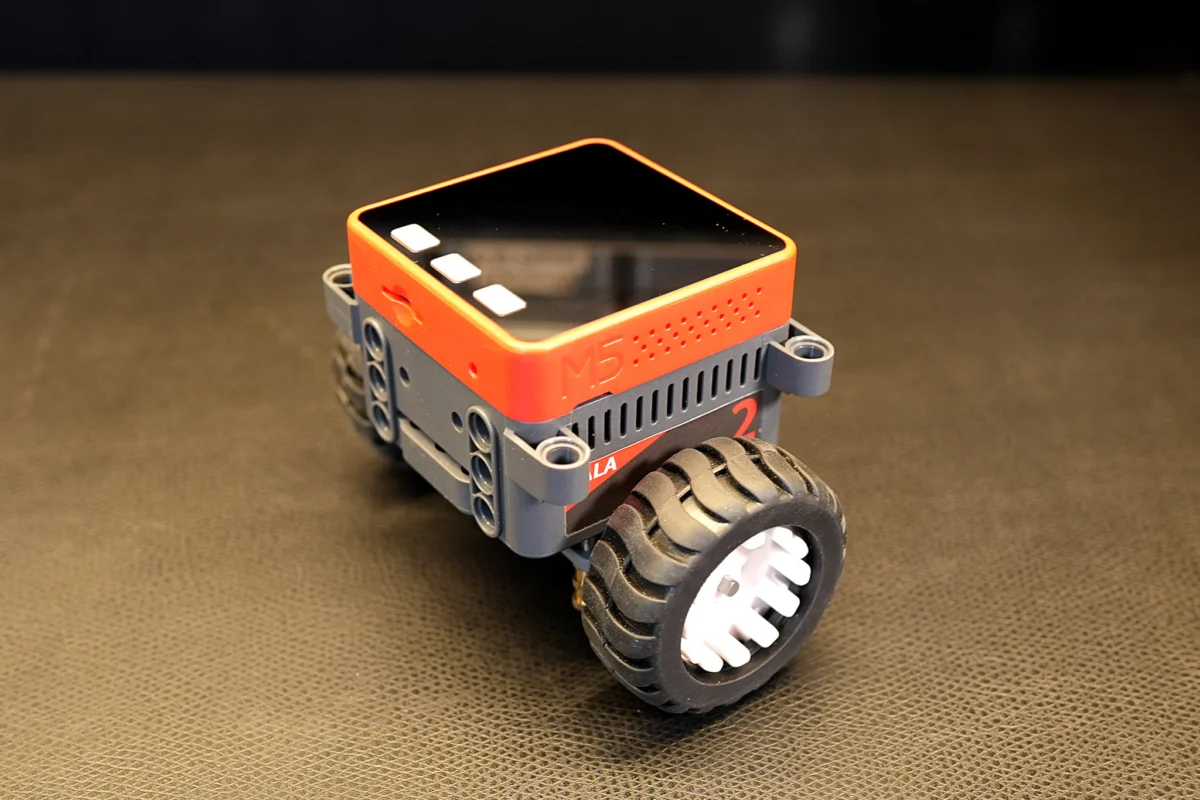
Once the agent is trained, the "critic" network is discarded, leaving only the "actor" (the policy). This is exported as a standard header file (actor.h), which contains the weights of the neural network. This header is then integrated into an Arduino sketch for the ESP32 microcontroller onboard the M5Stack Bala2-Fire kit.

The transition from a high-powered simulation to a 5ms control loop on a microcontroller is a triumph of modern engineering. Because the model is relatively lightweight, it can perform inference directly on the ESP32’s hardware. The final code takes the current sensor readings, passes them through the neural network, and outputs a PWM (Pulse Width Modulation) signal to the motors, creating a seamless, real-time feedback loop.
Implications for the Future of Robotics
The implications of this workflow are profound. By democratizing RL, we are moving away from the era of "brittle" robotics—where a robot only functions in the specific environment for which it was hand-coded—to a future of "adaptive" robotics.

The ability to train a robot in a browser and deploy it to a low-cost microcontroller suggests that the barrier to entry for advanced AI robotics is collapsing. As these techniques scale, we can expect to see more complex, autonomous agents: bipedal walkers, dexterous manipulators, and collaborative bots that don’t just follow instructions, but learn to navigate the complexities of their surroundings.
For those inspired by this project, the message is clear: the balance bot is merely the first step. The same PPO algorithms and domain randomization techniques can be applied to far more ambitious projects. As the community continues to refine these methods, the line between simulation and reality will continue to blur, paving the way for a new generation of intelligent, autonomous hardware.

Whether you are a student, an engineer, or a weekend tinkerer, the tools to build the future are already in your browser. All that remains is to start the simulation, tune your rewards, and watch your creation learn to stand on its own.