In the rapidly evolving landscape of Indian deep-tech, Chennai-based Garuda Aerospace has cemented its position as a dominant force. As the company prepares for its highly anticipated public market debut, its latest financial disclosures for the fiscal year 2026 (FY26) reveal a narrative of aggressive expansion, operational efficiency, and technological maturity. With a net profit surge of over 40% and a diversified revenue stream, Garuda Aerospace is signaling to the investor community that it is no longer just a startup, but a scalable industrial powerhouse.
Main Facts: A Financial Snapshot of FY26
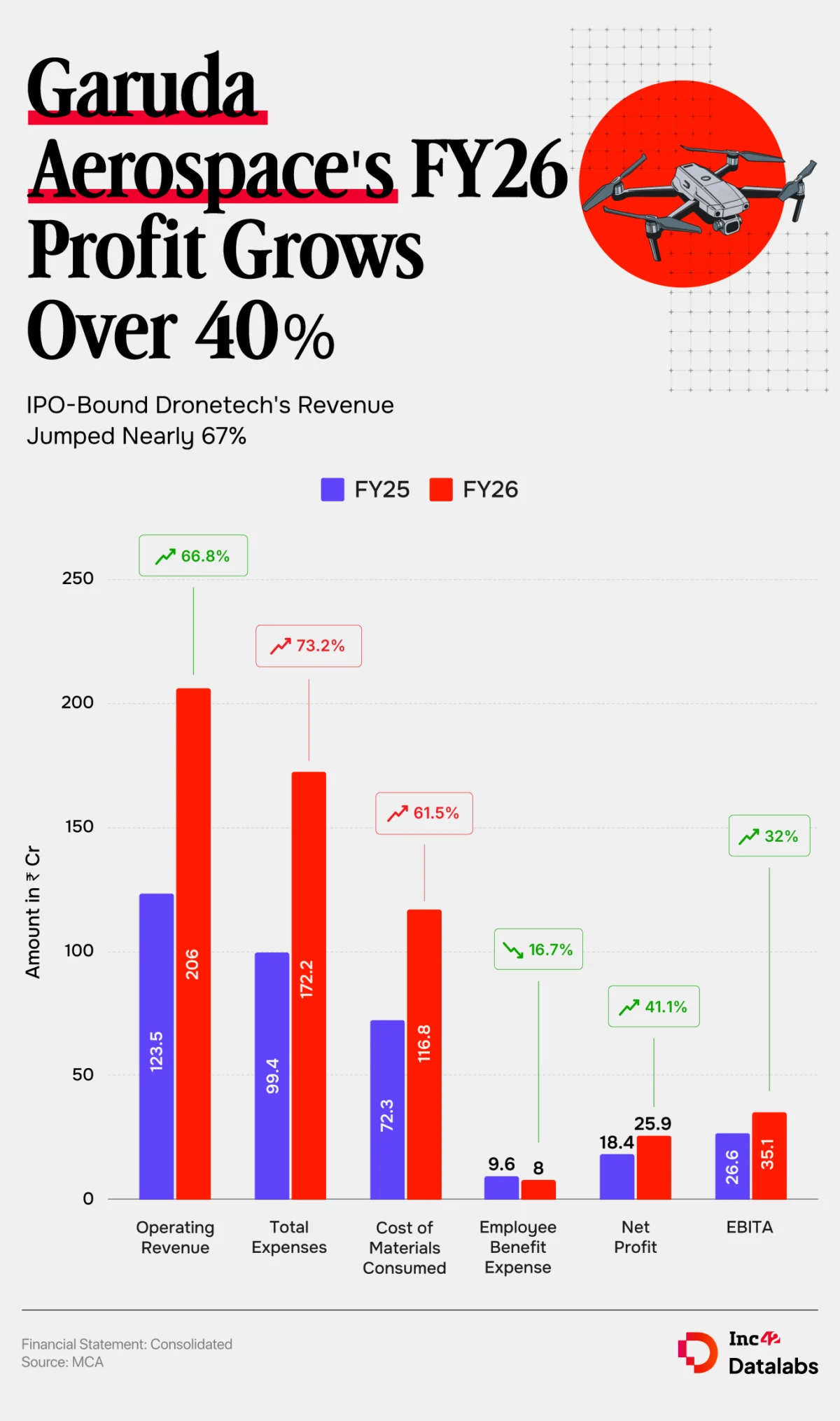
Garuda Aerospace’s performance in FY26 reflects a company successfully transitioning from a nascent venture to an enterprise-grade manufacturer. The startup reported a net profit of ₹25.9 Cr, marking a significant 41.1% increase from the ₹18.4 Cr recorded in the previous fiscal year.
The growth was underpinned by a massive 66.8% year-on-year (YoY) jump in operating revenue, which climbed to ₹206 Cr from ₹123.5 Cr in FY25. This revenue is increasingly balanced: drone and drone-part sales contributed ₹99.4 Cr, while the company’s "Drone-as-a-Service" (DaaS) model—a cornerstone of its recurring revenue strategy—generated ₹106.5 Cr. An additional ₹15 Lakh from delivery charges and ₹26.5 Lakh in other income brought the total income for the fiscal to ₹206.2 Cr.
Operational profitability also witnessed a healthy uptick. The company’s EBITDA (Earnings Before Interest, Taxes, Depreciation, and Amortization) rose by 31.8%, reaching ₹35.1 Cr, up from ₹26.6 Cr in FY25. This steady climb in operational efficiency suggests that the company is managing its scale-up costs effectively, even as it invests heavily in R&D and market penetration.
Chronology: The Road to the Public Markets
Garuda Aerospace’s journey toward an Initial Public Offering (IPO) has been a masterclass in strategic maneuvering. The timeline of its growth and regulatory milestones provides a clear picture of its institutional intent:
- Foundation and Early Scaling: Since its inception, the company has focused on mass-producing indigenous drones, crossing the milestone of 3,000 units sold. Its early ability to secure partnerships with three Defence Public Sector Undertakings (PSUs) established its credibility in the high-stakes defense sector.
- The Funding Path: With over $37 Mn in total funding, the company attracted marquee investors, including Venture Catalysts, We Founder Circle, and the legendary cricketer Mahendra Singh Dhoni. Its last valuation, following a $11 Mn Series B round, stood at $250 Mn.
- Pre-IPO Preparations (March–April 2026): In March, the board officially greenlit the proposal to raise ₹750 Cr via a fresh issue. By April, the startup took the confidential pre-filing route, submitting its draft papers to the Securities and Exchange Board of India (SEBI).
- Regulatory Nod (August 2026): The market regulator granted approval for the ₹750 Cr IPO in August, clearing the path for a public listing.
- Strategic Private Placement (August 2026): Demonstrating continued investor appetite, the board approved a private placement of equity shares worth ₹57.2 Cr. This round saw participation from Umasankar Nistala, Rakesh Pillai, Jitendra Rana, Vimaan Innovators LLP, and Aditum Management, providing immediate liquidity for growth and debt servicing.
Deep Dive: Supporting Data and Expense Analysis
While revenue growth is the headline, the structure of Garuda’s expenditure reveals where the company is betting its future. Total expenses in FY26 rose by 73.2% YoY, climbing from ₹99.4 Cr to ₹172.2 Cr.
This increase is largely attributable to the costs of scaling manufacturing facilities and the aggressive expansion of the DaaS vertical. The company’s investment into human capital—specifically engineers and pilots—and the procurement of high-grade components for its indigenous drone fleet represent the primary drivers of this expenditure. Despite this surge, the company remained profitable, a rarity in the capital-intensive hardware startup ecosystem.
The company’s ability to generate more than half of its revenue (₹106.5 Cr) from services rather than hardware sales is a critical data point. It indicates a shift toward a SaaS-like recurring revenue model, which is highly favored by public market investors for its predictability and lower cyclicality.
Official Responses: The Vision for the Future
Agnishwar Jayaprakash, co-founder and whole-time director of Garuda Aerospace, articulated the company’s strategic posture in a recent message to shareholders. He emphasized that the financial results are a reflection of a deliberate focus on long-term technological sovereignty.

"During the year, we continued to strengthen our manufacturing capabilities, expand our Drone-as-a-Service (DaaS) operations, and deepen our investment in indigenous research and development," Jayaprakash stated. He highlighted that the company is not merely an assembly house, but a deep-tech entity advancing "artificial intelligence, autonomous flight, data analytics, defence systems, and specialised mission platforms."
Jayaprakash’s comments underscore that the recent funding—both the private placement and the upcoming IPO—is earmarked for three specific areas: enhancing manufacturing throughput, fulfilling working capital requirements for large-scale service contracts, and accelerating the development of the next generation of autonomous mission platforms.
Strategic Implications: What the IPO Means for the Industry
The upcoming ₹750 Cr IPO is more than just a capital-raising exercise; it represents a coming-of-age moment for the Indian dronetech industry.
1. Market Validation
Garuda’s transition to a public company will set a benchmark for valuation and operational standards in the Indian drone sector. If the IPO is successful, it will likely trigger a wave of interest from retail and institutional investors in other deep-tech and hardware-based startups in India, moving the focus away from pure software plays.
2. The Shift to Indigenous Tech
By emphasizing its partnership with defense PSUs and its focus on "Make in India" initiatives, Garuda Aerospace is positioning itself as a strategic asset to the nation. The IPO will provide the necessary capital to reduce reliance on imported components, further bolstering the domestic supply chain for defense and agricultural drones.
3. Sustainability vs. Growth
The challenge for Garuda Aerospace in the coming quarters will be maintaining its profit trajectory while absorbing the overheads of being a listed entity. With total expenses rising at a faster rate than revenue (73.2% vs 66.8%), the company must prove that it can achieve operating leverage. Investors will be watching closely to see if the increased R&D spending translates into high-margin proprietary technology or if the cost of customer acquisition remains a drag on the bottom line.
4. Competitive Moat
The company’s claim of being India’s largest drone maker is backed by its 3,000+ unit deployment. In an industry where regulatory compliance (DGCA certification, remote pilot training) is a high barrier to entry, Garuda’s existing footprint provides a significant "moat." The IPO funds will likely be used to widen this moat, potentially through acquisitions of smaller tech startups that provide niche AI or sensor capabilities.
Looking Ahead: The Road to 2027
As Garuda Aerospace moves toward the final stages of its IPO documentation, the market is expecting an updated Draft Red Herring Prospectus (DRHP). Analysts anticipate that the proceeds from the IPO, combined with the recent ₹57.2 Cr private placement, will provide the company with a war chest capable of capturing a significant portion of the burgeoning Indian drone market—a sector expected to grow exponentially due to government incentives and the widespread adoption of drones in agriculture, logistics, and surveillance.
With a proven track record, a clear path to profitability, and a vision that aligns with national strategic goals, Garuda Aerospace is well-positioned to lead the charge in India’s aerial revolution. For shareholders, the journey from a niche Chennai startup to a publicly traded market leader is not just a financial milestone; it is a testament to the resilience and potential of India’s deep-tech manufacturing ecosystem. As the company prepares to ring the opening bell, all eyes will be on whether it can maintain its high-altitude flight in the turbulent, yet high-reward, waters of the public markets.