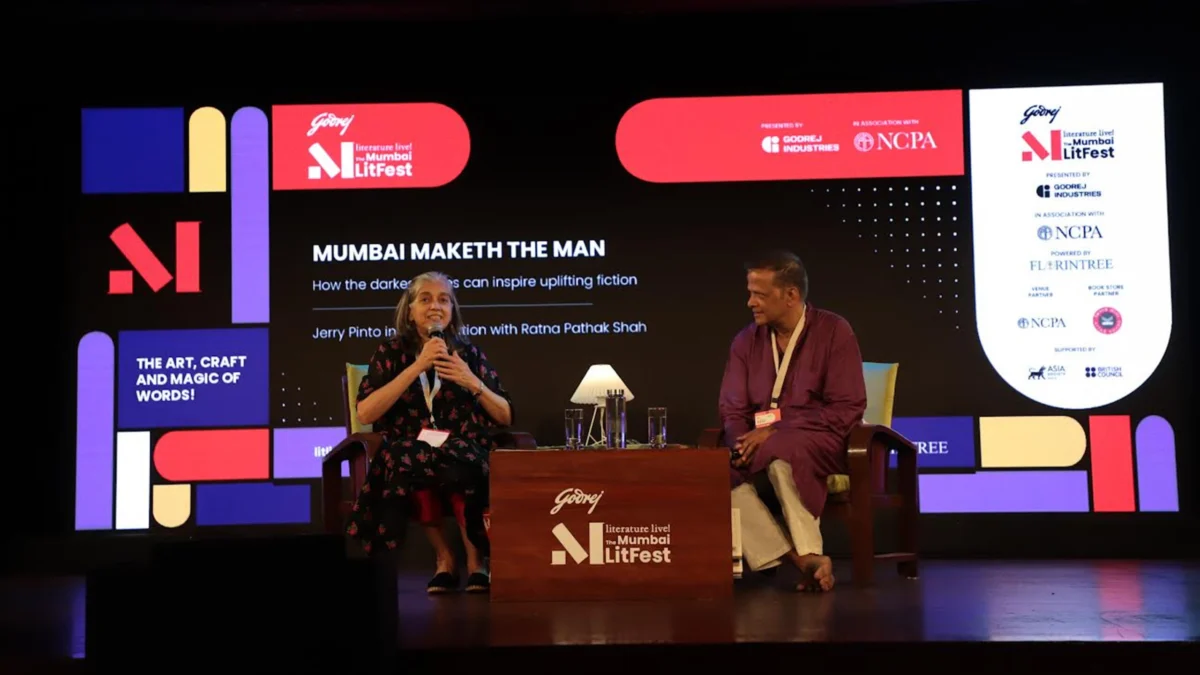
MUMBAI — Can the pen truly be a lantern in the darkest corridors of history? This was the central query that anchored the opening day of the Godrej Literature Live! The Mumbai LitFest 2026, as two of India’s most poignant cultural voices—author Jerry Pinto and veteran actor Ratna Pathak Shah—took to the stage at the National Centre for the Performing Arts (NCPA).
The session, titled "Mumbai Maketh The Man," was far more than a book launch or a literary retrospective; it was a profound autopsy of a city defined by its capacity to both shatter and rebuild. At the heart of the discussion was Pinto’s latest work, Yuri And The City, the eagerly awaited sequel to his acclaimed novel The Education of Yuri. As the conversation unfolded, the audience was invited to traverse the jagged landscape of 1992—a year synonymous with the demolition of the Babri Masjid and the subsequent communal upheaval that irrevocably altered the soul of Mumbai.
The Crucible of 1992: A Historical Context
To understand the weight of the conversation, one must understand the backdrop. The year 1992, and the ensuing months of 1993, remain a scar on the collective consciousness of India’s financial capital. The demolition of the Babri Masjid in Ayodhya triggered a seismic wave of communal violence that swept through the streets of Mumbai, leading to riots that claimed hundreds of lives, displaced thousands, and fundamentally restructured the city’s social fabric.
Pinto’s Yuri And The City acts as a fictional vessel for these historical tremors. By situating his characters—whose lives are entangled with the mundane struggles of friendship, family, and coming-of-age—within the epicenter of such immense political and social fracture, Pinto forces the reader to reconcile with the duality of human existence: the ability to endure profound cruelty while still harboring the mundane desires of youth.
The Writer’s Duty: Hope Amidst the Despair
A significant portion of the dialogue centered on the ethics of representing trauma. Critics often argue that literature dealing with communal violence risks becoming an exercise in voyeurism or gratuitous pain. Pinto, however, offered a more optimistic, if not radical, perspective on the role of the writer.
“No writer, however despairing, gives up hope,” Pinto stated, his voice resonant in the packed NCPA auditorium. “When there is despair, when there is anger and there is darkness in the writing, it is because the writer feels that by talking about this, perhaps we will all do something about it. We will also step away from the dark.”
For Pinto, the act of writing is a diagnostic tool. By articulating the darkness, the writer provides a mirror to society, forcing a confrontation with the uncomfortable. The implication is that silence is the accomplice of injustice; by breaking that silence through the intimate lens of fiction, the writer invites the reader to step out of the shadows of denial and into the light of accountability.
Deconstructing the "Communal Experience"
One of the most nuanced moments of the session occurred when the discussion turned to the homogenization of the riots. In political discourse, the "Muslim experience" or the "Hindu experience" is often flattened into monolithic blocks, stripped of the complexities of class, gender, and individual geography.
Pinto challenged this narrative with surgical precision. “It is not possible to talk about the Muslim experience or the Hindu experience of the riots, even the Christian experience of the riots, because there is no single experience,” he argued. “The experience of fear is individual and specific to the person experiencing it, and each person responds differently.”
This distinction is crucial for understanding the limitations of historical records versus literature. While history tracks the events—the dates, the casualty counts, the political shifts—fiction captures the resonance. By focusing on the individual, Pinto’s work suggests that fear is not a collective entity but a singular, terrifying intimacy. This approach serves as a counter-narrative to the polarizations that often define modern public debate.
The Art of the Uncomfortable: A Theatrical Perspective
Ratna Pathak Shah, whose own career has been defined by a commitment to bold, often provocative theatre and cinema, provided a vital counterpoint to Pinto’s literary focus. She explored the aesthetic difficulty of depicting violence on stage.
“Real things happen, unhappily, offstage,” Shah observed. “But on stage, the event itself is rarely shown. So we have a natural dislike, it seems, of representing the uncomfortable in art.”
Shah’s observation touches upon a fundamental tension in the arts: the threshold of representation. Does showing violence desensitize the audience, or does it heighten empathy? She suggested that the discomfort the audience feels when confronted with these realities is, in itself, a necessary reaction. In a world increasingly sanitized by digital media, the visceral, "uncomfortable" nature of live performance remains one of the few spaces where audiences are forced to look at what they would otherwise turn away from.
The Nostalgia Trap: A Symptom of the Present
Perhaps the most thought-provoking segment of the evening was the duo’s exploration of nostalgia. There is a growing trend among younger generations to look back at the late 20th century with a sense of longing—a "borrowed nostalgia" for a time they never lived through.
Shah, with her characteristic wit and insight, offered a sobering explanation for this phenomenon. She posited that this longing is not merely for the past itself, but a rejection of the perceived hopelessness of the present.
“At least we could buy into that lovely little dream world at that time,” she said. “Now, buying into any kind of dream is so hard. So you’re borrowing nostalgia.”
This realization underscores a profound societal implication: when the present feels fraught with instability and the future seems obscured by economic and social anxiety, the past becomes a curated sanctuary. However, both Pinto and Shah cautioned that such nostalgia is dangerous if it blinds us to the realities of the past. The 1992 that some view with rose-tinted glasses was also a time of deep, systemic prejudice and violence. The challenge, they suggested, is to learn from that past without retreating into it.
Implications for a Divided Society
As the session concluded, the consensus between the two speakers was clear: fiction is not an escape from reality, but a method for navigating it. By bringing together the disparate threads of political upheaval, the specificity of personal trauma, and the deceptive allure of the past, Pinto and Shah presented a roadmap for how art can serve as a bridge.
The implications for the audience—many of whom were young students, writers, and artists—were profound. The discussion served as a reminder that the "darkest chapters" of history are not closed books. They are alive in the way we talk, in the way we vote, and in the way we perceive our neighbors.
By demanding that we look at the individual stories of those who survived the riots, Pinto and Shah shifted the focus from broad ideological battles to the quiet, persistent resilience of the human spirit. In doing so, they echoed a sentiment that has become the unofficial creed of the Mumbai LitFest: that while the city may have been forged in fire, it is refined by its stories.
A Future Written in Ink
The conversation at the NCPA was a testament to the enduring power of literature to act as a witness. As Jerry Pinto continues to explore the complexities of Mumbai through his Yuri series, he invites his readers to do the same. Yuri And The City does not promise a happy ending—history, as he reminded the audience, rarely provides one. But it does offer something more valuable: the possibility of understanding.
In a climate where discourse is often weaponized, the act of sitting in a room and listening to two thinkers dissect the complexities of human suffering feels like a quiet act of defiance. The session did not offer simple solutions to the communal fractures that persist in Indian society, nor did it attempt to "solve" the trauma of 1992. Instead, it provided a space for the uncomfortable, the personal, and the hopeful to coexist.
As the attendees spilled out into the humid Mumbai night, the words of Pinto and Shah lingered—a reminder that while we cannot change the chapters that have already been written, we have the agency to decide how we interpret them, and more importantly, how we write the chapters that are yet to come. The city may "make the man," but through our stories, we, in turn, make the city.