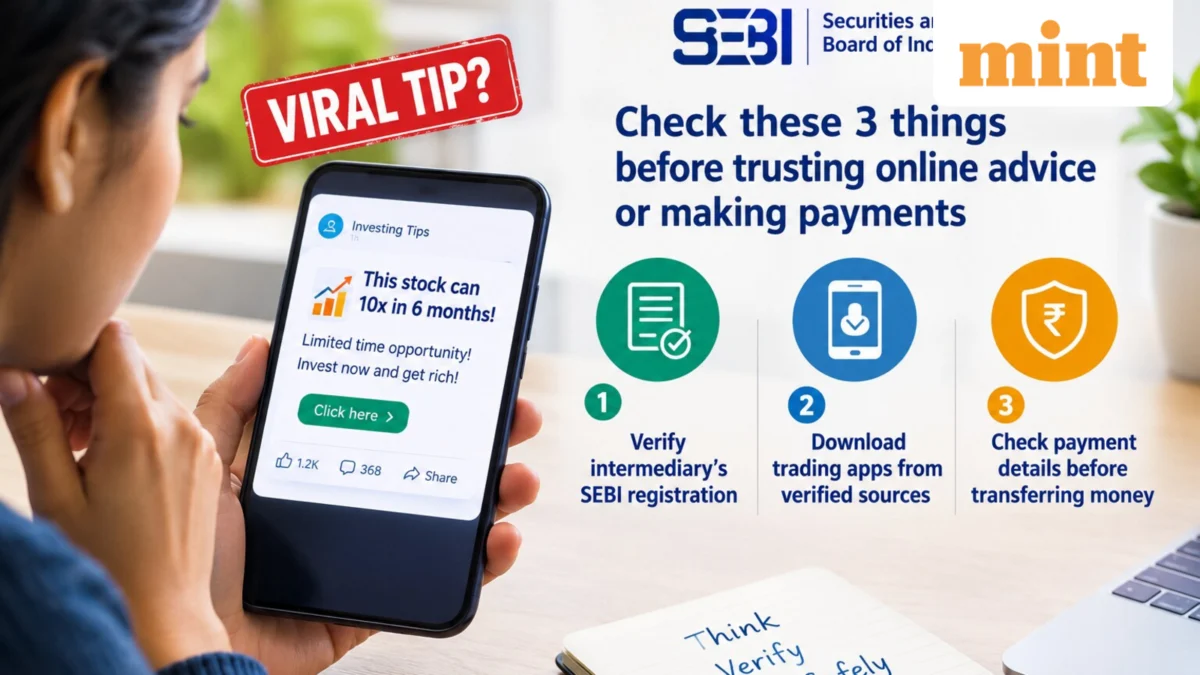
Mumbai, India – October 25, 2026 – In an era where financial advice proliferates across digital platforms, the Securities and Exchange Board of India (SEBI) has issued an urgent directive, urging investors to exercise extreme caution and conduct three essential verifications before succumbing to the allure of viral investment tips. This crucial advisory, part of SEBI’s ongoing "Samajh Se Investing Simple" (SSIS) initiative, aims to shield both seasoned and novice investors from the escalating threat of online financial fraud, which often masquerades as lucrative opportunities.
The regulatory body emphasizes that the rapid dissemination of investment ideas, stock recommendations, and trading advice through social media and messaging platforms, while offering convenience, also presents fertile ground for fraudulent schemes. To combat this growing menace and safeguard investors’ hard-earned savings, SEBI has underscored the necessity of verifying the intermediary’s registration status, ensuring the authenticity of trading applications, and meticulously checking payment details before committing any funds. This proactive stance highlights SEBI’s unwavering commitment to fostering a secure and transparent investment environment in India.
The Digital Deluge: A Breeding Ground for Scams
The technological advancements of the 21st century have irrevocably transformed the landscape of information sharing. While this digital revolution has democratized access to financial knowledge, it has simultaneously paved the way for an unprecedented deluge of investment tips, short-term trading ideas, and stock recommendations, often disseminated with lightning speed across platforms like WhatsApp, Telegram, YouTube, and various social media feeds. This ubiquitous presence of financial "advice" creates a complex environment for investors, where distinguishing legitimate guidance from malicious deception becomes increasingly challenging.
The Lure of Viral Tips: The appeal of these viral investment tips is multifaceted and powerful. They often promise astronomical returns in unrealistically short periods, tapping into the universal human desire for quick wealth accumulation. The seemingly personal endorsements from "influencers" or "experts" – sometimes even fabricated – lend an air of credibility, fostering a false sense of trust. Furthermore, the fear of missing out (FOMO) on a supposedly golden opportunity often overrides rational judgment, pushing individuals to act impulsively without adequate due diligence. The ease of access, requiring merely a click or a tap, further lowers the barrier to entry for potentially dangerous schemes.
The Inherent Risks: Beneath the surface of these seemingly harmless or even beneficial tips lie profound risks. The primary danger is, of course, significant financial loss. Fraudulent schemes, ranging from elaborate pump-and-dump operations to phantom investment products, are designed to siphon off investor funds with no intention of providing genuine returns. Beyond monetary losses, investors also face the peril of identity theft, where personal and financial data collected under false pretenses can be exploited for other illicit activities. Engaging with unregulated entities also means investors are exposed to markets devoid of regulatory oversight, offering no recourse in case of disputes or fraud. The psychological toll of falling victim to such scams – including stress, anxiety, and a profound sense of betrayal – can be devastating. Common tactics include creating fake trading platforms, mimicking legitimate financial institutions, or pressuring investors into quick decisions with exaggerated claims of exclusivity or time-sensitive opportunities.
SEBI’s Proactive Stance: The ‘Samajh Se Investing Simple’ Initiative
Recognizing the evolving nature of financial fraud in the digital age, SEBI has intensified its investor awareness efforts through the "Samajh Se Investing Simple" (SSIS) initiative. This campaign is a critical response to the proliferation of unverified and often fraudulent investment advice circulating online, aiming to empower investors with the knowledge and tools necessary to protect themselves.
Genesis and Objectives: The SSIS initiative was conceptualized with a clear objective: to simplify complex investment concepts and equip investors with fundamental principles of financial prudence. SEBI’s goal is not merely to issue warnings but to foster a culture of informed decision-making and critical verification among the investing public. By focusing on practical, actionable steps, the initiative seeks to demystify the process of identifying legitimate investment opportunities and exposing fraudulent ones. It represents a shift towards proactive investor education, recognizing that a well-informed investor is the first line of defense against market malpractice.
Reach and Methodology: To ensure its vital message permeates all strata of the investing population, SEBI has adopted a multi-channel approach for the SSIS initiative. A significant thrust involves direct communication, such as sending cautionary messages directly to citizens’ WhatsApp numbers, leveraging the widespread use of messaging platforms. Complementing this, SEBI actively utilizes its official website (investor.sebi.gov.in/ssis) as a repository of verified resources and information. Furthermore, the SEBI Saathi App serves as a convenient mobile platform for accessing investor awareness content and tools. This comprehensive outreach strategy ensures that critical information about safeguarding investments is accessible and understandable to a broad audience, from seasoned market participants to first-time investors.
Core Pillars of Vigilance: At the heart of the SSIS initiative lies SEBI’s concise yet potent three-point verification system. These pillars are designed to serve as an immediate checklist for investors confronted with any online investment opportunity:
- Intermediary Registration: Always verify if the entity offering advice or facilitating transactions is registered with SEBI.
- Trading App Authenticity: Download trading applications exclusively from official, verified app stores.
- Payment Details Scrutiny: Utilize SEBI’s dedicated "Check Tool" to meticulously review all payment details before transferring any funds.
These three checks are presented as non-negotiable prerequisites for any investment decision, acting as a crucial filter against the vast ocean of online deception.
Chronology of Regulatory Actions and Warnings
SEBI’s latest alert is not an isolated incident but rather a continuation of its long-standing commitment to investor protection, adapting to the evolving threats posed by technological advancements. The regulatory body has a robust history of safeguarding market integrity and ensuring fair practices.
Historical Context of Investor Protection: Since its inception, SEBI has consistently worked to build a robust regulatory framework for the Indian securities market. Its mandate includes protecting the interests of investors, promoting the development of the securities market, and regulating the market. Over the decades, SEBI has introduced numerous regulations, guidelines, and investor awareness programs to combat various forms of market manipulation and fraud. From cracking down on insider trading to establishing grievance redressal mechanisms, the emphasis has always been on creating a trustworthy and transparent ecosystem. Warnings against unauthorized collective investment schemes, unregistered portfolio managers, and dubious tips circulated through traditional media have been a recurring theme in SEBI’s history.
Recent Escalation of Warnings: The post-pandemic acceleration of digital adoption has brought with it a corresponding surge in online financial scams. In recent years, SEBI has significantly amplified its warnings against new-age fraudulent activities. This includes issuing alerts against unregistered "finfluencers" (financial influencers) who provide investment advice without proper qualifications or regulatory oversight, as well as cautioning against "pump and dump" schemes often orchestrated through social media. The regulator has taken decisive actions, including issuing show-cause notices and imposing bans on entities found to be misleading investors. The frequency and specificity of these warnings have increased, reflecting the growing sophistication of fraudsters and the widespread reach of their deceptive tactics through digital channels. Each warning builds upon previous advisories, reinforcing the message that vigilance is paramount in the digital investment landscape.
The Urgency of the Current Alert: The current alert regarding viral investment tips holds particular urgency. Fraudsters are increasingly leveraging the virality of social media content to quickly disseminate their schemes to a vast, unsuspecting audience. These "tips" are often packaged to appear legitimate, using sophisticated psychological manipulation tactics and exploiting the trust investors place in online communities or seemingly expert opinions. SEBI’s targeted advice on verifying intermediaries, authenticating apps, and scrutinizing payment details directly addresses the most common vectors of these modern-day scams. This alert is a crucial intervention, aiming to equip investors with immediate, practical defenses against a rapidly evolving threat landscape, underscoring that passive consumption of online information is no longer a viable approach to investment.
Supporting Data: The Rising Tide of Investment Fraud
While specific, granular data on Indian online investment fraud is often challenging to consolidate due to reporting complexities, general observations and anecdotal evidence from law enforcement agencies, cybercrime units, and financial institutions unequivocally point to a significant and alarming increase in financial fraud, particularly those perpetrated through digital means. The ease of anonymity, global reach, and low cost of operation have made online platforms a preferred hunting ground for fraudsters.
Statistics on Cybercrime and Financial Fraud: Reports from various national and international bodies consistently highlight an upward trajectory in cybercrimes, with financial fraud constituting a substantial portion. In India, cybercrime complaints have seen a steady rise year-on-year, and a significant percentage of these relate to financial deception, including investment scams. While precise statistics on the aggregate financial losses due to viral investment tips are difficult to pinpoint, the sheer volume of complaints registered on official cybercrime portals and with SEBI itself serves as a stark indicator of the problem’s scale. Experts suggest that the actual number of victims and the total financial impact are likely far greater than reported figures, as many instances go unreported due to embarrassment, fear, or a lack of awareness about redressal mechanisms. This "dark figure" of crime underscores the insidious nature of these digital threats.
Impact on Individual Investors: The consequences of falling prey to online investment scams are profound and far-reaching for individual investors. Beyond the immediate financial depletion, victims often experience severe emotional distress, including feelings of shame, anger, and betrayal. The psychological trauma can erode trust in legitimate financial institutions and advisors, leading to long-term aversion to investing, which can hinder their financial growth and retirement planning. For many, these losses represent their life savings, pension funds, or money earmarked for critical life events like education or housing. The recovery process, both financial and psychological, can be arduous and protracted, emphasizing the critical importance of prevention.

Generalised Case Studies/Examples: Consider a scenario where an individual, enticed by a viral WhatsApp message promising "guaranteed 30% monthly returns" on a "proprietary AI trading algorithm," clicks on a link. This link leads them to download an application that appears identical to a well-known trading platform. Unbeknownst to them, the app is fake, designed to capture their login credentials and bank details. Had they checked the app’s authenticity against official app stores and looked for a "Verified Label," they might have averted disaster. Another common tactic involves an "investment advisor" found through a social media group, who, despite claiming to be a market expert, is not registered with SEBI. This advisor pressures the investor to transfer funds to a personal bank account for "direct investment," bypassing regulated channels. A simple check of SEBI’s intermediary registration database would immediately expose the fraud. These generalized examples highlight how the three verification steps proposed by SEBI are not theoretical safeguards but practical, essential tools for real-world investor protection against sophisticated and deceptive schemes.
Official Responses: Deconstructing SEBI’s Three-Point Verification System
SEBI’s "Samajh Se Investing Simple" initiative distills investor protection into three critical, actionable checks. These official responses are designed to empower individuals with clear guidelines, transforming passive recipients of information into active guardians of their financial well-being.
Pillar 1: Verifying Intermediary Registration:
- Why it’s Crucial: The cornerstone of a regulated financial market is the registration of its participants. A SEBI-registered intermediary (such as a stockbroker, investment advisor, or research analyst) operates under strict regulatory oversight. This ensures accountability, mandates adherence to ethical standards, requires specific qualifications, and most importantly, provides investors with a formal grievance redressal mechanism should disputes arise. Dealing with an unregistered entity means operating outside this protective framework, leaving investors vulnerable with virtually no legal recourse. These unregistered players often lack the necessary expertise, operate with malicious intent, and are not subject to audits or compliance checks, making them high-risk propositions.
- How to Verify: SEBI provides easily accessible tools for verification. Investors should visit the official SEBI website (sebi.gov.in) and navigate to the "Intermediaries" section. Here, they can search for specific entities by name, registration number, or type of intermediary. It is crucial to cross-reference the details provided by the purported intermediary with the official SEBI database. Any discrepancy should be an immediate red flag. This simple step can help investors avoid falling prey to individuals or firms falsely claiming affiliation with SEBI or legitimate market operations.
- The Dangers of Unregistered Entities: Engaging with unregistered entities is akin to entering an unregulated gambling den. There is no transparency, no accountability, and no legal protection. Such entities can easily manipulate markets, misappropriate funds, or simply vanish with investors’ money. They are not bound by capital adequacy norms, client segregation rules, or ethical conduct guidelines, making investment with them an extremely high-stakes gamble with typically dire outcomes.
Pillar 2: Authenticating Trading Applications:
- The Threat of Fake Apps: In the digital age, malicious actors frequently create replica applications designed to mimic legitimate trading platforms. These fake apps are often visually indistinguishable from their authentic counterparts, but they serve nefarious purposes. Their primary function is to steal sensitive information such as login credentials, bank account details, and personal identification. Once installed, they can also inject malware onto devices, compromise security, or even facilitate unauthorized transactions, leading to significant financial and data loss.
- Best Practices for Downloads: To mitigate this risk, SEBI strongly advises downloading trading applications exclusively from official and verified sources. This means using only the Google Play Store for Android devices and the Apple App Store for iOS devices. These platforms have stringent security protocols, including developer verification and malware scanning, which significantly reduce the risk of downloading malicious software. Furthermore, investors should look for the "Verified Label" or similar indicators within these app stores, which signifies that the developer has been authenticated and the app meets specific quality and security standards.
- Warning Against Unsolicited Links: A critical warning is against clicking on unsolicited links received via email, SMS, WhatsApp, or other messaging services, even if they appear to come from a known entity. These links often lead to phishing sites or directly download malicious APK (Android Package Kit) files that bypass the security checks of official app stores. Such practices are a common vector for installing fake apps or malware.
Pillar 3: Scrutinizing Payment Details with SEBI’s ‘Check Tool’:
- The Final Gateway of Fraud: Often, even if an investment tip or an intermediary seems plausible initially, the true nature of a fraudulent scheme reveals itself at the payment stage. Legitimate investment payments are typically routed through regulated banking channels to specific, verified accounts belonging to the registered intermediary or a pooled client account. Fraudsters, however, often request transfers to personal bank accounts, obscure third-party accounts, or through unusual, unregulated payment gateways. These requests are significant red flags that should immediately trigger alarm bells.
- SEBI’s ‘Check Tool’: While the original article does not detail the specific functionalities of SEBI’s ‘Check Tool’, its stated purpose is to allow investors to "analyse, verify, and review the relevant payment details." This implies a mechanism, potentially integrated into the SEBI website or Saathi App, where investors can input payment details or check against a database of verified payment channels for registered entities. The tool serves as a crucial final safeguard, enabling investors to cross-verify the legitimacy of the payment recipient before any funds are transferred. Investors are urged to actively use this tool as a mandatory step before authorizing any transaction.
- Red Flags in Payment Requests: Beyond using SEBI’s tool, investors should be aware of common red flags:
- Requests to transfer money to personal bank accounts of individuals.
- Demands for payment through unusual methods like gift cards, cryptocurrency wallets (if not for direct crypto investment on a regulated platform), or peer-to-peer payment apps for investment purposes.
- Pressure tactics to make immediate payments, often citing "limited-time offers" or "exclusive opportunities."
- Lack of clear receipts or proper documentation for payments.
- Any discrepancy between the entity claiming to be an intermediary and the name on the bank account.
Implications for Investors and the Market Ecosystem
SEBI’s proactive measures and the three-point verification system carry profound implications, not just for individual investors but for the broader integrity and stability of the Indian securities market.
Empowering the Individual Investor: The most direct implication is the empowerment of the individual investor. By providing clear, actionable steps, SEBI is shifting investors from a passive, vulnerable position to an active, vigilant role. These checks equip investors with the knowledge to discern legitimate opportunities from fraudulent schemes, fostering self-reliance and critical thinking. This empowerment is crucial in a digital age where information overload can be both a blessing and a curse. Informed investors are better positioned to make sound financial decisions, protect their capital, and participate confidently in the market. It cultivates a culture of ‘buyer beware’ but with regulatory support, ensuring investors have the tools to be truly aware.
Strengthening Market Integrity: On a broader scale, a more vigilant investor base contributes significantly to strengthening market integrity. When investors consistently verify intermediaries, authenticate apps, and scrutinize payment details, it makes it increasingly difficult for fraudulent entities to operate. This collective vigilance acts as a deterrent, reducing the incidence of market malpractice and enhancing transparency. A market perceived as safe and fair attracts more participants, fostering growth and development. It reinforces the trust investors place in SEBI’s regulatory framework and encourages adherence to compliance by legitimate market participants. Ultimately, a market free from widespread fraud is more efficient and resilient.
SEBI’s Role as a Guardian: This initiative further solidifies SEBI’s role as the guardian of investor interests and the steward of market development. By continuously adapting its strategies to counter new forms of fraud, SEBI demonstrates its commitment to maintaining a robust and trustworthy financial ecosystem. These alerts and awareness campaigns are integral to its mandate, ensuring that as the market evolves, investor protection mechanisms evolve alongside it. SEBI’s efforts are not just about regulation but also about education, acknowledging that informed investors are the market’s strongest asset.
A Call to Action: The implications extend to a direct call to action for all stakeholders. Investors are urged to embed these verification steps into their routine investment process. They are encouraged to utilize official SEBI resources, including the investor.sebi.gov.in/ssis website and the SEBI Saathi App, for verified information and tools. Furthermore, reporting suspicious activities and potential fraud is crucial. Every complaint registered contributes to SEBI’s intelligence gathering, enabling the regulator to identify patterns, take swift action against perpetrators, and refine its protective measures. Continuous learning and proactive engagement are the pillars of safe and successful investing in the digital era.
How to Register a Complaint with SEBI
Despite all precautions, if an investor suspects malpractice or has fallen victim to a fraudulent scheme in the equity markets, SEBI provides a clear and accessible mechanism for lodging a complaint. This vital recourse ensures that grievances are heard and appropriate action can be taken.
To register a complaint, follow these simple steps:
- Visit the Official SEBI Website: Navigate to the official Securities and Exchange Board of India website:
https://www.sebi.gov.in/. - Locate the ‘Vigilance’ Tab: On the homepage or within the site’s main navigation, look for the ‘Vigilance’ tab. This section is specifically dedicated to addressing complaints and unethical practices.
- Click on ‘Register a complaint’: Under the ‘Vigilance’ tab, you will find an option to ‘Register a complaint’. Click on this link to proceed to the complaint registration portal.
- Follow the Instructions: The portal will guide you through the process of submitting your complaint. You will likely need to provide details about the alleged malpractice, the entity involved, any supporting evidence you possess (e.g., screenshots, communication records, transaction details), and your contact information.
Submitting a complaint is a crucial step not only for seeking redressal for individual losses but also for contributing to SEBI’s efforts to identify and curb systemic fraud. It reinforces market integrity and protects other potential investors from similar threats.
Conclusion
In an increasingly digitized financial world, the siren call of viral investment tips can be irresistible, promising quick fortunes with minimal effort. However, as SEBI unequivocally warns, this digital convenience is often a veil for sophisticated scams. The "Samajh Se Investing Simple" initiative serves as a timely and indispensable guide, equipping investors with a robust, three-pronged defense mechanism.
Vigilance is no longer an optional virtue but an absolute necessity. Before acting on any online investment advice, the imperative to verify intermediary registration, authenticate trading applications, and scrutinize payment details using SEBI’s tools cannot be overstated. These simple yet powerful checks are the investor’s first and most critical line of defense against the pervasive threat of online fraud. By embracing these principles and actively utilizing the resources provided by SEBI, investors can safeguard their financial well-being, make truly informed decisions, and contribute to a healthier, more trustworthy investment ecosystem. Remember, independent verification is the only legitimate shortcut to financial security.