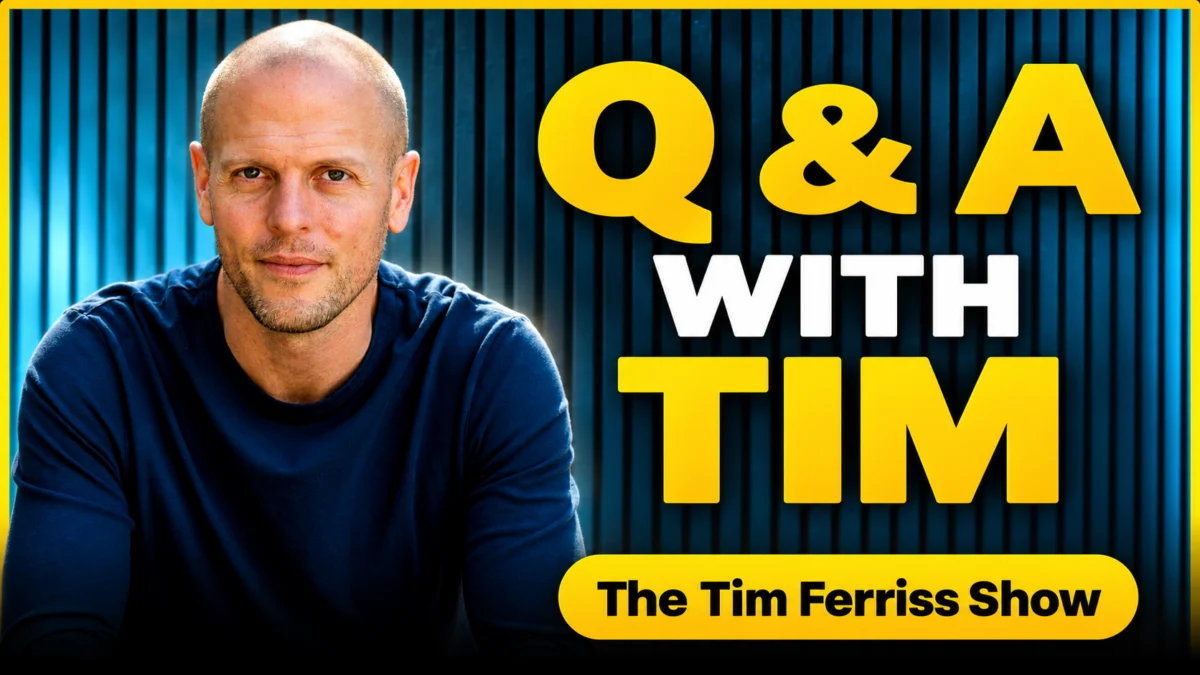
In the nearly two decades since Tim Ferriss published his seminal work, The 4-Hour Workweek, the landscape of global labor, personal productivity, and digital lifestyle design has undergone a tectonic shift. What was once a manifesto for outsourcing tasks to virtual assistants and escaping the traditional 9-to-5 has now evolved into a broader philosophy of personal agency. In his latest podcast episode, Ferriss returns to the core tenets of his life’s work, re-examining them through the lens of a rapidly accelerating Artificial Intelligence (AI) revolution.
The episode serves as a wide-ranging Q&A session, addressing the existential questions of the modern professional: How do we maintain human agency when algorithms do the heavy lifting? How does one rebuild momentum after a period of stagnation? And, perhaps most importantly, how do we integrate the pursuit of efficiency with the chaotic, unscripted serendipity that makes life worth living?
Main Facts: The New Frontier of Personal Agency
The central theme of this episode is the recalibration of the "4-Hour" philosophy in a world where AI can handle cognitive labor at a scale previously unimaginable. Ferriss posits that the goal of his early work was never just "leisure"; it was the creation of options. In the age of AI, those options have expanded, but so has the risk of becoming subservient to the tools we employ.
Key takeaways from the session include:
- The AI Pivot: Ferriss argues that AI should be used as a "force multiplier" for high-leverage activities, rather than a crutch for intellectual laziness.
- Rebuilding Momentum: When stuck, Ferriss suggests a "de-load" approach—simplifying inputs, returning to fundamental movement, and reducing cognitive noise to allow for a natural re-emergence of creative drive.
- The 4-Hour Body at 40+: Addressing aging, Ferriss touches on the importance of metabolic health, noting that the physiological requirements for peak performance shift significantly as one moves past the age of 40, requiring a more nuanced approach to nutrition and recovery.
Chronology: The Evolution of Ferriss’s Methodology
To understand the current discourse, one must look at the timeline of Ferriss’s output:
- 2007: The Foundation: The publication of The 4-Hour Workweek challenged the status quo of career-ladder climbing, introducing the concepts of "lifestyle design" and "mini-retirements."
- 2010: The Physical Shift: The 4-Hour Body moved the focus from external productivity to internal optimization, utilizing self-experimentation to solve health issues.
- 2016: The Mental Game: Tools of Titans distilled the habits of world-class performers, highlighting the role of meditation, journaling, and psychological resilience.
- 2024/2025: The AI Integration: The current phase represents a synthesis. Ferriss is now integrating the technological leverage of Large Language Models (LLMs) and automated workflows back into the lifestyle design framework.
This progression marks a shift from "how to get more done" to "how to be more effective while remaining profoundly human."
Supporting Data and Strategic Partnerships
A defining feature of the Tim Ferriss Show is its rigorous vetting of sponsors—companies that align with his data-driven, health-conscious, and privacy-focused ethos. This episode highlights a strategic focus on health and data security:
- Privacy and Digital Hygiene: Ferriss emphasizes the importance of data scrubbing via Incogni. With personal data being a primary vector for identity theft and spam, the shift toward automated privacy management is framed as a foundational requirement for the modern digital nomad.
- Chemical Safety: The episode features Our Place’s Titanium Always Pan Pro. This reflects a broader trend in health-conscious consumerism—moving away from PFAS ("forever chemicals") in the kitchen. Ferriss links the reduction of environmental toxins to long-term health, citing the importance of gut microbiome integrity.
- Nutritional Optimization: Through his long-standing partnership with AG1, Ferriss promotes the concept of "nutritional insurance." The focus is on bridging the gap between high-performance demands and the reality of modern, travel-heavy lifestyles.
- Advanced Supplementation: The inclusion of Momentous Creatine highlights the shift toward pharmaceutical-grade transparency in the supplement industry. By focusing on heavy-metal testing and microplastic screening, the conversation moves from "more is better" to "purity is essential."
Official Perspectives: The Philosophy of "Enough"
Throughout the Q&A, Ferriss addresses the "trap of optimization." He notes that listeners often get stuck trying to optimize every micro-second of their day, which leads to burnout rather than freedom. His official stance is one of "principled minimalism."
He emphasizes that while AI can draft emails, write code, and analyze data, it cannot determine what is worth doing. That remains the human prerogative. When a listener asks about the balance between working and living, Ferriss points toward the importance of "serendipity surfaces"—structuring one’s life so that unexpected, positive events are more likely to occur. This is not something that can be automated; it requires deliberate, low-stakes exploration and the courage to leave gaps in one’s schedule.
Implications: The Future of the "4-Hour" Individual
What does this mean for the listener? The implications of this episode are twofold:
1. The Death of Busywork
If AI can perform 80% of administrative tasks, the individual who insists on doing them manually is not being "diligent"; they are being obsolete. The implication is that we must shift our skill sets toward high-level strategy, creative direction, and human-to-human connection. The "4-Hour Workweek" is no longer a dream for the few; it is becoming a technological necessity for the many.
2. The Premium on Human Connection
As digital interactions become increasingly synthetic, the value of deep, authentic friendships and professional relationships will rise. Ferriss notes that as the world gets louder and more automated, the ability to navigate friendships and maintain community becomes a form of competitive advantage.
3. The New Biological Baseline
The discussion on health after 40 suggests that we are entering an era of "proactive aging." By utilizing tools like creatine, focusing on gut health, and avoiding environmental toxins, the high-performer is no longer content with mere maintenance; they are seeking to extend the "health span" to match the "life span."
Conclusion: Designing Your Life in Real-Time
The Q&A episode serves as a vital touchstone for the Ferriss community. It acknowledges that while the tools of the trade have changed—moving from simple outsourced assistants in the Philippines to sophisticated neural networks—the goal remains the same: the preservation of personal agency.
By returning to the basics—health, focus, privacy, and the intentional pursuit of wonder—Ferriss provides a roadmap for navigating the complexities of the 21st century. Whether you are a long-time listener or a newcomer to the "lifestyle design" movement, the message is clear: the future belongs to those who use technology to amplify their humanity, not those who use it to escape it.
As the AI revolution continues to unfold, the most important work will not be done by the machine, but by the individual who has the clarity to ask the right questions. As Ferriss frequently notes, "What we fear doing most is usually what we most need to do." In the age of AI, perhaps that fear is simply the act of stepping away from the screen, reclaiming our time, and choosing to live on our own terms.
For those looking to deepen their understanding of financial and lifestyle freedom, the episode also highlights the work of Ramit Sethi, whose approach to "rich life" spending complements Ferriss’s focus on productivity. Together, these perspectives offer a comprehensive toolkit for anyone looking to build a life of both abundance and autonomy.