LUCKNOW — In the aftermath of significant administrative embarrassment caused by absurd entries in the electoral rolls for the Uttar Pradesh Legislative Council elections, the Election Commission has initiated formal inquiry proceedings against senior electoral officials. The move comes after embarrassing errors—including voters listed with names like "Ram ne Yadav ko maara" ("Ram hit Yadav") and educational qualifications recorded as parental names—went viral on social media, raising broader questions about algorithmic verification and administrative oversight in digitized voter registration.
The Legislative Council polling, conducted on October 23, 2026, across more than 30 districts in Uttar Pradesh, saw high participation across key Graduate and Teachers constituencies. However, the discovery of severe clerical and software-driven blunders in the published voter lists—particularly within the prestigious Allahabad graduate constituency—overshadowed the voting process and forced the Office of the Chief Electoral Officer (CEO) to issue immediate damage-control protocols.
Main Facts: Technological Failure and Administrative Slip-ups
The core controversy revolves around 158 highly unusual voter profiles identified within a master database comprising 14,81,310 electors across five Graduate and six Teachers constituencies. These errors stemmed from a dual failure of software translation tools and multi-tiered human verification during the rollout of Uttar Pradesh’s newly introduced online registration portal for Council elections.
Among the most egregious anomalies detected in the official voter lists were:
- Literal Software Translation Errors: Phrases such as "Ram ne Yadav ko maara" ("Ram hit Yadav") and "Ram ne Sharma ko maara" appeared in the place of actual voter names.
- Data Field Inversion: Standard academic designations, such as "B.Com", were recorded in the column designated for the elector’s father’s name.
- Phonetic Corruption: Standard English names entered into the digital registration portal were automatically converted using algorithmic machine translation rather than standard phonetic transliteration software.
Following an intense social media outcry on the eve of polling, UP Chief Electoral Officer (CEO) Navdeep Rinwa confirmed that show-cause notices and official demands for explanation had been issued to the designated Electoral Registration Officers (EROs)—who hold the rank of Divisional Commissioners—and Assistant Electoral Registration Officers (AEROs), who are the District Magistrates (District Officers) of the respective districts.
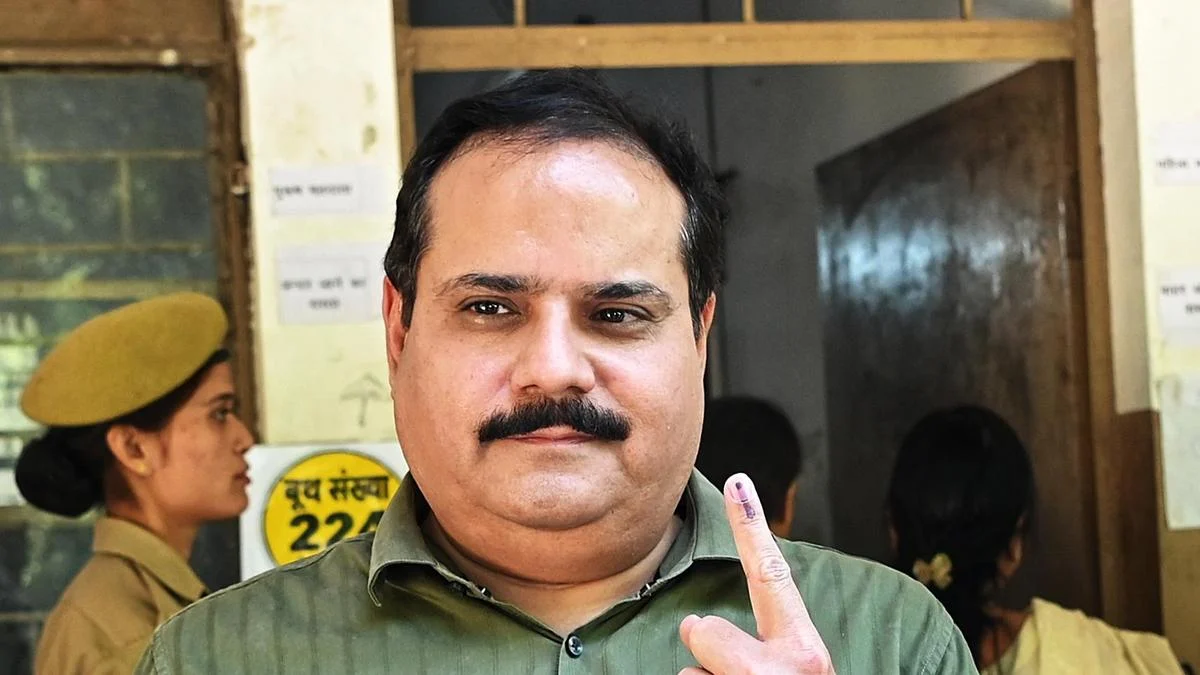
Despite the procedural embarrassment, election authorities emphasized that voter participation was safeguarded on polling day. CEO Navdeep Rinwa himself cast his vote at the Kendriya Vidyalaya polling booth in Lucknow, displaying his inked finger to media personnel while reassuring the public that corrective steps were actively underway to ensure no legitimate voter was disenfranchised due to official oversight.
Chronology of Events leading to the Roll Discrepancies
The emergence of these voter list errors highlights a timeline extending from the initial digitalization push to election day actions:
[Early Rollout Phase]
 └── Election Commission introduces dedicated online voter portal for UP Legislative Council elections.
 └── Voters submit forms online; automated translation engine processed text fields.

[Draft Publication & Verification]
 └── Electoral Registration Officers (EROs) compile regional database (14.8+ lakh entries).
 └── Verification procedures miss 158 flawed auto-translated entries across constituencies.

[Pre-Polling Discovery (Mid-October 2026)]
 └── Draft voters lists released for public scrutiny.
 └── Observers notice anomalies in Allahabad graduate constituency; screenshots go viral online.

[Polling Day & EC Intervention (October 23, 2026)]
 └── Voting opens across 30+ UP districts for 11 Legislative Council seats.
 └── CEO Navdeep Rinwa votes in Lucknow; EC issues formal notices to EROs/AEROs.

[Post-Poll Investigation (October 24, 2026)]
 └── Official CEO statement released acknowledging software/human failure; administrative inquiry launched.
Phase 1: Portal Deployment and Registration
In an effort to modernize voter enrollment for the upper house elections, the Election Commission introduced a streamlined digital registration platform across Uttar Pradesh. This marked the first time that graduates and teachers could submit Form 18 (for Graduate constituencies) and Form 19 (for Teachers constituencies) entirely online.
Phase 2: Processing and Algorithmic Misconfiguration
During the data aggregation phase, the software integrated into the portal was tasked with converting English input entries into Devanagari script for the final printed electoral rolls. However, instead of deploying a phonetic transliteration engine—which maps English letters directly to their closest Hindi sound equivalents—the system relied on an automated translation algorithm. When applicants entered specific descriptive text or phonetic names, the software translated words literally (e.g., converting "hit" into the Hindi verb "maara").
Phase 3: Failure of Manual Vetting
Under the statutory provisions of the Representation of the People Act, draft electoral rolls are subject to rigorous field verification by Block Level Officers (BLOs) and supervisory review by AEROs and EROs. During
this review stage, the 158 erroneous entries remained uncorrected, passing through multiple administrative levels without intervention.
Phase 4: Public Outcry and Polling Day Protocol
When candidate representatives and political workers analyzed the final rolls ahead of the October 23 polling date, the glaring mistakes came to light. Screenshots of the Allahabad graduate constituency voter roll circulated widely across social media platforms, drawing sharp criticism from civil society and opposition leaders regarding the technical readiness of the Election Commission.

Supporting Data: Electoral Scale and Technical Breakdown
The UP Legislative Council elections cover a broad geographical expanse, spanning over 30 districts divided into specific regional constituencies reserved for electors with higher education degrees or teaching credentials.
Overview of Legislative Council Constituencies in the Election
| Constituency Type | Constituency Names | Target Voter Base Characteristics | Total Registered Voters |
|---|---|---|---|
| Graduate Constituencies (5) | Lucknow, Agra, Meerut, Varanasi, Allahabad-Jhansi | University graduates residing within the constituency for at least 3 years | ~9.2 Lakh Electors |
| Teachers Constituencies (6) | Lucknow, Agra, Meerut, Varanasi, Bareilly-Moradabad, Gorakhpur-Faizabad | Full-time teachers in recognized secondary or higher educational institutions | ~5.6 Lakh Electors |
| Total Combined Electors | 11 Special Constituencies across 30+ Districts | Graduates and Academic Professionals | 14,81,310 Electors |
Breakdown of Roll Errors Identified
Out of the total 1,481,310 entries finalized across Uttar Pradesh, the official statement released by the Chief Electoral Officer identified 158 specific entries containing critical linguistic or data-field corruption.
Total Registered Voters: 1,481,310
├── Validated & Clean Entries: 1,481,152 (99.989%)
└── Flagged Erroneous Entries: 158 (0.011%)
    ├── Translation/Transliteration Glitches (~70%)
    └── Field Misplacement / Negligence (~30%)
While 158 errors represent a small percentage (0.011%) of the total roll volume, the high profile of these entries—including full English sentence translations appearing in voter name fields—exposed technical gaps in the software architecture deployed for civil registration.
Official Responses and Administrative Accountability
Addressing the media following the conclusion of voting, UP Chief Electoral Officer Navdeep Rinwa provided a detailed technical explanation of the mishap, highlighting both technological faults and administrative oversights.
"For the first time, an online registration facility has been provided in Uttar Pradesh for adding names to the voter list for the Legislative Council elections. There is a possibility of mistakes when doing any work for the first time," the official statement from the CEO Office noted.
"The software was supposed to transliterate the names typed in English into Hindi, but probably due to some error, it translated them. For example, when ‘Ram hit Yadav’ was typed, the software translated it as ‘Ram ne Yadav ko maara’. There was a system to edit and correct such mistakes, but where people were not careful, such mistakes persisted. Typing ‘B.Com’ in place of father is a human error or negligence."
Reassignment of Responsibility to Senior Field Officers
The Election Commission emphasized that statutory responsibility for voter roll accuracy rests with local administrative authorities:
- Electoral Registration Officers (EROs): The Divisional Commissioners assigned to each multi-district constituency hold primary legal responsibility for approving the published electoral roll.
- Assistant Electoral Registration Officers (AEROs): The District Officers (District Magistrates) in charge of individual districts are responsible for field verification and data entry accuracy.
The CEO’s office confirmed that formal explanations have been demanded from the EROs and AEROs overseeing the affected constituencies. District Officers were given direct orders on polling day to ensure that affected voters whose identity could be established were permitted to exercise their franchise without harassment.
Implications for Digital Governance and Electoral Reforms
The electoral roll errors in the 2026 Uttar Pradesh Legislative Council elections highlight the ongoing challenges state and national election bodies face during rapid digital transitions.
Key Lessons from the 2026 Roll Discrepancies:
├── Language Engine Audits: Algorithmic transliteration must be strictly isolated from translation tools.
├── Automated Input Validation: System must restrict non-standard entries in structural fields (e.g., degree names in family fields).
├── Enhanced Human Supervision: Multi-tier administrative review must involve mandatory sample audits before final publication.
└── Voter Grievance Mechanisms: Real-time correction protocols are essential on polling day to prevent disenfranchisement.
1. The Risk of Automated Language Engines in Civic Tech
The primary systemic lesson from the incident lies in the technical design of localized software applications. In a multilingual democratic system, software used for public documentation must strictly separate transliteration engines (which convert script phonetically without altering meaning) from machine translation engines (which interpret semantic context). The integration of uncalibrated open-source translation APIs into state databases creates significant risks of data corruption.
2. Reinforcing Human-in-the-Loop (HITL) Verification
While digital portals reduce paper overhead and simplify access for citizens, fully automated data ingestion introduces vulnerability to input errors. The presence of degree names like "B.Com" in family information fields indicates a lack of automated input validation (regex checks) within the web portal forms, combined with inadequate manual review by local Block Level Officers prior to roll finalization.
3. Impact on Public Trust and Policy Adjustments
The public visibility of these electoral roll errors underlines the sensitivity of election infrastructure. Moving forward, the Election Commission of India (ECI) is expected to issue updated guidelines for state-level portal deployments. These will likely mandate third-party software audits, mandatory input field restrictions, and stricter compliance standards for EROs and AEROs before electoral rolls are certified for public use.