In the high-stakes arena of Indian manufacturing, few companies have undergone a transformation as radical as Zetwerk. Founded in 2018 by Amrit Acharya, Srinath Ramakkrushnan, and Vishal Chaudhary, the company began its journey as a modest platform designed to bridge the gap between industrial buyers and a fragmented network of local vendors. Today, that narrative has shifted entirely. On Friday, October 23, 2026, Zetwerk officially rang the opening bell on the stock exchange, presenting itself not as a facilitator, but as a full-stack manufacturing titan.
The company’s debut on the public markets marks a watershed moment for India’s "Make in India" aspirations. However, as the dust settles on the listing, the focus for investors has shifted from the glitz of the IPO to the gritty reality of the firm’s balance sheet. With razor-thin margins and a complex, capital-intensive business model, Zetwerk now faces the ultimate public test: can it scale its infrastructure without succumbing to the cash-flow traps that have historically plagued the manufacturing sector?
The Evolution: A Strategic Pivot
The seeds of today’s Zetwerk were sown during the pandemic-era funding boom. In August 2021, the company secured a massive $150 million injection from D1 Capital Partners, a move that catapulted the firm into the unicorn club during a year when Indian startups raised an unprecedented $42 billion.
Rather than resting on its laurels, Zetwerk utilized this capital to aggressively pivot. Through a series of strategic acquisitions in 2021 and 2022—most notably the $39 million purchase of the US-based Unimacts—the company transitioned from a simple "connector" to a "controller." It moved away from the low-margin, high-risk marketplace model toward a full-stack play that manages the entire lifecycle of a product: from procurement and specification engineering to manufacturing and final delivery.

Chronology of a Growth Strategy
- 2018: Amrit Acharya, Srinath Ramakkrushnan, and Vishal Chaudhary launch Zetwerk as a B2B manufacturing marketplace.
- 2021: The company achieves unicorn status following a $150 Mn round led by D1 Capital Partners.
- 2021–2022: A flurry of acquisitions, including the takeover of US-based Unimacts, signals the pivot toward becoming a full-stack manufacturing entity.
- 2024–2025: Significant investments are made into owned manufacturing facilities to complement third-party capacity.
- October 23, 2026: Zetwerk makes its stock market debut, pitching itself as a cornerstone of India’s industrial supply chain.
Financial Performance: Growth vs. Profitability
The numbers reflect a company in a state of hyper-growth, yet grappling with the growing pains of a maturing business. In FY26, Zetwerk reported revenue from operations of INR 15,913 Cr, a robust 40.4% increase over the INR 11,331 Cr recorded in the previous fiscal year.
However, profitability remains elusive. The consolidated net loss widened to INR 1,606 Cr in FY26, up from INR 371 Cr in FY25. While this includes an exceptional charge of INR 836 Cr from continuing operations and a INR 453 Cr impairment related to the discontinuation of its civil infrastructure business, the core operational metrics are what keep analysts up at night. The adjusted EBITDA stood at a modest INR 421 Cr, representing a margin of only 2.65%.
For a company of this scale, such thin margins underscore the vulnerability of the business to commodity price volatility and logistics costs. As the firm continues to scale, it must prove that it can capture greater value through technological efficiency and supply chain optimization rather than just revenue volume.
The Two Pillars of Revenue
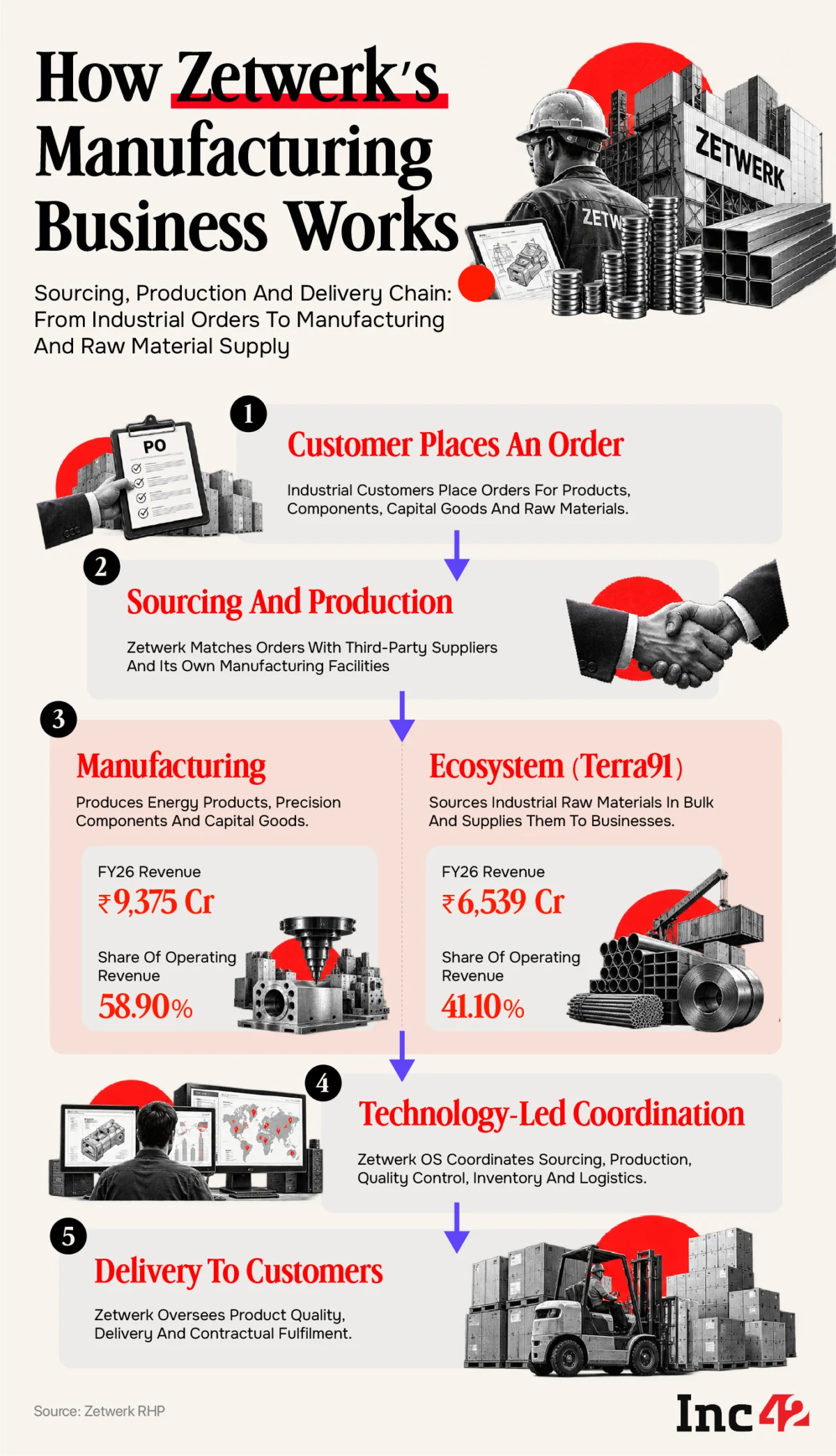
Zetwerk’s revenue model is bifurcated into two distinct segments: Manufacturing and Ecosystem.

1. The Manufacturing Segment
Accounting for 58.9% of total revenue (INR 9,375 Cr), this segment is the heart of Zetwerk’s operation. It focuses on custom-made industrial products, energy sector components, and precision-machined parts. Here, the company earns revenue by leveraging both its own facilities and a network of third-party suppliers.
The complexity of the work dictates the "take rate." In instances of precision manufacturing—where products require high-level engineering and tight tolerances—the margins are naturally more attractive than in general fabrication. The segment reported a standalone EBITDA of INR 565 Cr, translating to a 6.03% margin.
2. The Ecosystem Segment (Terra91)
Operating under the Terra91 brand, this segment functions by aggregating demand for industrial raw materials like steel, aluminum, copper, and bitumen. Contributing 41.1% of revenue (INR 6,539 Cr), this business is essentially an arbitrage play on commodity prices. With an adjusted EBITDA margin of approximately 1.24%, it is a high-volume, low-margin business that is highly sensitive to market fluctuations.
The Cash Flow Conundrum
The most pressing concern for shareholders is the discrepancy between revenue growth and cash generation. While the manufacturing order book grew by 43.4% to reach a staggering INR 12,370 Cr, the company’s net cash outflow from operating activities simultaneously widened to INR 682 Cr, up from INR 386 Cr in FY25.

This "growth paradox" is characteristic of the manufacturing sector. As Zetwerk grows, it must front-load the costs of procurement, production, and logistics. Because payments from clients often lag behind these expenditures, the company is effectively financing the supply chain of its customers.
Strategic Responses and Future Outlook
In previous interactions, CEO Amrit Acharya has emphasized that the company does not view its income as a mere commission, but as a "take rate for services." He has maintained that as the company grows, its ability to secure exclusive, long-term, low-price contracts will naturally improve margins.
Moving Toward ODM
To mitigate the risk of being a "glorified middleman," Zetwerk is aggressively pushing into Original Design Manufacturing (ODM). By taking on design and engineering responsibilities—which accounted for 13.93% of manufacturing GMV in FY26—the company is moving up the value chain. ODM contracts are stickier and command higher margins, providing a buffer against the commoditized nature of its ecosystem business.
Reducing Third-Party Dependency
The company is also slowly transitioning from an asset-light to an asset-right model. As of June 2026, Zetwerk operated 26 manufacturing facilities across four countries. The reliance on third-party suppliers, while still significant (80.46% of manufacturing revenue), has dropped from 96.51% in FY24. This suggests a long-term strategy of vertical integration, which could eventually lead to better cost control and quality assurance.

Implications for Investors
The market’s reception of Zetwerk will likely be tempered by the realization that "scale" in manufacturing is not a silver bullet. The company is effectively trying to rewrite the rules of a legacy industry using tech-enabled efficiency.
Investors must watch two key metrics in the coming quarters:
- Working Capital Cycle: Can Zetwerk reduce the time between cash outflow for procurement and cash inflow from customers?
- Margin Expansion: Can the shift toward ODM and owned-facility production push the EBITDA margin into double digits?
Zetwerk has successfully navigated the transition from a startup to a publicly traded manufacturing giant. However, the path ahead requires more than just filling an order book. It requires the disciplined management of physical goods, volatile commodity markets, and complex global logistics. As a public entity, the company no longer has the luxury of quiet pivots; every operational inefficiency will now be reflected in its share price. Whether Zetwerk can prove that its platform-based approach is fundamentally more profitable than traditional manufacturing remains the defining question of its public life.