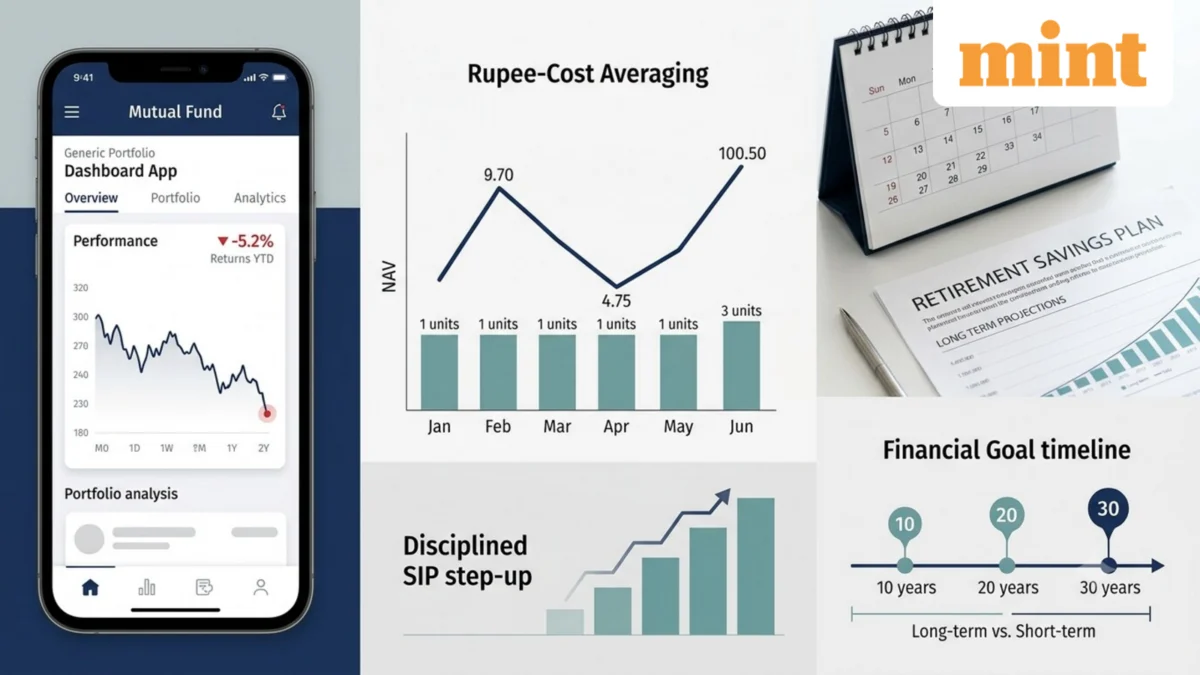
For many retail investors, the Systematic Investment Plan (SIP) is the cornerstone of wealth creation—a disciplined, automated bridge toward financial independence. However, when the broader market enters a correction and your mutual fund portfolio slips into the red, the natural human instinct is to hit the "pause" button. Yet, financial experts argue that this is precisely when the concept of a "SIP Step-up"—the practice of increasing your monthly investment by a fixed percentage or amount annually—becomes most critical.
While it may seem counterintuitive to pour more money into an underperforming asset, the decision to continue or defer a planned SIP step-up should be driven by cold, hard financial logic rather than the emotional volatility of the ticker tape.
Understanding the Mechanics: What is a SIP Step-up?
A SIP step-up is a strategic financial maneuver where an investor voluntarily increases their monthly investment contribution at pre-defined intervals, typically annually. For instance, an investor committing ₹10,000 per month today might choose to increase that amount by 10% each year. By the second year, the monthly commitment becomes ₹11,000; by the third, ₹12,100, and so on.
The primary objective of a step-up is to align your savings trajectory with your career growth. As your salary increases or your expenses stabilize, the step-up ensures that your investment portfolio keeps pace with both inflation and your expanding financial goals. It prevents "lifestyle creep," where increased income is absorbed by discretionary spending rather than wealth-building assets.
The Case for Staying the Course During Market Volatility
Aditya Agarwal, Co-Founder of Wealthy.in, emphasizes that a market correction is not a signal to abandon a well-thought-out plan. "If the investor can afford it, the step-up should go ahead as planned," he asserts. "A correction does not change the fundamental reason the investment was initiated in the first place; it merely changes the price point at which your additional capital is deployed."
The psychology of investing often traps individuals into viewing a portfolio in the red as a loss. In reality, for a long-term SIP investor, a market dip is a "sale." When the Net Asset Value (NAV) of your mutual fund drops, your fixed monthly contribution automatically purchases more units. By stepping up your SIP during this period, you are not just maintaining your discipline; you are aggressively accumulating units at a discount, which significantly lowers your average cost of acquisition.
Rupee-Cost Averaging: Turning Volatility to Your Advantage
The core benefit of the SIP model is "rupee-cost averaging." In a volatile market, this mechanism acts as a stabilizer. Consider an investor who contributes ₹10,000 when the NAV is ₹50, purchasing 200 units. If the market corrects and the NAV falls to ₹40, a standard ₹10,000 investment would yield 250 units.
However, if that investor triggers a step-up to ₹12,000 during that same dip, they purchase 300 units. By increasing the contribution when prices are low, the investor accelerates the growth of their unit count. When the market eventually recovers—as history suggests it historically does—the compounding effect on this larger pool of units can lead to significantly higher wealth accumulation.
However, Agarwal issues a vital caveat: "Investors should not use the concept of rupee-cost averaging as an excuse to overextend. The additional contribution must come from genuine surplus income, not by liquidating emergency reserves or cannibalizing existing long-term investments."
When Should You Pause or Defer?
While the math favors stepping up, the reality of personal finance is nuanced. There are legitimate scenarios where pausing a step-up is the prudent choice:
- Cash Flow Constraints: If your monthly expenses have spiked due to inflation, medical emergencies, or job instability, your primary responsibility is to maintain your base SIP rather than the step-up. Financial security requires liquidity; never jeopardize your emergency fund to maintain an investment step-up.
- Portfolio Underperformance: A common trap is "averaging a loser." If your fund has consistently underperformed its benchmark index and category peers over a sustained period—typically 3 to 5 years—it is time to review the fund’s mandate and management. Simply pouring more money into a structurally weak fund because of a market dip is not a strategy; it is a mistake.
- Goal Proximity: If your financial goal (e.g., a child’s education or a home purchase) is less than 3 years away, the volatility of the equity market poses a risk. In this scenario, the priority should shift toward capital preservation. Instead of stepping up into equity, surplus funds should be diverted toward debt instruments or conservative hybrid funds.
Strategic Alignment: Goals vs. Horizon
The decision to step up is highly dependent on the "time-to-goal" ratio.
Long-Term Goals (15–20 Years)
For retirement or long-term wealth building, market corrections are essentially "noise." In a 20-year horizon, a 10–20% market correction is a historical certainty. Continuing a step-up during these periods is one of the most effective ways to build a substantial corpus. The longer the runway, the more effective the "buy low" mechanism becomes.
Short-Term Goals (3–5 Years)
As an investment goal approaches, the asset allocation must shift. If your portfolio is equity-heavy, you should be de-risking, not increasing exposure. "The mistake to avoid with shorter-term goals is using a market fall as a desperate attempt to ‘catch up’ on returns," warns Agarwal. If you attempt to load up on equity just before you need the money, you expose yourself to the risk of a prolonged market slump, which could leave you short of your target exactly when the liquidity is required.
The Financial Planning Checklist: Before You Step Up
Before you increase your SIP contribution, conduct a brief financial audit to ensure you are doing so from a position of strength:
- Review the Surplus: Calculate your monthly disposable income after all essential expenses, debt obligations (EMIs), and insurance premiums are accounted for. The step-up should ideally be funded by a portion of your recent salary hike or annual bonus.
- Verify Goal Alignment: Confirm that the goal for which you are investing is still valid and that the target amount hasn’t changed significantly due to inflation.
- Evaluate Fund Health: Perform a performance check. Is your fund’s underperformance due to broader market sentiment, or is it a result of poor stock selection? If it is the latter, consider switching funds rather than increasing the contribution.
- Emergency Fund Check: Ensure your emergency fund—which should cover 6 to 12 months of expenses—is intact. Never prioritize a step-up over your financial safety net.
Implications for the Modern Investor
The "Step-up SIP" is not merely a tool for accumulation; it is a psychological contract with your future self. By automating the increase of your investments, you remove the emotional burden of having to decide whether or not to invest during a market downturn.
The data is clear: those who remain disciplined, continue their step-ups during market dips, and maintain a focus on their long-term horizon tend to accumulate significantly higher wealth than those who time the market or react to short-term volatility.
Ultimately, the best approach is a balanced one. Use the step-up as a mechanism to combat inflation and ensure your financial goals remain on track. But, maintain the flexibility to pause if your life circumstances change. As the adage goes in the world of finance: "It is not the timing of the market, but the time in the market that determines your success."
Disclaimer: This article is intended for educational purposes only and does not constitute financial advice. Investment in mutual funds is subject to market risks. Please consult with a certified financial planner or investment advisor before making significant changes to your portfolio or investment strategy.